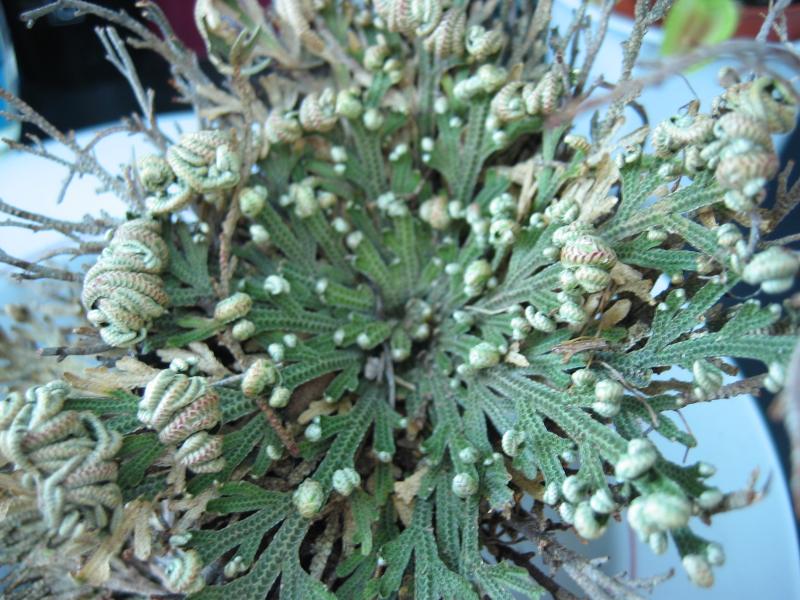
Krauss’s spikemoss (Selaginella kraussiana) is a mat-forming lycophyte native to Sub-Saharan Africa and Macaronesia, known for its branched, moss-like carpets of bright green microphylls. Despite its common names, it is neither a true moss nor a true fern, but an ancient lineage of spore-bearing vascular plants.
This species collapses irreversibly if its soil dries out completely for even 24 hours, demanding continuous soil moisture and high ambient humidity whether grown as a garden groundcover or in an enclosed glass container.
Key Facts
- Light: Full shade to bright, dappled indirect light
- Moisture: Consistently moist; never allow to dry out
- Hardiness: USDA Zones 8 to 11
- Mature Size: 2.5–5 cm (1–2 in) tall, spreading indefinitely
- Ideal Humidity: 60% or higher year-round
- Toxicity: Non-toxic to humans, dogs, and cats
Growing Krauss’s Spikemoss in Gardens and Terrariums
Krauss’s spikemoss suits sheltered, moist shade borders and closed terrariums where relative humidity stays reliably high. It forms an expansive, soft green carpet that weaves around stones, pathway edges, and damp rockery crevices without crowding out deeper-rooted perennials.
In standard living rooms, dry central heating often desiccates the foliage within a matter of weeks. The plant performs best under the following conditions:
- Sealed or partially vented glass terrariums and vivariums
- Damp, frost-sheltered woodland gardens in USDA Zones 8–11
- Greenhouse staging benches and moist indoor planter bowls
- Shaded margins surrounding garden water features and rills
Botanical Look and Identification
Krauss’s spikemoss produces creeping, prostrate stems that rarely exceed 2.5 to 5 cm (1 to 2 in) in height while spreading across ground by trailing runners. The stems branch profusely and produce aerial root-like structures called rhizophores that peg directly into the soil.
Its tiny leaves (microphylls) measure 2 to 4 mm (0.08 to 0.16 in) long and are arranged in four distinct rows along the stem: two rows of larger lateral leaves spreading flat, and two rows of smaller median leaves pressed closely to the upper stem surface. Instead of flowers, mature shoots produce compact, four-angled cones called strobili at the branch tips that release microscopic spores.
Light and Humidity Needs
Provide bright, indirect light or full shade with humidity levels maintained at or above 60%. Direct midday sunlight scorches the delicate leaves within hours, turning the lush green tips into bleached, brittle parchment.
In an outdoor bed, site the plant under the canopy of deciduous trees or on the north side of a masonry wall. Indoors, place containers 1 to 2 m (3 to 6 ft) away from an east- or north-facing window, and run a cool-mist humidifier nearby if the plant is grown outside a closed terrarium.
Planting and Terrarium Substrate
Plant into an open, organic-rich soil mix with a pH between 5.5 and 6.8 that drains freely while retaining moisture. Heavy, compacted garden clays suffocate the fine root system, while pure sand drains too quickly for the creeping rhizophores to establish.
When establishing plants in garden soil or glass jars, use these planting guidelines:
- Blend 2 parts peat moss or coco coir with 1 part compost and 1 part perlite
- Space plugs 15 to 20 cm (6 to 8 in) apart in outdoor garden beds
- Add a 2 cm (0.8 in) gravel drainage layer at the bottom of enclosed terrariums
- Press stem nodes flat against the substrate surface to help rhizophores take hold
Watering and Fertilizer Requirements
Water Krauss’s spikemoss often enough that the soil never feels dry to the touch. Unlike drought-adapted resurrection plants in the same genus, this species has no dormancy mechanism to survive complete desiccation.
Use rainwater, distilled water, or filtered water whenever possible, as dissolved mineral salts and fluoride in hard tap water cause leaf tips to turn brown. Apply a balanced liquid houseplant fertilizer diluted to one-quarter strength once a month from April to August, withholding all nutrients through the dark winter months.
How to Prune and Control Spread
Trim the perimeter of the mat every 4 to 6 weeks during the active growing season to keep trailing runners within their allocated space. The creeping stems root wherever they contact damp ground, allowing the plant to rapidly carpet small borders.
Use sharp scissors to sheer back frayed, brown, or overcrowded patches to ground level. Fresh green growth will emerge from rooted stems within 14 days if the soil remains continuously damp.
How to Propagate Selaginella kraussiana
Propagate Krauss’s spikemoss by taking stem division cuttings 5 to 8 cm (2 to 3 in) long during spring or early summer. Because stems already carry active rhizophores, rooting occurs rapidly without specialized hormone powders.
Follow these steps to generate new plants from established mats:
- Snip healthy, branched stem tips with clean scissors
- Lay the cuttings flat across pre-moistened potting soil or terrarium substrate
- Press nodes gently into the surface so the small downward roots make firm contact
- Enclose the pot in a clear plastic bag or cover it with a humidity dome
- Maintain a temperature of 18 to 22 °C (65 to 72 °F) until new shoots emerge in 10 to 14 days
Overwintering and Cold Tolerance
Krauss’s spikemoss tolerates brief frost dips down to -5 °C (23 °F), but hard freezes will kill exposed top growth. In USDA Zones 8 through 11, plants survive outdoor winters under snow cover or light leaf litter, resprouting from the base in early spring.
In colder regions (USDA Zone 7 and below), lift small clumps in September and pot them up as indoor houseplants or terrarium specimens before the first autumn freeze. Keep indoor overwintering pots on pebble trays filled with water away from heating ducts and cold window drafts.
Reproduction and the Absence of Flowers
Krauss’s spikemoss produces zero flowers or seeds, reproducing instead through microscopic spores formed in specialized cones. As a heterosporous lycophyte, a single plant produces two distinct spore types within the axils of modified leaves called sporophylls.
Large female megaspores and tiny male microspores are shed into damp soil where they germinate into independent gametophytes. Water is strictly necessary for fertilization, as flagellated male sperm must swim through a film of moisture to fertilize the female archegonia.
Companion Plants for Moist Shade
Pair Krauss’s spikemoss with compact, shade-loving foliage species that share its appetite for sheltered positions and continuous moisture. It serves as an understory living mulch beneath taller woodland herbs and ferns.
Excellent garden and terrarium companions include:
- Delta maidenhair fern (Adiantum raddianum), offering soft, arching fronds above the mossy carpet
- Mind-your-own-business (Soleirolia soleirolii), creating contrasting texture along damp stone paths
- Nerve plant (Fittonia albivenis), bringing patterned veins into enclosed terrarium plantings
- Hart’s-tongue fern (Asplenium scolopendrium), providing broad, leathery, upright foliage in garden beds
Frequently Asked Questions
What is the common name of Selaginella kraussiana?
The plant is most commonly called Krauss's spikemoss, Krauss's clubmoss, or African clubmoss. It is also sold under the misnomer 'peacock fern' or simply 'spike moss'.
Why is Selaginella kraussiana important in plant genome research?
It possesses an extraordinarily compact nuclear genome of approximately 110 to 120 megabase pairs, making it one of the smallest known genomes among vascular land plants. Scientists use it as a reference model to understand the evolutionary transition from primitive non-seed plants to flowering flora.
Can Krauss's spikemoss grow in a normal open terrarium or dish garden?
It will struggle in open-air dishes unless the room maintains 60% or higher humidity. Enclosed or lidded glass terrariums are substantially more reliable because they trap the steady moisture this species requires.
Is Krauss's spikemoss safe for cats, dogs, and reptiles?
Yes, Krauss's spikemoss is non-toxic to cats, dogs, and humans, making it a safe choice for pet-friendly homes and humid reptile or amphibian vivariums.
Is Krauss's spikemoss invasive outdoors?
Yes, in wet, mild temperate climates such as parts of New Zealand, coastal Australia, and parts of the Pacific Northwest, it naturalizes aggressively. Check local guidelines before planting it outdoors in frost-free riparian zones.
Sources & Verification
Taxonomy and distribution are checked against the databases below. Care guidance is written for cultivated species only and reviewed by our editor. How We Build Plant Profiles →
- Royal Botanic Gardens, Kew: Plants of the World OnlineTaxonomy, native range, and synonymy verification
- Global Biodiversity Information Facility (GBIF)Occurrence records and geographic distribution
- Royal Horticultural Society (RHS)Hardiness ratings and garden cultivation notes
- NC State Extension Gardener Plant ToolboxCultivation profile and landscape attributes
- Wikipediageneral reference