
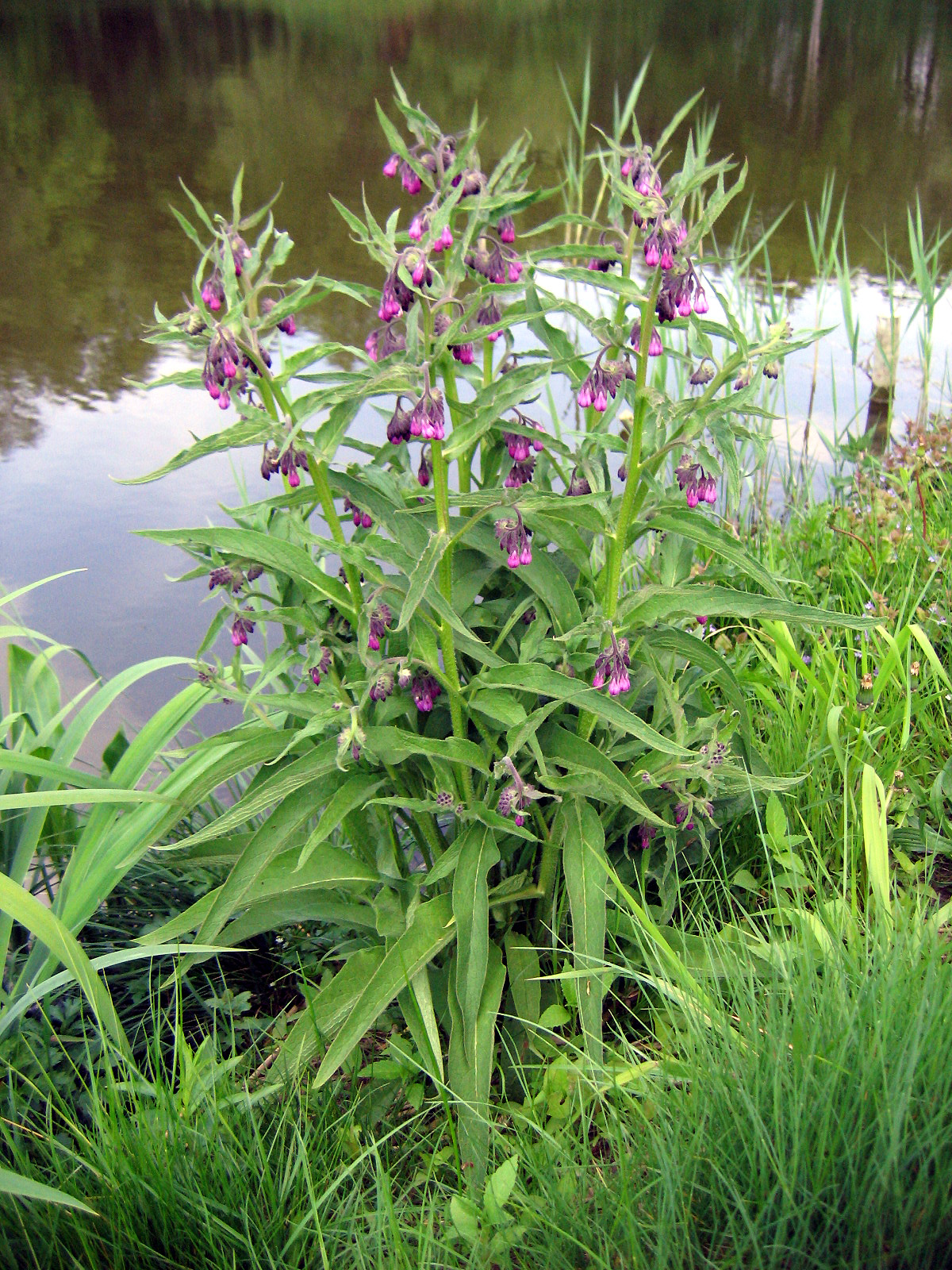
Comfrey (Symphytum officinale) is a fast-growing, bristly perennial herb native to Europe and western Asia, recognised by its decurrent winged stems and drooping clusters of bell flowers.
Permaculturists and organic growers plant it primarily as a nutrient accumulator for mulch and liquid feed. The critical rule is choosing its location with care, as its taproots penetrate deeply and cannot be eradicated once established.
Key Facts
- Plant type: herbaceous perennial dynamic accumulator
- Mature spread: 60 to 90 cm (24 to 36 in)
- Cutting frequency: 3 to 5 cuts every growing season
- Soil requirement: moist, fertile loam with high nitrogen
- Toxicity: toxic if ingested due to liver-damaging alkaloids
Is Comfrey Right for Your Garden Plot?
Comfrey suits growers who need a permanent supply of potassium-rich biomass for compost acceleration and surface mulching around heavy-feeding vegetables.
Because a single crown persists for upwards of twenty years and sends taproots over 1.5 m (5 ft) into the subsoil, you must not plant it in beds intended for annual crop rotations. Growers with limited garden boundaries often place it beneath established orchard trees or alongside compost heaps where it can mine leaching minerals without encroaching on delicate root crops.
How to Identify Common Comfrey
Common comfrey is identified by stiff-haired leaves whose leaf margins run downward into the stem to form prominent green wings or ridges.
Mature plants reach heights of 60 to 120 cm (24 to 48 in) and display thick, branched central stalks covered in prickly, rough setae. The basal foliage grows up to 30 cm (12 in) in length with an ovate-lanceolate shape, while upper leaves sit alternate along the stalk. Flowering cymes curl downward in scorpioid clusters, producing pendulous, bell-shaped corollas 1.5 cm (0.6 in) long in shades of dull purple, lilac, creamy white, or pale pink from May through July.
Soil and Light Requirements for Comfrey
Comfrey yields the highest weight of cut foliage when grown in full sun to partial shade in soil that holds steady moisture throughout the summer.
While the plant tolerates clay, silt, and moderately poor ground, it responds rapidly to high levels of nitrogen and organic matter. Soil that dries to dust stalls foliage regeneration between cuts.
- Light exposure: 6 hours or more of direct sunlight daily for maximum biomass
- Moisture level: consistently damp ground, including areas near ditch banks and swales
- Soil reaction: neutral to slightly acidic pH between 6.0 and 7.0
- Soil texture: deep, stone-free loams that allow downward taproot development
Propagating and Planting Comfrey Seeds and Root Cuttings
The standard way to propagate comfrey is by planting root cuttings 5 to 8 cm (2 to 3 in) long horizontally beneath the surface in early spring.
Wild Symphytum officinale produces viable seeds that require 2 to 4 weeks of cold stratification at 4 °C (39 °F) to germinate, though seed-grown plants often spread aggressively throughout cultivated soil. Most kitchen gardeners instead obtain root crowns or dormant root pieces from sterile cultivars to prevent unwanted self-seeding across garden rows.
- Crown planting depth: position the growing eye 2.5 to 5 cm (1 to 2 in) below the surface
- Root cutting depth: lay root fragments flat at a depth of 5 cm (2 in) in damp soil
- Row spacing: space crowns 60 to 90 cm (24 to 36 in) apart to give foliage room to expand
- First-year care: avoid cutting foliage during season one so the root system establishes
Comfrey Plant Care Guide: Water, Weeding, and Maintenance
Apply 2.5 cm (1 in) of water weekly during the first three months of growth, after which mature plants need manual watering only during sustained summer droughts.
Because comfrey leaves quickly shade out competing flora, mature stands require zero hand-weeding after their spring flush. Top-dress crowns with 5 cm (2 in) of aged manure or compost every March to replenish nitrogen taken up during repeat leaf harvests.
How and When to Harvest Comfrey Leaves
Harvest comfrey by cutting foliage back to 5 to 8 cm (2 to 3 in) above ground level just as flower buds begin to form in late spring.
A healthy crown produces 3 to 5 full cuts each season between May and September, regenerating a dense canopy within 21 to 30 days under warm conditions. Always wear thick work gloves when handling fresh foliage, as the stiff, bristly foliar hairs cause contact skin irritation and itching.
- Cut timing: sever foliage before full bloom to keep energy in leaf production
- Tool choice: use a sharp sickle, hedging shears, or garden scythe
- Final autumn cut: harvest no later than mid-September to let root reserves recharge for winter
Garden Fertilizer, Comfrey Salve, and Traditional Uses
Comfrey is primarily grown as an organic green manure and potassium-rich liquid plant feed, while its leaves and roots have a long record in traditional topical herbalism.
To make liquid fertiliser tea for fruiting vegetables like tomatoes (Solanum lycopersicum), cram harvested leaves into a covered bucket, weigh them down with a brick, and collect the thick black liquid that decomposes over 3 to 4 weeks, diluting it 1:10 with water. Historically, external comfrey salve, ointment, and comfrey oil extracted from dried roots were applied to closed skin for bruises, sprains, and shallow scrapes, earning the plant names like knitbone and boneset. Never drink comfrey tea or consume oral products: modern toxicology confirms the plant contains pyrrolizidine alkaloids that cause irreversible liver damage and veno-occlusive disease.
Troubleshooting Comfrey Pests and Diseases
The most widespread issue on comfrey foliage is comfrey rust (Melampsora species), which erupts as bright orange powder pustules on the lower leaf surface.
Slugs and snails frequently feed on tender new spring crowns but rarely kill established taproots. Avoid planting crowns in standing water during winter, which leads to crown rot pathogens rotting the central growing core.
- Orange pustules on leaves: comfrey rust; cut the plant to the ground and discard foliage in green waste
- Holes in young spring shoots: slug rasping; clear debris away from crown centers in early March
- Black, mushy crown tissue: waterlogged soil rot; replant healthy root tips in free-draining ground
- Stunted summer growth: nitrogen depletion; top-dress with blood meal, comfrey compost, or poultry manure
Drying, Storing, and Processing Comfrey
Dry comfrey foliage by spreading clean leaves in a single layer across mesh screens in a dark room at 25 to 30 °C (77 to 86 °F) for 4 to 6 days.
Because comfrey leaves have a high moisture content, piling them into deep trays causes them to turn black and rot before dehydrating. Store fully brittle green leaves in airtight containers away from sunlight for up to 12 months for external salve making, or chop excess summer cuttings directly onto garden beds as a 5 cm (2 in) thick weed-suppressing mulch.
Year-Round Care for Comfrey
| Spring | Top-dress the crown with 5 cm (2 in) of well-rotted manure in March. Plant new root cuttings 5 cm (2 in) deep. Take your first foliage cut once flower buds form in late spring. |
|---|---|
| Summer | Harvest foliar growth down to 8 cm (3 in) every 4 to 6 weeks. Soak leaf matter in closed drums to brew liquid plant tea. Water crowns during rainless dry spells exceeding three weeks. |
| Autumn | Complete the final leaf harvest by mid-September to allow crown regeneration. Dig and divide root sections for propagation once top growth dies back after the first frost. |
| Winter | Let frosted foliage rot naturally over the crown to insulate the soil. Clean and sharpen sickle blades and shears for spring cutting cycles. |
Common Comfrey Problems and Solutions
| What you see | Likely cause | What to do |
|---|---|---|
| Orange pustules beneath foliage | Comfrey rust fungus | Cut the entire plant to ground level immediately and burn or bin the infected leaves. |
| Ragged holes in fresh spring shoots | Slugs and snails | Scatter organic iron phosphate bait around the emergence zone in early spring. |
| Soft, black, foul-smelling crown centers | Bacterial or fungal crown rot | Excise rotted tissue with a clean knife and improve surrounding soil drainage. |
| Yellowing leaves with slow regrowth | Nitrogen and water deficit | Apply 5 cm of composted manure and provide 2.5 cm of irrigation weekly. |
Comfrey Cultivars and Clones
- 'Bocking 14' – Russian comfrey hybrid clone; sterile, high potassium, non-invasive
- 'Bocking 4' – high-protein sterile Russian comfrey; historical choice for animal fodder
- 'Axminster Gold' – ornamental selection; leaves bordered with wide golden-yellow margins
- 'Variegatum' – soft green leaves splashed with irregular creamy-white borders
Frequently Asked Questions
Can you drink comfrey tea safely?
No, you should never drink comfrey tea. Comfrey contains pyrrolizidine alkaloids that cause severe, cumulative liver toxicity and veno-occlusive disease in humans.
What is the difference between common comfrey and Bocking 14 comfrey?
Common comfrey (Symphytum officinale) produces viable seeds and can spread wearily across cultivated land, whereas 'Bocking 14' (a Symphytum × uplandicum hybrid) is completely sterile and spreads only when its roots are physically divided.
What is comfrey called in Bengali?
Comfrey is not native to Bengal and is typically referred to phonetically as কমফ্রে (kamphre), occasionally noted in botanical references alongside traditional bone-knitting plants like hadjod (Cissus quadrangularis).
How do you make comfrey salve for skin care?
Comfrey salve is traditionally made by infusing dried leaves or roots into a carrier oil such as olive oil for 2 to 4 weeks, straining the oil, and melting it together with beeswax. It is used historically only on closed, unbroken skin.
Why does comfrey make your hands itch when harvesting?
Comfrey leaves and stems are covered in sharp, stiff hairs containing calcium carbonate and silica that mechanically irritate and pierce sensitive skin. Always wear gardening gloves when cutting the plant.
Information about traditional or historical uses is provided for educational interest only and is not medical advice. Do not use any plant to treat a condition without speaking to a qualified professional.
Sources & Verification
Taxonomy and distribution are checked against the databases below. Care guidance is written for cultivated species only and reviewed by our editor. How We Build Plant Profiles →