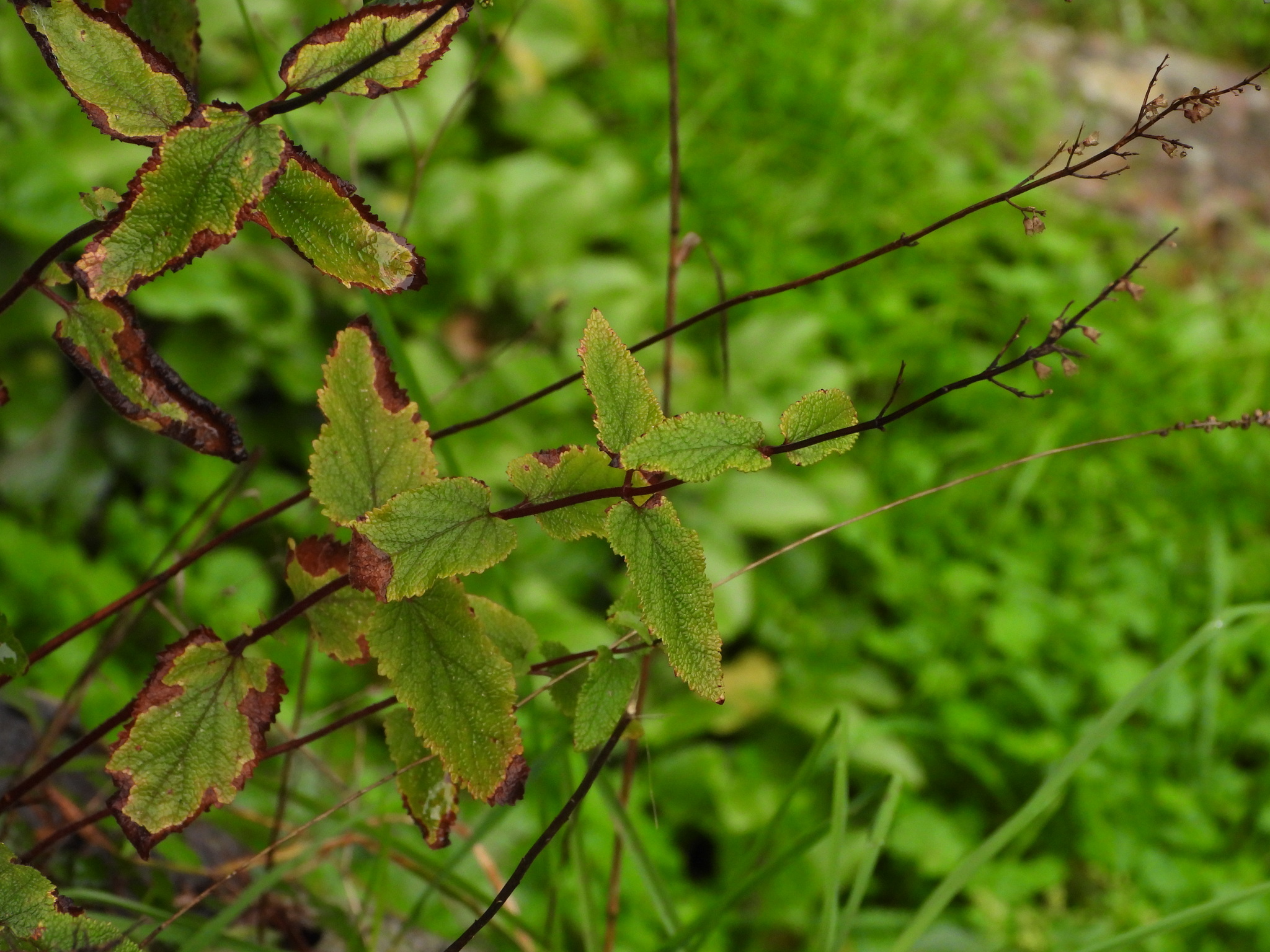
Coast germander (Teucrium cubense), also known as small coastal germander, is a low-growing perennial herb in the mint family native to the southern United States, Mexico, Central America, and the Caribbean. It features square stems, deeply lobed foliage, and white or pale blue flowers peppered with tiny purple spots.
This wild species grows in coastal dunes, alkaline mudflats, and sandy pastures. It withstands heavy salt spray and high heat where more tender herbaceous plants scorch.
Key Facts
- Plant Type: Herbaceous perennial wildflower
- Native Range: Southern US, Mexico, Caribbean, South America
- Mature Height: 15–50 cm (6–20 in)
- Flower Color: White to pale blue with purple spots
- Bloom Season: March through October
- Soil Preference: Sandy, saline, or alkaline soils
Where Coast Germander Belongs in the Wild Landscape
Coast germander grows wild in sun-drenched, sandy coastal flats and alkaline lowlands across warm temperate and tropical regions. It functions primarily as a pioneer groundcover in open, disturbed soil where turfgrasses fail to take root.
The plant thrives under intense solar radiation and high temperatures up to 38 °C (100 °F). Its extensive taproot network helps it anchor firmly into loose beach sands and tidal margins.
How to Identify Small Coastal Germander
Small coastal germander reaches 15–50 cm (6–20 in) in height with erect, square-cornered stems that branching mainly from the plant base. The leaves are arranged oppositely along the stems and feature distinct pin-shaped or wedge-shaped lobes.
The white to pale lavender blossoms measure 6–10 mm (0.2–0.4 in) across and open progressively along upper stem axils. The lower lip of the corolla extends much larger than the upper lip and displays a pattern of fine purple dots near the throat.
- Stems: Four-angled, soft-haired, branching from the base
- Leaves: Deeply 3- to 5-lobed, 1.5–4 cm (0.6–1.6 in) long
- Flowers: Five-lobed white corolla spotted with purple
- Fruit: Four small, brown, reticulated nutlets per flower
Native Habitat and Distribution of Teucrium cubense
Teucrium cubense occurs natively across coastal dunes, inland prairies, and salt marshes from Texas and Florida down through Mexico and South America. It prefers elevations below 300 m (980 ft) near marine or brackish water sources.
The species regularly populates disturbed coastal roadsides, ditch banks, and shell mounds. Soil in these zones typically tests alkaline, ranging between pH 7.2 and 8.5, with high mineral sand content.
Ecological Value and Pollinators
The long flowering season provides a steady source of nectar for native bees and small butterflies from early spring through mid-autumn. Sweat bees and hoverflies frequently visit the accessible lower flower lip.
Dense mats of coast germander help bind loose sand near sea lines, reducing wind erosion on coastal dunes. Birds occasionally feed on the small seed nutlets produced in late summer.
Conservation Status and Wild Population
Coast germander holds an overall conservation status of Least Concern (LC) across its broad continental range. Natural populations remain stable throughout Texas, Mexico, and South America.
Localized coastal habitat loss from beach development presents minor pressures in select eastern Florida counties. However, its tendency to colonize disturbed roadside gravel keeps global numbers robust.
Traditional Uses and History
Coast germander was traditionally used in regional folk remedies across parts of Mexico and the Caribbean as an herbal tea for gastrointestinal distress. Decoctions made from the aerial parts were applied topically for mild skin irritations.
Modern native plant restoration programs occasionally sow the species to stabilize disturbed coastal restoration sites. Its tolerance to brackish soil makes it suitable for revegetation projects along coastal lagoons.
Distinguishing Coast Germander from Similar Species
Coast germander is distinguished from its close relatives by its deeply lobed leaves and purple-spotted white corollas. Other wild members of the mint family share similar square stems but differ markedly in flower color and leaf shape.
It is commonly confused with four related species in overlapping geographic regions:
- American germander (Teucrium canadense) – grows taller up to 1 m (3.3 ft) with unlobed, serrated leaves and pink-purple flowers
- Wood sage (Teucrium scorodonia) – features wrinkly, heart-shaped leaves and yellowish-green flowers
- Creeping germander (Teucrium chamaedrys) – produces dark magenta flowers and ovate, oak-like leaves
- Cat thyme (Teucrium marum) – forms a woody subshrub with tiny, entire leaves and intense pungent scent
Frequently Asked Questions
Is small coastal germander native to the United States?
Yes, small coastal germander is native to southern states including Texas and Florida, extending southward through Mexico into South America.
What color are coast germander flowers?
Coast germander flowers are white to pale blue or light lavender, featuring distinct purple spots on the large lower lip.
How tall does Teucrium cubense grow in the wild?
Teucrium cubense typically grows between 15 and 50 cm (6 and 20 in) tall, forming low, branching clusters.
Where does small coastal germander grow best?
It grows best in full sunlight and well-drained sandy or alkaline soils near coastal dunes, tidal flats, and disturbed fields.
Information about traditional or historical uses is provided for educational interest only and is not medical advice. Do not use any plant to treat a condition without speaking to a qualified professional.
Sources & Verification
Taxonomy and distribution are checked against the databases below. Care guidance is written for cultivated species only and reviewed by our editor. How We Build Plant Profiles →