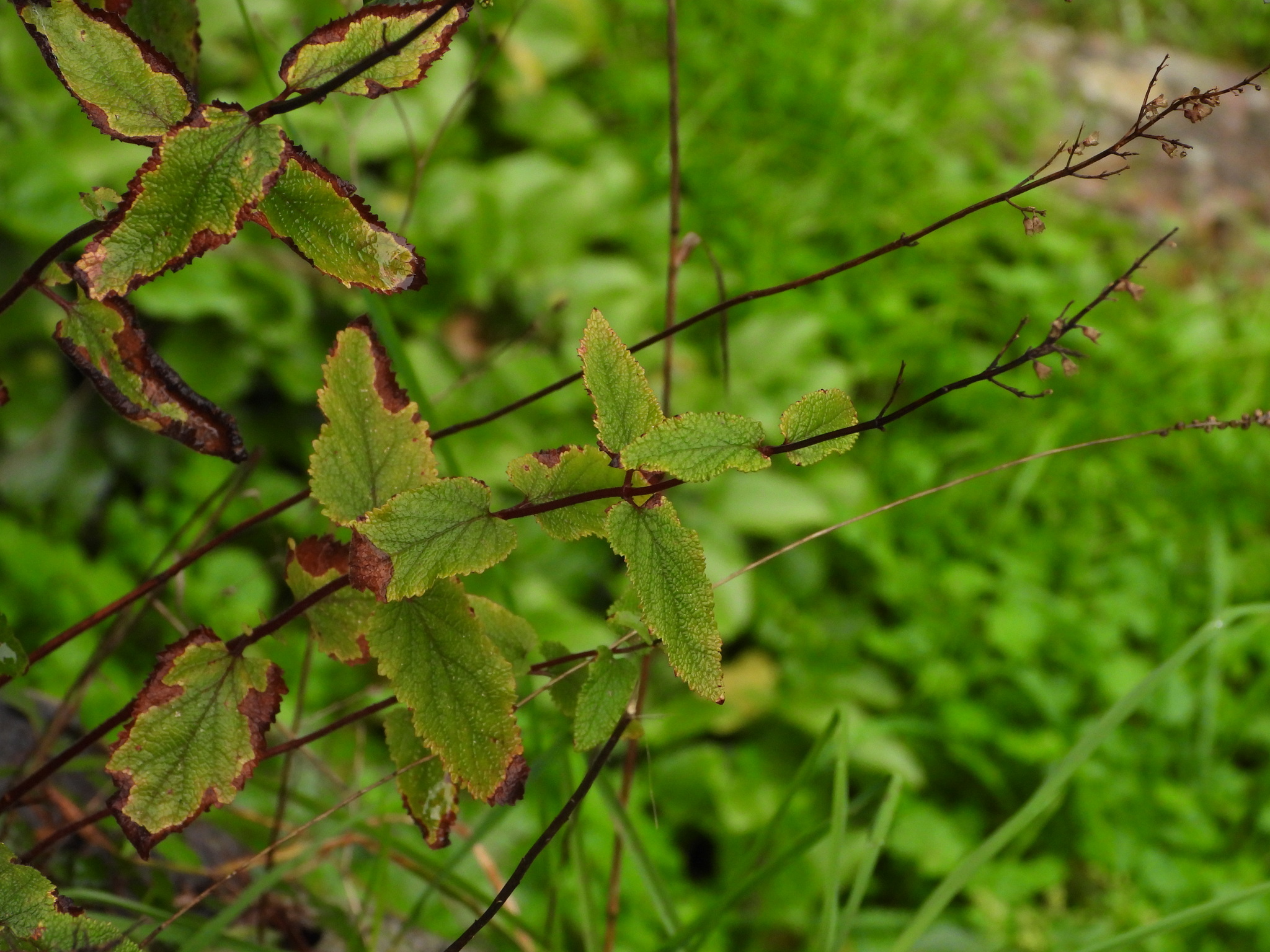
Wall germander (Teucrium chamaedrys) is a woody, semi-evergreen subshrub native to dry hillsides and rocky scrub across the Mediterranean basin, North Africa, and the Middle East. It develops a dense mound of dark green, glossy leaves with scalloped edges resembling miniature oak foliage.
In heavy clay or waterlogged soils, winter moisture kills the crown within weeks. The plant requires fast-draining, gritty soil and continuous sun exposure to maintain tight, hedge-forming growth.
Key Facts
- Growth habit: woody subshrub spreading by underground rhizomes
- Mature size: 25–40 cm (10–16 in) high and 30–60 cm (12–24 in) wide
- Hardiness: USDA Zones 5 to 9
- Light: full sun (at least 6 hours daily)
- Water: low; allow top 5 cm (2 in) to dry completely
- Soil drainage: sharp drainage essential; neutral to alkaline pH
Is Wall Germander Right for Your Garden?
Wall germander functions as a drought-tolerant substitute for boxwood in dry, sun-drenched landscapes and knot gardens. Its aromatic foliage naturally repels deer and rabbits while withstanding hot, dry winds that scorch softer perennials.
Grow this subshrub if you want low-maintenance edging along gravel paths, dry stone walls, or formal herb borders. Avoid planting it in low-lying garden beds where surface runoff collects, or in soil rich in water-retentive organic matter.
Identifying Wall Germander Foliage and Flowers
Wall germander is recognized by its dark green, oak-shaped leaves measuring 1 to 2.5 cm (0.4 to 1 in) long with distinct scalloped margins. The square stems emerge upright and become woody at the base as the clump matures into a 25 to 40 cm (10 to 16 in) mound.
From June to August, the plant bears two-lipped, pinkish-purple flowers in loose whorls on upright terminal spikes. The blooms lack an upper lip and feature a five-lobed lower lip that attracts honeybees and native solitary bees. When crushed, the leaves release a pungent, spicy herbal scent characteristic of the mint family (Lamiaceae).
Light and Soil Requirements
The plant requires full sun with at least six to eight hours of direct light each day to prevent leggy growth. In partial shade, stems stretch outward, the interior foliage thins out, and flower production declines drastically.
Sharply draining soil is mandatory for root survival:
- Texture: sandy, gritty, or rocky soils with minimal clay content
- Soil pH: 6.5 to 8.0; the species naturally colonizes limestone outcrops
- Drainage test: water must drain away in under ten minutes from a 30 cm (12 in) test hole
- Amendments: incorporate crushed gravel or coarse horticultural grit rather than peat or rich manure
Planting a Wall Germander Hedge
For a formal dwarf hedge, space young plants 20 to 30 cm (8 to 12 in) apart along your planting line. Staggering them in a slight double row produces a solid, gap-free border within two full growing seasons.
Dig each planting hole to the exact depth of the root ball and twice as wide. Set the crown level with the surrounding soil grade; burying the woody base traps surface moisture and invites crown rot. Water thoroughly right after planting, then mulch the surrounding soil with a 2 cm (1 in) layer of coarse mineral gravel rather than wood bark.
Water and Fertilizer Routine
Established plants need supplemental water only during extended dry spells lasting more than three weeks. During the first growing season, water once every 7 to 10 days, allowing the top 5 cm (2 in) of soil to dry out between applications.
Fertilizer is rarely necessary and often counterproductive:
- Spring feeding: scratch a handful of balanced compost or bone meal around the base in April
- Avoid high nitrogen: excess nitrogen creates weak, floppy growth that collapses under rain
- Late season feeding: stop all feeding by midsummer to let wood harden before freezing weather arrives
How to Prune Wall Germander
Prune your plants back by one-third to one-half in early spring just as new growth begins to show at the base. This annual cut removes winter-damaged stem tips and forces dense branching from the lower woody framework.
If you maintain a manicured hedge, shear the sides lightly following the main summer bloom in late July or August. Shearing off spent flower heads tidies the foliage canopy and prevents self-seeding into adjacent path gravel. Never cut down into bare, ancient woody stems that lack green shoots, as regeneration from old wood is slow.
Propagating Wall Germander
The most dependable propagation method is taking semi-ripe stem cuttings in midsummer. Cuttings root reliably within three to five weeks without specialized heating equipment.
Follow these steps to take cuttings:
- Cut 7 to 10 cm (3 to 4 in) non-flowering shoots in July or August
- Strip the lower leaves to expose the bottom 3 cm (1.2 in) of bare stem
- Insert stems into a mix of 50% coarse perlite and 50% sand
- Keep the potting medium lightly damp in bright, indirect light
- Transplant rooted cuttings into individual pots by autumn and overwinter in a cold frame
Winter Care and Cold Hardiness
Wall germander is cold hardy down to -29 °C (-20 °F), corresponding to USDA Zone 5, provided the roots stay dry. In Zones 5 and 6, freezing winter winds cause foliage desiccation and tip dieback, turning leaves bronze or grey-brown.
Protect plants in cold-winter climates with evergreen boughs placed loosely over the mound in late November to trap insulating snow. Never pile heavy autumn leaves or wet compost over the foliage, which smothers the crowns and introduces grey mould during winter thaws.
Common Growing Problems and Diseases
Wall germander suffers almost exclusively from excessive soil moisture and poor airflow. In well-drained, open sites, the plant remains virtually pest-free throughout the entire year.
Inspect for these common issues:
- Crown rot: lower stems turn black and mushy due to standing water; remove infected plants and improve gravel drainage
- Powdery mildew: white dusty coating on upper leaf surfaces caused by crowded planting; thin surrounding stems to restore air circulation
- Spider mites: fine stippling and webbing during prolonged, hot droughts; spray foliage with a firm jet of water
- Dieback in the centre: older clumps split apart and go bare; dig up and divide the clump every 4 to 5 years
Seasonal Care for Wall Germander
| Spring | Cut stems back by one-third in March or April before new growth emerges. Apply a thin 1 cm (0.5 in) top-dressing of crushed grit around crowns to keep low stems off damp earth. |
|---|---|
| Summer | Shear off spent floral spikes in late July to preserve a neat hedge shape and stimulate compact leafy branching. Water new plantings deeply every 10 to 14 days during heatwaves. |
| Autumn | Clear fallen tree leaves from the crowns to prevent trapped moisture and rot. Stop all fertilization and reduce watering so stems fully harden before the first ground frost. |
| Winter | Lay evergreen branches across the mounds in Zones 5 and 6 to block desiccating winter winds. Check that runoff from gutters or snow piles does not flood the bed. |
Diagnosing Wall Germander Growing Problems
| What you see | Likely cause | What to do |
|---|---|---|
| Yellowing leaves that rapidly blacken and rot at soil line | Phytophthora root or crown rot from waterlogged soil | Dig up dying plants, discard them, and replant in raised gravel beds or containers. |
| Leggy, floppy stems with pale green foliage and sparse blooms | Insufficient sunlight or excessive soil nitrogen | Relocate to a site with 6+ hours of full sun and stop applying fertilizers. |
| Brown, crispy foliage tips following winter | Windburn from freezing winter winds while the ground is frozen | Prune away damaged brown tips in mid-spring; new green growth will emerge from lower nodes. |
| Greyish-white powder on leaves during late summer | Powdery mildew from stagnant air and dense foliage | Prune out dense internal stems to increase airflow and avoid overhead watering. |
Named Wall Germander Cultivars
- ‘Prostratum’ – low creeping form reaching 15 cm high, ideal groundcover
- ‘Nanum’ – dwarf compact habit growing under 20 cm tall
- ‘Album’ – pure white blossoms over deep green foliage
Companion Plants for Wall Germander
Combine wall germander with Mediterranean subshrubs that share identical requirements for lean soil, full sun, and low moisture. Its glossy dark foliage provides an effective textural contrast against fine-leaved, grey-foliaged species.
Reliable companions include:
- English lavender (Lavandula angustifolia) for contrasting silver-grey leaves and blue flower spikes
- Cotton lavender (Santolina chamaecyparissus) to introduce bright yellow button blooms and woolly textures
- Rosemary (Salvia rosmarinus) for upright structural backdrop behind lower germander borders
- Common thyme (Thymus vulgaris) to knit together low margins and gravel edges
- Common box (Buxus sempervirens) for mixed geometric patterns in formal knot gardens
Frequently Asked Questions
Is wall germander evergreen?
Wall germander is broadleaf evergreen in USDA Zones 7 through 9, retaining glossy dark leaves year-round. In colder Zones 5 and 6, foliage often bronzes or drops during harsh winters, behaving as a semi-evergreen subshrub that resprouts in spring.
Does wall germander spread?
Yes, wall germander spreads slowly by underground stolons and rhizomes to form broad colonies 30 to 60 cm (12 to 24 in) across. It is not invasive and spreads gradually enough to remain easily controlled with an annual spade edge.
Is wall germander edible or safe to consume?
Wall germander is not safe to consume. While traditionally used as a folk remedy and brewing bitter, it contains neoclerodane diterpenoids that cause acute hepatitis, jaundice, and severe liver failure, leading several countries to ban its sale in herbal products.
Is wall germander toxic to dogs and cats?
Wall germander is not listed as toxic to dogs or cats by veterinary toxicologists for casual yard contact. However, pets should not ingest large quantities of the foliage due to the bitter compounds and potential for gastrointestinal upset.
Can you grow wall germander from seeds?
Yes, you can sow wall germander seeds indoors in early spring at 18 to 21 °C (65 to 70 °F) after a 4-week period of cold moist stratification. Germination typically takes 14 to 30 days, though rooting stem cuttings remains a much faster method.
Is wall germander deer resistant?
Yes, wall germander is highly deer and rabbit resistant. Its leaves contain pungent, bitter-tasting aromatic oils that grazing mammals consistently avoid.
Information about traditional or historical uses is provided for educational interest only and is not medical advice. Do not use any plant to treat a condition without speaking to a qualified professional.
Sources & Verification
Taxonomy and distribution are checked against the databases below. Care guidance is written for cultivated species only and reviewed by our editor. How We Build Plant Profiles →
- Royal Horticultural SocietyCultivation profile and hardiness ratings
- Missouri Botanical GardenPlant characteristics and landscape uses
- NC State Extension Gardener Plant ToolboxBotanical traits and cultural requirements
- Kew Plants of the World OnlineTaxonomy and native distribution
- GBIF — Global Biodiversity Information Facilitytaxonomy, synonyms, occurrence records
- Wikipediageneral reference