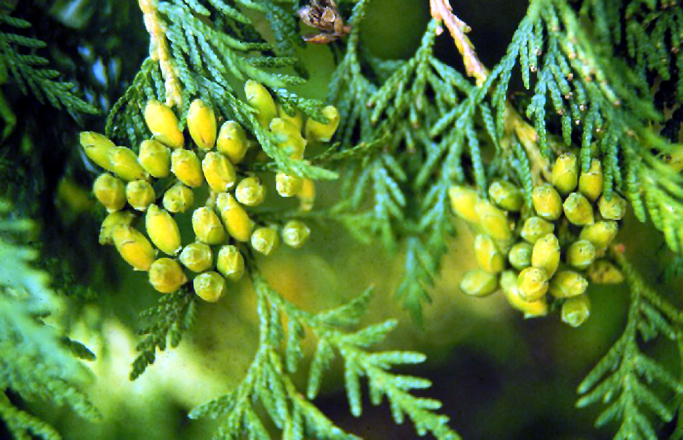
Western red cedar (Thuja plicata) is a massive evergreen conifer native to the moist coastal forests and river valleys of the Pacific Northwest. It stands out for its aromatic, scale-like foliage held in flat sprays and fibrous, reddish-brown bark that shreds in long vertical strips.
In residential landscapes, standard trees quickly outgrow modest boundaries, making compact cultivars or strict hedging routines essential to prevent them from overwhelming overhead wires and foundations.
Key Facts
- Growth rate: 45-75 cm (18-30 in) per year once established
- Sunlight: full sun to partial shade; tolerates deep shade when young
- Soil moisture: moist, well-draining ground; sensitive to drought
- Hardiness: USDA zones 5 through 9
- Foliage: evergreen, aromatic scale sprays with white butterfly markings beneath
- Toxicity: non-toxic to dogs and cats; foliage causes contact dermatitis
Is Western Red Cedar Right for Your Yard?
Western red cedar suits rural properties, windbreaks, and large garden boundaries that have consistently moist, acidic soil and ample vertical clearance. It struggles on hot, arid plains and shallow chalky soils that dry out during midsummer heatwaves.
Before planting a standard forest form, evaluate your space realistically. While dwarf forms suit domestic borders, the straight species requires significant root room and will suppress turf directly beneath its evergreen canopy.
- Best for: perimeter boundary screens, windbreaks, and deep hedgerows.
- Avoid planting: under utility lines, against building foundations, or on dry south-facing slopes.
- Moisture needs: requires steady groundwater or regular irrigation during dry spells.
Identifying Western Red Cedar Foliage, Bark, and Cones
Western red cedar is distinguished by flattened sprays of glossy, scale-like leaves that emit a sweet, pineapple-resin scent when bruised. Unlike spiny conifers, the foliage is soft to the touch and arranged in opposite, overlapping pairs.
Turn a branch over to inspect the undersides, which feature faint, whitish stomatal bands shaped like small butterflies or inverted V-marks. The bark is stringy, cinnamon-brown to gray-brown, and fissures into long, peeling vertical ribbons as the trunk widens with age.
Seed cones are small and leathery, measuring 10-14 mm (0.4-0.6 in) long. They point upward along the branchlets, emerging green in late spring before drying to a light woody brown with 8 to 12 thin scales by autumn.
Mature Size and Growth Spacing
In cultivation, straight species specimens mature at 15-30 m (50-100 ft) tall with a spread of 4.5-8 m (15-26 ft), though wild forest trees exceed 60 m (200 ft). They grow at a brisk pace of 45-75 cm (18-30 in) annually when moisture is adequate.
Proper spacing prevents fungal leaf blight and root competition between young trees.
- Dense hedging: space plants 60-90 cm (2-3 ft) apart on center.
- Unclipped screen: space trees 2.5-3.5 m (8-11 ft) apart.
- Specimen planting: allow at least 6-8 m (20-26 ft) of clearance from walls and structures.
Where to Plant Western Red Cedar
Position western red cedar in an open spot receiving full sun to partial shade, sheltered from desiccating winter winds. In regions with baking summer afternoons, planting where the tree receives morning sun and dappled afternoon light preserves deep leaf color.
The ground must be rich in organic matter and retain moisture without waterlogging for prolonged periods. The root system spreads wide and relatively shallow, making it sensitive to soil compaction from heavy foot traffic or machinery.
How to Plant Western Red Cedar
Plant container-grown or balled-and-burlapped saplings during early autumn or mid-spring when the soil is cool and rains are frequent. Autumn planting allows the root zone to settle before the onset of summer heat.
Follow these steps to establish a healthy root system:
- Dig a hole twice as wide as the root ball and equal to its depth, keeping the root flare level with the surrounding grade.
- Loosen circling roots gently with your fingers to prevent girdling.
- Backfill with native soil, firming lightly with your hands to remove large air pockets.
- Apply a 7-10 cm (3-4 in) layer of wood mulch around the base, keeping it 10 cm (4 in) away from the trunk.
- Soak the entire planting zone with 20-30 L (5-8 gal) of water immediately after backfilling.
Water and Fertilizer Requirements
Supply new trees with 25 mm (1 in) of water weekly during their first two growing seasons whenever rainfall falls short. Mature trees develop drought tolerance over time, but foliage turns dull and casts inner scales if soil moisture drops severely during midsummer.
Fertilizer is rarely necessary if the tree is planted in native loam. If growth appears sluggish or yellowed in spring, broadcast a balanced, slow-release granular evergreen fertilizer (such as a 10-8-6 formulation) beneath the dripline before new growth flushes in April.
How to Prune a Western Red Cedar Hedge
Prune hedges and formal screens between late spring and midsummer, completing all cuts before late August to avoid cold injury on tender late shoots. Never cut back into bare, leafless wood, as old cedar branches do not produce latent buds and will leave permanent bare patches.
Use clean hedge shears or hand pruners to shape the hedge with a slight batter, tapering the top so it remains narrower than the base. This profile ensures that lower branches receive direct sunlight, which prevents the bottom skirts of the hedge from thinning out over time.
Pests and Disease Problems
The most common disease on young trees is Keithia blight (Didymascella thujina), which causes individual scale leaves to turn brown and drop from lower branches during humid summers. Improving airflow through selective thinning reduces spore accumulation.
- Cedar bark beetles: cause branch tip dieback; target drought-stressed or root-damaged specimens.
- Scale insects: excrete sticky honeydew followed by black sooty mold on branch stems.
- Deer browsing: strips tender leader tips in winter; use protective wire cages around young saplings.
- Root rot (Phytophthora): wilts entire crowns in heavy, waterlogged clay; avoid planting in poorly draining depressions.
Winter Care and Snow Protection
Western red cedar survives winter temperatures down to -29 °C (-20 °F) without issue, but heavy, wet snow can splay multiple leaders. Brush heavy snow accumulation off horizontal boughs upward using a soft broom to prevent branch snapping.
Multi-stemmed specimen trees and trimmed hedges benefit from being wrapped with spiraled polypropylene twine in late autumn to prevent snow loads from bowing outer limbs outward. Avoid applying chemical de-icing salts near root zones, as sodium runoff triggers severe foliage burn along windward branches.
Western Red Cedar Wood and Timber Uses
Western red cedar produces light, stable softwood packed with natural thujaplicins that repel rot and insect infestation without requiring chemical preservatives. Because of its dimensional stability and weather resistance, it is a primary material for outdoor construction across the globe.
Common uses include architectural cladding, tongue-and-groove siding, exterior decking, roof shingles, and privacy fencing. While outdoor structures withstand years untreated, weathering to an even silvery-gray, applying a penetrating oil or UV-blocking stain preserves the timber’s natural amber and cinnamon color.
Frequently Asked Questions
What is the difference between western red cedar and eastern red cedar?
Western red cedar is a true arborvitae with flat, glossy scale sprays and small woody cones, whereas eastern red cedar (Juniperus virginiana) is a juniper with prickly needle-like juvenile foliage, shreddy bark, and fleshy, berry-like blue cones. Western red cedar prefers cool, moist soils, while eastern red cedar thrives in dry, rocky, alkaline ground.
Does western red cedar wood need to be treated for outdoor use?
No, western red cedar naturally resists rot and fungal decay for decades without chemical treatment due to high levels of organic thujaplicins in its heartwood. However, applying a water-repellent preservative or UV-inhibiting oil prevents surface checking and stops the wood from turning silver-gray under direct sunlight.
Is western red cedar poisonous to dogs or cats?
Western red cedar is not poisonous to dogs, cats, or horses. Its foliage and wood shavings can cause mild contact dermatitis or digestive upset if chewed in large amounts, but the plant contains none of the lethal yew-type alkaloids found in trees like English yew (Taxus baccata).
How do you care for a Whipcord western red cedar?
Grow Whipcord western red cedar in moist, well-draining soil in full sun to partial shade, watering weekly through summer dry spells. Pruning is rarely needed because its mounding, mop-head habit of whip-like pendulous branchlets naturally stays under 1.2 m (4 ft) tall and wide.
Why are the inner leaves of my western red cedar turning brown in autumn?
Inner leaf browning in autumn is normal seasonal needle drop, where the tree sheds two- to three-year-old interior branchlets that receive diminished sunlight. As long as outer branch tips remain green, supple, and actively growing, the tree is healthy.
Sources & Verification
Taxonomy and distribution are checked against the databases below. Care guidance is written for cultivated species only and reviewed by our editor. How We Build Plant Profiles →
- Kew Plants of the World OnlineTaxonomy, native range, and botanical distribution
- USDA Forest Service Silvics ManualSilvics, growth rates, site requirements, and ecology
- Missouri Botanical GardenGarden culture, hardiness, and ornamental cultivars
- RHS GardeningPruning guidelines and hedging specifications
- GBIF — Global Biodiversity Information Facilitytaxonomy, synonyms, occurrence records
- Wikipediageneral reference