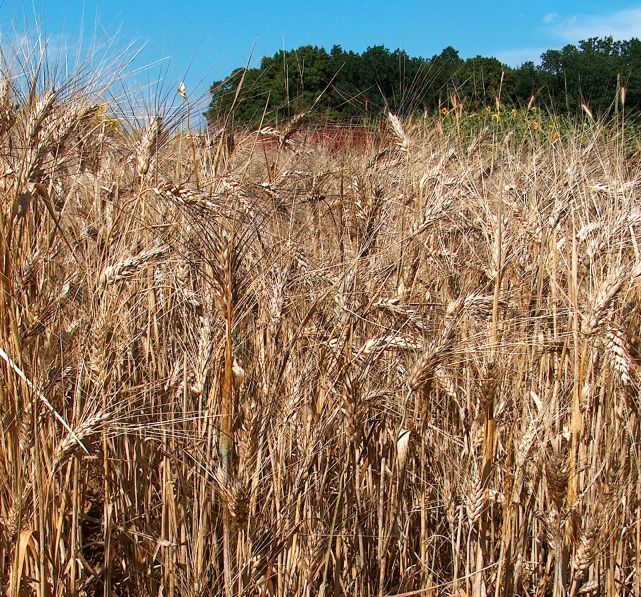
Bread wheat (Triticum aestivum) is an annual cereal grass originating in the South Caucasus and Middle East, distinguished by its hollow tillering culms and terminal grain-bearing spikes. It accounts for roughly 95% of all wheat grown globally, making it the most heavily harvested food crop on Earth.
Smallholders and farmers cultivate it to mill fresh baking flour or supply grain for whole-food cooking. Success depends on selecting the right seasonal variety for your climate and maintaining dry conditions during grain maturation.
Key Facts
- Grain moisture: harvest when moisture drops below 14%
- Sowing depth: plant 2.5 to 5 cm (1 to 2 in) deep
- Sunlight: requires 6 to 8 hours of direct full sun daily
- Genome: allohexaploid containing 42 chromosomes (genome AABBDD)
- Energy content: raw grain provides roughly 340 calories per 100 grams
Is Bread Wheat Practical for Home Gardens?
Bread wheat requires a dedicated plot of at least 10 square metres (108 sq ft) to produce a practical yield of roughly 4 to 6 kg (9 to 13 lb) of milled grain. While industrial farms manage thousands of hectares with combine harvesters, homesteaders can easily grow and thresh small stands by hand.
Before planting, decide between two seasonal growth habits:
- Winter wheat: sown in autumn, requires 4 to 8 weeks of winter temperatures between 0 and 7 °C (32 and 45 °F) to trigger flowering, and matures by midsummer.
- Spring wheat: sown in early spring as soon as soil can be worked, bypassing winter chill to produce grain by late summer.
The crop suits gardeners with open sunny ground who want homegrown baking flour or straw for garden mulch.
Bread Wheat Plant Botanical Description
Bread wheat grows as a tufted annual grass reaching 60 to 120 cm (24 to 48 in) in height with smooth, hollow jointed stems called culms. Each stem carries linear, flat leaves that measure 10 to 30 cm (4 to 12 in) long and 1 to 2 cm (0.4 to 0.8 in) wide, with small clasping auricles at the base of the blade.
The reproductive terminal spike measures 7 to 15 cm (3 to 6 in) long and bears 15 to 25 alternate spikelets arranged along a zigzag central axis:
- Spikelets: hold 3 to 6 florets enclosed by stiff, keeled glumes.
- Awns: stiff bristles projecting from lemma tips, present in bearded types and absent in awnless cultivars.
- Grain (caryopsis): oval kernel measuring 5 to 8 mm (0.2 to 0.3 in) in length with a deep longitudinal crease on one side.
Ideal Growing Conditions for Common Wheat
Bread wheat performs best in open, sunny locations with fertile, well-draining loam and a soil pH of 6.0 to 7.2. Dense, waterlogged soils invite fungal root rots, while extremely light sands dry out too rapidly during grain filling.
Maintain these physical parameters throughout cultivation:
- Sunlight: unfiltered direct sun for at least 6 to 8 hours daily.
- Vegetative temperature: active growth occurs between 12 and 22 °C (54 and 72 °F).
- Ripening temperature: sunny, dry conditions of 20 to 28 °C (68 to 82 °F) prevent head mould during late seed fill.
How to Sow Bread Wheat Seeds
Sow clean bread wheat seeds at a depth of 2.5 to 4 cm (1 to 1.5 in) into weed-free, lightly raked soil. For spring varieties, plant as soon as the soil hits 4 °C (39 °F); for winter varieties, sow 4 to 6 weeks before your first killing frost in autumn.
Follow this spacing routine for an even canopy:
- Broadcast method: scatter 150 to 180 grams (5.3 to 6.3 oz) of seed per 10 square metres, then rake lightly to cover.
- Row method: plant seeds 2 to 3 cm (0.8 to 1.2 in) apart in furrows spaced 15 to 20 cm (6 to 8 in) apart.
- Tamping: firm the surface with the back of a rake or a light lawn roller to ensure uniform seed-to-soil contact.
Watering Schedule and Nutrient Care
Bread wheat needs approximately 350 to 500 mm (14 to 20 in) of total water across its growing cycle. Natural rainfall often covers this requirement in temperate zones, but dry spells during jointing and head emergence require supplemental irrigation.
Apply balanced organic or mineral nutrition across key growth phases:
- Basal dressing: incorporate compost or a balanced fertiliser before sowing to establish root depth.
- Tillering boost: apply nitrogen as tillers emerge to increase the number of grain heads per plant.
- Water cut-off: withhold all supplemental water once grain heads turn yellow to hasten drying and avoid kernel sprouting.
Harvesting Bread Wheat Grain
Harvest bread wheat once stalks turn completely golden-brown and the grain moisture drops to 14% or less. Test readiness by pressing a thumbnail into a kernel; if it resists indentation without releasing milky sap, the grain is mature.
Use the traditional three-step field process:
- Reaping: cut the culms 10 cm (4 in) above ground level using a sickle, scythe, or shears on a dry, sunny afternoon.
- Curing: bundle stems into upright sheaves (stooks) and dry for 3 to 7 days if weather threatens rain.
- Threshing: strike seed heads against the inside of a clean bucket or walk over seed bags to dislodge kernels from chaff.
- Winnowing: pour the threshed seed between two buckets in front of a fan or breeze to blow away loose hulls.
Processing Wheat Berries for Bread and Baking
Turning raw wheat into bread requires milling the clean grain berries into whole wheat or sifted white flour. Bread wheat is specifically bred for high concentrations of glutenin and gliadin, the storage proteins that form an elastic gluten network to trap gas during yeast fermentation.
Homesteaders use the harvest across several kitchen applications:
- Stone-ground flour: milling unpearled grain retains the bran, germ, and endosperm for whole-wheat artisan loaves.
- Plant-based staple: whole wheat bread provides an entirely plant-based source of protein, complex carbohydrates, and B vitamins.
- Grain berries: whole wheat kernels can be simmered like brown rice or sprouted for salads.
Commercial bread wheat flour differs from durum wheat (Triticum durum), which is much harder and primarily used for extruded pasta, as well as rye (Secale cereale) and barley (Hordeum vulgare), which produce much denser loaves with less rise.
Pests, Diseases, and Lodging Problems
Fungal leaf blights and stem lodging present the biggest challenges to bread wheat, especially during warm, wet flowering periods. Crop rotation and selecting resistant strains significantly limit field losses.
Watch for these common disorders:
- Stripe and leaf rust (Puccinia spp.): causes raised yellow or orange-brown powdery pustules on foliage, reducing photosynthate transport.
- Fusarium head blight: bleaches individual spikelets white while heads are green, often producing a salmon-pink fungal growth.
- Lodging: stems snap or bend permanently to the ground under heavy rain, caused by excess nitrogen or overly tall varieties.
- Grain aphids: cluster on immature ears to suck sap, vectoring barley yellow dwarf virus.
Storage and Preserving Whole Grain
Whole bread wheat berries store successfully for 10 to 30 years when kept at or below 12% moisture in sealed containers. Once ground into whole-wheat flour, natural oils in the germ oxidise rapidly, reducing shelf life to roughly 1 to 3 months at room temperature.
Follow safe post-harvest storage standards:
- Containers: seal whole berries in food-grade buckets or glass jars fitted with oxygen absorbers.
- Temperature: store in a cool, dark room kept below 18 °C (64 °F) to preserve baking quality.
- Insect protection: freeze dry grain for 48 hours before packing to eliminate any dormant pantry weevils or moths.
- Flour preservation: keep freshly milled whole-wheat flour in the freezer to prevent rancidity.
Bread Wheat Through the Seasons
| Spring | Sow spring wheat seed directly into prepared beds as soon as soil thaws. Apply a nitrogen top-dressing to autumn-sown winter wheat at the tillering stage, and hoe emerging broadleaf weeds. |
|---|---|
| Summer | Withhold supplemental irrigation as heads change from green to tan. Cut mature golden stalks when kernel moisture falls below 14%, thresh on dry days, and winnow away chaff. |
| Autumn | Sow winter wheat seed 3 to 4 cm (1.2 to 1.6 in) deep roughly 4 to 6 weeks before freezing ground. Firm the seedbed to promote root contact and ensure winter drainage. |
| Winter | Allow winter wheat to cold-harden beneath snow cover; avoid foot traffic across frozen fields to prevent crown heave. Inspect stored wheat berries in pantries for moisture or weevils. |
Troubleshooting Common Wheat Problems
| What you see | Likely cause | What to do |
|---|---|---|
| Yellow, linear stripes of rust-orange powder on leaf blades | Stripe rust fungus (Puccinia striiformis) | Plant rust-resistant cultivars and avoid high density planting that traps moisture. |
| Bleached, premature whitening of individual grain spikelets | Fusarium head blight (scab) | Avoid overhead watering during flowering and never plant wheat immediately following field corn. |
| Stems collapse and fall flat to the ground before harvest | Stem lodging from excess nitrogen or heavy wind | Reduce nitrogen applications and select stiff-strawed, semi-dwarf cultivars. |
| Hollowed kernels and powdery webbing in storage buckets | Grain weevils or meal moths | Freeze dry grain berries for 48 hours before storage and pack inside airtight containers with oxygen absorbers. |
Popular Bread Wheat Varieties
- 'Red Fife' – heritage Canadian hard red spring wheat with rich flavour
- 'Turkey Red' – cold-hardy winter wheat introduced from Crimea
- 'Marquis' – historic early-ripening spring wheat with high gluten strength
- 'Glenn' – modern hard red spring variety showing high resistance to fusarium head blight
Frequently Asked Questions
What is bread wheat?
Bread wheat (Triticum aestivum) is a cultivated annual cereal grass that accounts for roughly 95% of worldwide wheat production. It is grown primarily for its high-gluten grain, which is milled into flour for bread, pastries, and baked goods.
What is the chromosome number and genome of bread wheat?
Bread wheat is an allohexaploid plant with 42 chromosomes (2n = 6x = 42). Its genome combines three distinct ancestral subgenomes, designated as AABBDD, resulting from ancient natural hybridisations between primitive wheat species and wild goatgrass (Aegilops tauschii).
Is bread wheat gluten-free?
No, bread wheat is not gluten-free and is the primary natural source of dietary gluten. People with coeliac disease or non-coeliac gluten sensitivity must strictly avoid bread wheat, its berries, and all flours derived from it.
Is wheat bread plant-based?
Yes, bread wheat is a 100% plant-based cereal grain. Traditional whole wheat bread made from milled wheat flour, water, yeast, and salt fits directly into a whole-food, plant-based diet, though commercially processed sandwich breads often contain added dairy or animal fats.
What wheat berries are best to use for bread flour?
Hard red wheat berries and hard white wheat berries are the best choice for bread flour because their grain contains 12% to 15% protein. Soft wheat varieties contain less protein and are better suited for light cakes, pastries, and biscuits.
Sources & Verification
Taxonomy and distribution are checked against the databases below. Care guidance is written for cultivated species only and reviewed by our editor. How We Build Plant Profiles →