
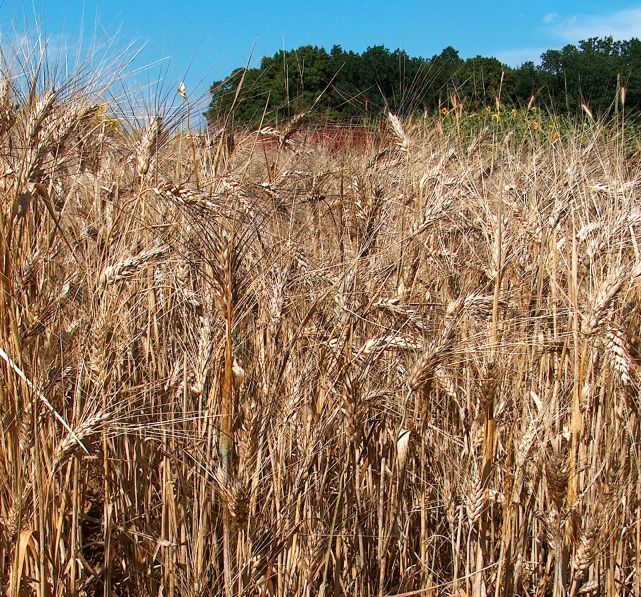
Durum wheat (Triticum durum) is a cool-season annual grass originating in the Near East and Mediterranean basin, distinguished by its heavily awned seed spikes and flinty, high-protein amber kernels.
It requires hot, dry ripening conditions to prevent kernel discoloration and fungal blight, yielding between 250 and 450 g per square metre in productive small-scale field beds.
Key Facts
- Kernel type: Hardest of all cultivated wheats
- Planting depth: 3 to 5 cm (1 to 2 in) deep
- Row spacing: 15 to 20 cm (6 to 8 in) apart
- Maturity: 90 to 120 days from emergence
- Protein content: Typically 12% to 15% dry basis
Is Durum Wheat Right for Your Garden or Homestead?
Durum wheat requires an open area of at least 10 square metres (108 sq ft) to produce a practical kitchen harvest of dry grain. It suits smallholders and home millers with open land in dry continental or Mediterranean climates.
Unlike tender culinary herbs, this crop occupies garden ground for up to four months and cannot handle waterlogged soils or overcast coastal summers. If you have full overhead sun, freely draining loam, and low humidity during the midsummer grain-filling window, this grain performs reliably.
What Does Durum Wheat Look Like?
Durum wheat grows as an erect, tufted grass standing 70 to 120 cm (28 to 47 in) tall with flat, coarse leaf blades up to 2 cm (0.8 in) wide. Stiff, hollow stems terminate in a dense, four-sided spike packed with overlapping spikelets.
Long, bristly awns measuring 8 to 15 cm (3 to 6 in) emerge from the spikelet glumes, pointing stiffly upward and creating a spiky silhouette distinctly longer-awned than common wheat (Triticum aestivum). As the crop matures in late summer, the green vegetation cures to a pale straw gold, and the spikes bend slightly under the weight of large, translucent, amber-coloured kernels.
Ideal Growing Conditions for Durum Wheat
Durum wheat performs best with at least 6 to 8 hours of direct, unfiltered sunlight daily throughout its vegetative and reproductive cycles. Cloud cover and shaded plots weaken the culms, leading to premature lodging before harvest.
Target fertile, medium-textured soils with stable drainage. Key soil and climate parameters include:
- Soil pH: 6.0 to 7.5 for optimal mineral uptake
- Soil texture: Deep clay loams or silt loams with good water-holding capacity
- Temperature range: Germinates at 4 to 12 °C (39 to 54 °F), ripening fastest at 24 to 32 °C (75 to 90 °F)
- Atmospheric moisture: Low ambient humidity during flowering and grain fill
How to Plant and Sow Durum Wheat
Sow durum wheat seed at a depth of 3 to 5 cm (1 to 2 in) into a finely cultivated, firm seedbed. Surface sowing reduces crown root anchoring, causing plants to topple in summer winds.
Plant spring cultivars as soon as the soil can be worked in early spring, or plant winter types in autumn around mid-September to October. Space your planting effectively:
- Row spacing: 15 to 20 cm (6 to 8 in) apart
- In-row spacing: 2 to 3 cm (1 in) between individual seeds
- Sowing density: 120 to 160 g of viable seed per 10 square metres
- Germination time: 6 to 10 days at soil temperatures above 8 °C (46 °F)
Ongoing Crop Care, Irrigation, and Feeding
Provide 25 mm (1 in) of water per week during early tillering and stem extension if seasonal rainfall drops below normal levels. Taper off supplemental irrigation entirely once flowering finishes.
Hand-weed or hoe lightly between the rows while the plants are under 15 cm (6 in) tall. Once the wheat reaches the jointing stage, its dense canopy outcompetes emerging annual broadleaf weeds. Avoid excessive nitrogen applications, which cause rapid stem lengthening and soft culms that collapse in rainstorms.
Harvesting Durum Wheat at the Right Time
Harvest durum wheat heads when kernel moisture drops to 13% to 14%, usually in midsummer to early autumn. At this point, you cannot dent the grain with a thumbnail, and the straw is entirely dry and brittle.
Follow these steps to gather your harvest:
- Cut stems 10 cm (4 in) above ground level using a sickle or sharp hand shears
- Bundle the stems into loose sheaves and dry them upright in an airy shed for 4 to 7 days
- Thresh the grain by beating the dry heads inside a clean canvas sack or plastic bin
- Winnow the cracked chaff using an electric fan or a steady outdoor breeze
Culinary Uses, Semolina, and Pasta Making
Durum wheat is the foundational ingredient for dry pasta, couscous, and bulgur due to its exceptionally high protein and gluten strength. Milled coarsely rather than finely, the grain produces semolina rather than standard white flour.
The endosperm contains high amounts of lutein, giving handmade pasta dough a golden tint without eggs. To cook whole durum grain, simmer 1 part berries in 3 parts water for 45 to 60 minutes until chewy. For pasta, blend coarse semolina with warm water at a ratio of 100 g semolina to 50 ml water, knead for 10 minutes, rest the dough, and extrude or cut into desired shapes.
Managing Durum Wheat Diseases and Cultural Problems
Prevent fungal infections by maintaining wide row spacing of at least 15 cm (6 in) to ensure airflow through the canopy. Wet conditions during flowering allow spores to enter developing kernels directly.
Keep an eye out for these widespread grain issues:
- Fusarium head blight: Bleached spikelets with pinkish spore masses; discard infected heads entirely
- Stem rust: Reddish-brown pustules erupting along leaves and stems; switch to rust-resistant seed stock
- Lodging: Stems flattened by rain or wind; reduce nitrogen and avoid overwatering
- Bird predation: Birds feeding on milk-stage grain; drape protective netting over heads once seed sets
Storing Whole Durum Grain and Milled Semolina
Store cleaned durum wheat berries in airtight food-grade containers at below 15 °C (59 °F) with a relative humidity under 60%. Properly dried whole grains keep in sound condition for over five years.
Whole grain contains the germ and bran, so keeping it in a dark pantry or unheated larder prevents rancidity. Once you grind the grain into semolina flour, store it in an airtight glass jar and use it within 3 months, or freeze it for up to 12 months to stop natural oils from oxidising.
Frequently Asked Questions
What does durum wheat mean?
The word "durum" is Latin for "hard", referring to the extreme density and resistance of the grain kernel. It describes the tetraploid cereal species cultivated specifically for producing coarse semolina and commercial pasta.
Is durum wheat hard or soft?
Durum wheat is the hardest of all cultivated wheats. Its flinty endosperm shatters into coarse, gritty particles rather than fine powder when milled, which allows pasta dough to hold its structural shape during boiling.
What is the difference between durum wheat and whole wheat?
Durum wheat is a specific botanical species (Triticum durum) grown for high-protein semolina, whereas whole wheat simply refers to flour milled from the entire kernel of any wheat species, most commonly Triticum aestivum. Durum produces firm, extensible dough suitable for pasta, while whole common wheat produces elastic dough built for leavened sandwich breads.
How do you cook durum wheat pasta?
Cook dry durum pasta in a large pot with 1 litre of rolling boiling water and 7 g of salt per 100 g of pasta. Boil uncovered for 8 to 11 minutes until al dente, testing a strand for a firm core before draining.
How do you pronounce durum wheat?
Durum is pronounced "DOOR-um" or "DYOOR-um". It rhymes with the first syllable of "plural".
Is durum wheat in Minecraft?
No, Minecraft features a single generic crop named "Wheat" rather than specific real-world species like durum wheat. In the game, you obtain ordinary wheat seeds by breaking wild grass blocks.
Sources & Verification
Taxonomy and distribution are checked against the databases below. Care guidance is written for cultivated species only and reviewed by our editor. How We Build Plant Profiles →
