
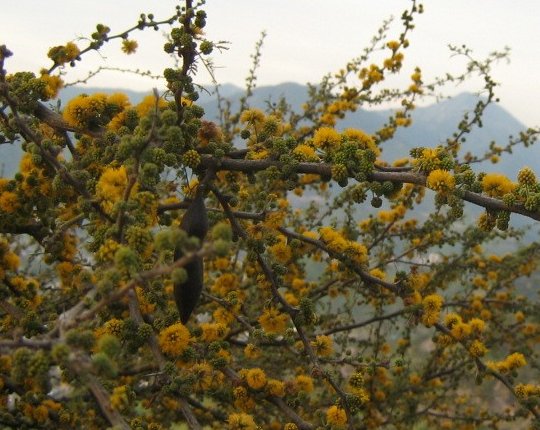
Vachellia caven is a deciduous shrub or small tree native to the arid and semi-arid regions of South America, including Argentina, Chile, and Uruguay. It is recognized by its dark, deeply furrowed bark and pairs of stiff, white thorns that grow along its branches.
In early spring, the tree produces spherical, bright yellow flower clusters that emit a heavy, sweet fragrance before the leaves appear. This species thrives in open woodlands and disturbed soils where it faces little competition for light.
Key Facts
- Light: Requires full sun for proper flowering and growth
- Water: High drought tolerance once the root system is established
- Thorns: Sharp, white spines reaching up to 2 cm (0.8 in)
- Hardiness: Survives temperatures down to -7 °C (20 °F)
- Flowers: Fragrant yellow pom-poms appearing in early spring
Is Caven Thorn Right for Your Garden?
Full sun and well-drained soil are the primary requirements for this South American native to thrive in a landscape. It is an appropriate choice for dry, Mediterranean-style gardens or xeriscaping projects where water conservation is a priority. Because of its aggressive thorns, you should avoid planting it near walkways, children’s play areas, or high-traffic zones.
The tree provides excellent structure for wildlife, offering nesting sites that are protected from predators by the 2 cm (0.8 in) spines. It is often used in rural areas as a living fence or boundary marker. While it is deciduous, the architectural skeleton of the branches provides visual interest throughout the winter months.
Identifying Vachellia caven
Identifying the Caven Thorn requires looking at the bark, thorns, and foliage, which change significantly as the tree matures. The bark is dark grey to black and develops deep, vertical fissures that give the trunk a rugged appearance. Each branch is armed with pairs of straight, white thorns that contrast sharply against the darker wood.
- Thorns: Straight, white, and very sharp, typically 1-2 cm (0.4-0.8 in) long.
- Leaves (Hojas): Bipinnate and delicate, 2-5 cm (0.8-2 in) long with numerous tiny leaflets.
- Flowers: Bright yellow spheres, 1-2 cm (0.4-0.8 in) in diameter, appearing in clusters of 1-3.
- Fruit (Fruto): A thick, woody, dark brown pod, 4-10 cm (1.6-4 in) long, containing several hard seeds.
How Large Does Caven Thorn Grow?
Expect a mature height of 4 to 6 meters (13 to 20 feet) with a wide, spreading canopy that can reach a similar width. In its native habitat, it often grows as a multi-stemmed shrub, but it can be trained into a single-trunk tree with regular pruning. The growth rate is moderate, typically adding 30-50 cm (12-20 in) of height per year under optimal conditions.
The canopy is relatively open, allowing dappled sunlight to reach the ground beneath. This makes it possible to grow small, drought-tolerant groundcovers or grasses under the tree. The root system is deep and expansive, which helps the tree remain stable during high winds and find moisture during prolonged droughts.
Best Site and Soil for Espinillo
Choose a location with maximum solar exposure and soil that never remains waterlogged after heavy rain. Vachellia caven is highly adaptable to various soil textures, including sandy, rocky, and loamy types, provided the drainage is excellent. It tolerates alkaline conditions well, with a pH range of 6.0 to 8.5.
This tree is particularly useful for stabilizing soil on slopes or in areas prone to erosion. It is hardy to USDA zones 8 through 11, though young saplings may require protection from hard frosts during their first two years. Once established, the tree is remarkably resistant to heat and low atmospheric humidity.
Planting Vachellia caven Seeds
Scarify the seeds by nicking the seed coat or soaking them in hot water for 24 hours before sowing in the spring. The seed coat of the Caven Thorn is extremely hard and prevents water from reaching the embryo without physical or thermal intervention. Use a well-draining seed-starting mix composed of half sand and half compost.
- Soak seeds in water heated to 80 °C (176 °F) and let them sit overnight.
- Sow seeds 1 cm (0.4 in) deep in individual pots to avoid root disturbance.
- Maintain a temperature of 20-25 °C (68-77 °F) for germination.
- Germination typically occurs within 10 to 21 days after treatment.
Watering and Care Requirements
Water young trees once a week during their first two growing seasons to ensure the taproot reaches deep into the soil. Once the tree is established, it survives on natural rainfall and rarely requires supplemental irrigation, even in semi-arid climates. Overwatering is the most common cause of failure, leading to root rot and weak wood.
Fertilization is generally unnecessary as Vachellia caven is a nitrogen-fixing plant. It forms symbiotic relationships with soil bacteria to convert atmospheric nitrogen into a usable form. Excessive nitrogen fertilizer can actually inhibit flowering and lead to lanky, weak growth that is more susceptible to wind damage.
Pruning for Shape and Bonsai
Prune the tree in late winter or early spring before the flower buds begin to swell. For garden specimens, focus on removing crossing branches or those that grow too low to the ground. Always wear thick, leather gloves and eye protection when working with this species due to the sharp 2 cm (0.8 in) thorns.
Caven Thorn is a frequent subject for bonsai (vachellia caven bonsai) because of its naturally small leaves and the ease with which it develops an aged, rugged bark. In bonsai culture, the tree is wired during the growing season, though care must be taken as the branches can be brittle. Frequent pinching of new growth helps maintain the dense, ramified canopy required for miniature styles.
Traditional Uses for Wood and Flowers
The wood of the Caven Thorn is exceptionally dense and heavy, making it a primary source for high-quality charcoal and durable fence posts in South America. The timber resists decay and insect attack, which is why it was historically used for tool handles and rural construction. The flowers, known as “Roman Cassie,” are harvested for the perfume industry to create floral absolutes.
The woody pods (fruto) are rich in tannins and were traditionally used for tanning leather and producing black dyes. In some regions, the seeds were roasted and used as a coffee substitute, though they lack caffeine. The tree also serves as a vital nectar source for honeybees and native pollinators during the early spring when few other plants are in bloom.
Year-Round Care for Caven Thorn
| Spring | Monitor for the bright yellow flower clusters. Sow pre-treated seeds in pots and ensure they receive full sun as they germinate. |
|---|---|
| Summer | Water saplings weekly during extreme heat. Check for scale insects on the inner branches and remove them manually if found. |
| Autumn | Collect mature, dark brown woody pods (fruto) for seed harvesting. Reduce watering as the tree prepares for dormancy. |
| Winter | Perform structural pruning to remove dead or crossing branches. Protect young trees from temperatures below -5 °C (23 °F) with burlap. |
Common Caven Thorn Problems and Fixes
| What you see | Likely cause | What to do |
|---|---|---|
| Yellowing leaves and wilting | Waterlogged soil or poor drainage | Stop watering and ensure the soil is sandy or rocky enough to drain quickly. |
| Lack of flowers in spring | Insufficient sunlight or too much nitrogen | Relocate the tree to a full sun position and stop applying nitrogen-rich fertilizers. |
| White, waxy bumps on stems | Scale insect infestation | Apply horticultural oil or prune away heavily infested small branches. |
Natural Varieties of Vachellia caven
- var. caven – the standard form with woody, non-splitting pods.
- var. dehiscens – features seed pods that split open at maturity.
- var. microcarpa – produces significantly smaller fruit than the type.
- var. stenocarpa – noted for having narrower, elongated seed pods.
Frequently Asked Questions
What is the common name for Vachellia caven?
Its most common names are Caven Thorn, Espinillo, and Espino, though it is also known as Roman Cassie in the perfume trade.
Is Vachellia caven suitable for bonsai?
Yes, it is highly valued for bonsai because it develops rugged bark early and has naturally small, bipinnate leaves.
How do you germinate Caven Thorn seeds?
You must scarify the hard seed coat by soaking them in 80 °C (176 °F) water for 24 hours before sowing in a sandy mix.
Is the wood of Caven Thorn useful?
The wood is extremely dense and durable, commonly used for making high-grade charcoal, tool handles, and fence posts.
What does the fruit of Vachellia caven look like?
The fruit (fruto) is a dark brown, woody, cylindrical pod between 4 and 10 cm (1.6-4 in) long that contains several hard seeds.
What does Vachellia caven (Molina) Seigler & Ebinger mean?
This is the formal botanical name, crediting Juan Ignacio Molina for the first description and Seigler & Ebinger for moving the species into the Vachellia genus.
Information about traditional or historical uses is provided for educational interest only and is not medical advice. Do not use any plant to treat a condition without speaking to a qualified professional.
Sources & Verification
Taxonomy and distribution are checked against the databases below. Care guidance is written for cultivated species only and reviewed by our editor. How We Build Plant Profiles →
