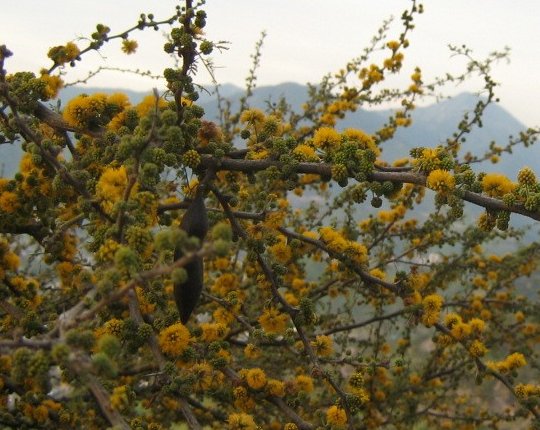
The gum arabic tree, Vachellia nilotica, is a medium-sized legume tree native to the arid regions of Africa, the Middle East, and the Indian subcontinent. It is distinguished by its dark, deeply fissured bark and bright yellow, spherical flower heads that appear in clusters.
While it is a primary source of gum in its native range, this species is often confused with the Senegal gum acacia (Senegalia senegal), which produces the higher-grade commercial gum used in food. This tree thrives in saline soils and is frequently used for land reclamation and erosion control in desert climates.
Key Facts
- Water: Low; drought-tolerant once established
- Soil: Prefers alkaline, sandy, or heavy clay
- Hardiness: USDA zones 9 to 11
- Growth Rate: Fast, up to 1 m (3 ft) per year
- Size: Reaches 5 to 20 m (16 to 66 ft) tall
Is the Gum Arabic Tree Right for Your Garden?
You should only plant this tree if you have ample space and a dry, frost-free climate. The gum arabic tree is a pioneer species that excels in poor, rocky, or saline soils where other trees struggle to survive. Its deep taproot allows it to find water far below the surface, making it suitable for xeriscaping.
Consider the physical impact of the tree before planting. It features long, sharp thorns that can reach 5 cm (2 in) in length, which makes it an effective security hedge but a hazard in high-traffic areas. It is widely used in India and Africa for silvopasture because the leaves and pods provide high-protein fodder for livestock.
Identifying Vachellia nilotica by Its Thorns and Flowers
Identify the gum arabic tree by its dark, deeply fissured bark and pairs of straight white thorns. The bark is typically blackish-grey or brown, often exuding a reddish gum when wounded. The thorns grow in pairs at the base of the leaves and are particularly prominent on younger branches.
The botanical features include:
- Leaves: Bipinnate and feathery, 4-15 cm (1.5-6 in) long with 3-10 pairs of pinnae.
- Flowers: Bright yellow globes, 1.2 cm (0.5 in) in diameter, growing on stalks from the leaf axils.
- Pods: Greyish-green and velvety, 7-15 cm (3-6 in) long, constricted between each seed like a string of beads.
- Seeds: Dark brown, flattened, and circular, with 8-15 seeds per pod.
How Big Does a Babul Tree Grow?
A mature Babul tree usually reaches 5 to 12 m (16 to 40 ft) in height, though some specimens in ideal conditions hit 20 m (66 ft). The canopy is often umbrella-shaped or rounded, providing dense shade in arid environments. The spread can be equal to or greater than the height, requiring a clearance of at least 6 m (20 ft) from buildings.
Growth is rapid during the first three to five years. In the Indian subcontinent, the tree develops a thick trunk that can reach 1 m (3 ft) in diameter. Because it is a nitrogen-fixer, the soil directly beneath the canopy often becomes more fertile over time, though the thorns may limit what you can plant underneath.
Choosing the Best Site for Planting
This species requires full sun and well-draining soil to prevent fungal infections. It is highly tolerant of alkaline conditions and can grow in soils with a pH as high as 9.0. While it survives in heavy clay, it grows most vigorously in alluvial soils near riverbanks or in sandy plains.
Avoid sites with high water tables or poor drainage, as the roots are susceptible to rot. The tree is salt-tolerant, making it a viable option for coastal regions in tropical climates. Ensure the site is far from underground pipes, as the aggressive taproot can cause structural damage during its search for moisture.
Planting from Seeds and Saplings
Soak seeds in boiling water for 30 seconds and then leave them in cool water for 24 hours to break dormancy. The seed coat is extremely hard and requires scarification to germinate successfully. Once soaked, sow the seeds 1 cm (0.4 in) deep in a mix of sand and compost.
Germination typically occurs within 7 to 21 days at temperatures of 25-30 °C (77-86 °F). When transplanting saplings:
- Wait until the sapling is 30 cm (12 in) tall.
- Dig a hole twice as wide as the root ball.
- Keep the root collar at the same level as the soil surface.
- Space trees 5 to 6 m (16 to 20 ft) apart for wood production or 2 m (6.5 ft) for hedges.
Watering and Feeding Requirements
Water young trees once a week during their first growing season to ensure the taproot establishes. Once the tree is three years old, it rarely requires supplemental watering except during extreme multi-year droughts. Overwatering is a common cause of death for this species in garden settings.
Fertilizer is generally unnecessary because the tree fixes its own nitrogen through a symbiotic relationship with Rhizobium bacteria. In very poor soils, you may apply a low-nitrogen, high-phosphorus fertilizer in early spring to encourage flowering. Avoid high-nitrogen fertilizers, which can lead to weak, lanky growth and reduced gum production.
Pruning for Wood and Shape
Prune the lower branches during the dormant winter season to encourage a clear trunk if you are growing the tree for timber. Removing lower limbs also makes it easier to walk near the tree without encountering thorns. Use sharp, sterilized loppers, as the wood is exceptionally hard and can dull blades quickly.
For hedge maintenance, prune the tips of the branches twice a year to encourage dense, bushy growth. If the canopy becomes too thick, thin out crossing branches to improve airflow and reduce the risk of powdery mildew. Always wear heavy leather gloves and long sleeves when handling this tree to protect against the 5 cm (2 in) spines.
Common Pests and Growth Problems
The most common issue is root rot caused by waterlogged soil, which leads to sudden leaf yellowing and dieback. In humid environments, the foliage may develop powdery mildew, appearing as a white dusty coating on the leaves. Increasing airflow through pruning and reducing overhead watering can mitigate these fungal problems.
Watch for these specific pests:
- Seed Borers: Beetles like Bruchidius species often infest the pods and eat the seeds.
- Stem Borers: Larvae can tunnel into the trunk, causing sap leakage and structural weakness.
- Scale Insects: Small, bumpy pests that suck sap from the stems, often followed by sooty mold.
- Termites: While the heartwood is resistant, young saplings can be attacked in very dry soils.
Protecting the Tree During Winter
Young trees require protection when temperatures drop below 0 °C (32 °F). While mature gum arabic trees can survive brief, light frosts, extended freezing temperatures will kill the saplings. In marginal climates, wrap the trunk in burlap and mulch the root zone heavily with 10 cm (4 in) of straw to retain heat.
If the tree suffers frost damage, do not prune the dead wood until late spring. The dead branches provide a small amount of insulation for the living tissue underneath during subsequent cold snaps. If the main stem dies back to the ground, the tree may resprout from the base in spring, as the root system is often hardier than the foliage.
Traditional and Industrial Uses of Gum Arabic
The wood is termite-resistant and has a density of approximately 830 kg/m³, making it excellent for tool handles, boat building, and railway sleepers. It is also a preferred fuelwood and charcoal source because it burns slowly with high heat. The bark contains high levels of tannins (12-20%) and was historically used for tanning leather.
The gum produced by Vachellia nilotica is known as ‘Babul gum’. While the food industry prefers gum from Senegalia senegal, Babul gum is traditionally used in India for making sweets and as a stabilizer in local inks and paints. The pods and bark have been traditionally used in various cultures to treat coughs and skin inflammations due to their astringent properties.
Year-Round Maintenance for Babul Trees
| Spring | Scarify and sow seeds once temperatures reach 25 °C (77 °F). Apply a light layer of compost to young saplings. |
|---|---|
| Summer | Water young trees weekly. Monitor pods for seed borer infestations and check for scale insects on new growth. |
| Autumn | Collect mature grey pods for seed harvesting. Reduce watering as growth slows down in preparation for cooler weather. |
| Winter | Prune lower branches for shape and wood quality. Protect saplings from frost using burlap wraps or frost blankets. |
Gum Arabic Tree Problems Explained
| What you see | Likely cause | What to do |
|---|---|---|
| Yellowing leaves and soft trunk base | Root rot from overwatering | Stop all watering immediately and ensure the soil has better drainage. |
| Holes in seed pods | Seed borer beetles | Harvest pods early and freeze them for 48 hours to kill larvae. |
| White dusty coating on leaves | Powdery mildew | Prune the canopy to increase airflow and avoid wetting the foliage. |
Common Subspecies of Vachellia nilotica
- subsp. ‘nilotica’ – the typical form found along the Nile river.
- subsp. ‘indica’ – common in India with slender, spreading branches.
- subsp. ‘adstringens’ – found in drier parts of Africa with wider pods.
- subsp. ‘tomentosa’ – features more densely hairy branchlets and pods.
Frequently Asked Questions
Is gum arabic tree sap edible?
Yes, the gum exuded from the bark is edible and is used as a natural stabilizer in foods, though it is considered lower quality than the gum from Senegalia senegal.
What is the botanical name for the Babul tree?
The current botanical name is Vachellia nilotica, though it was previously known as Acacia nilotica for many decades.
Is gum arabic natural?
Gum arabic is a 100% natural product, consisting of the dried sap harvested from the trunks and branches of Vachellia or Senegalia trees.
What are the benefits of Vachellia nilotica?
It provides durable, termite-resistant timber, high-protein fodder for livestock, tannins for leather work, and helps fix nitrogen in poor soils.
Does Vachellia nilotica contain DMT?
While some Acacia species contain psychoactive alkaloids, Vachellia nilotica is primarily known for its high tannin and mucilage content, with negligible amounts of DMT reported in most subspecies.
Information about traditional or historical uses is provided for educational interest only and is not medical advice. Do not use any plant to treat a condition without speaking to a qualified professional.
Sources & Verification
Taxonomy and distribution are checked against the databases below. Care guidance is written for cultivated species only and reviewed by our editor. How We Build Plant Profiles →