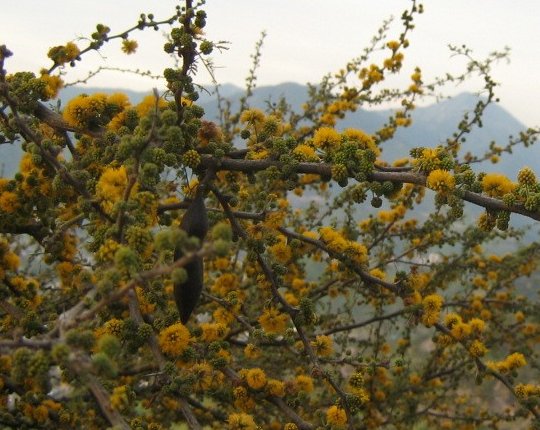
The Umbrella Thorn is a medium to large deciduous tree native to the savannas and deserts of Africa and the Middle East, scientifically known as Vachellia tortilis. It is most recognized for its wide, flat-topped canopy that provides essential shade in arid environments.
This species thrives in extreme heat and alkaline soils where most other trees fail. It produces distinctive spirally twisted pods that are a vital high-protein food source for livestock and wildlife during dry seasons.
Key Facts
- Height: Reaches 5–20 m (16–65 ft) at maturity
- Light: Requires full sun for healthy canopy development
- Water: Extremely drought-tolerant once roots are established
- Thorns: Features both long straight and short hooked thorns
- Hardiness: Minimum temperature of -1 °C (30 °F)
Is Umbrella Thorn Right for Your Landscape
Growing an Umbrella Thorn requires unrestricted full sun and a large amount of horizontal space. Because of its wide-spreading canopy, it is unsuitable for small suburban gardens or proximity to buildings. It is a specialist for xeriscaping and arid-land restoration projects.
The root system is deep and aggressive, searching for moisture in dry substrates. You should avoid planting it near drainage pipes or foundations. In the Middle East and parts of India, it is frequently used for sand dune stabilization due to its ability to fix nitrogen and survive in shifting sands.
How to Identify Vachellia tortilis
You can identify the Umbrella Thorn by its flat-topped crown and its unique combination of two different thorn types. The tree carries pairs of long, straight, white thorns alongside shorter, recurved, hooked thorns. This dual-thorn defense is a botanical adaptation against different types of browsing animals.
The leaves are bipinnately compound, typically 1.25–3.75 cm (0.5–1.5 in) long, with many tiny leaflets. Its flowers appear as cream or pale yellow globose heads, which eventually develop into the characteristic spirally twisted or curled seed pods. The bark on older specimens is rough and fissured, ranging from grey to dark brown.
Ideal Site Conditions and Soil
The Umbrella Thorn requires well-drained, alkaline soil with a pH between 7.0 and 8.5. It naturally occurs in areas with annual rainfall as low as 100 mm (4 in), but it can tolerate up to 1000 mm (39 in) if the drainage is perfect. It fails in heavy clay or waterlogged soils.
- Prefers sandy or rocky substrates
- Needs high light intensity for seedling survival
- Highly tolerant of saline conditions
- Fixes nitrogen, improving poor soil quality
Planting and Establishing Umbrella Thorn
To plant an Umbrella Thorn, you must scarify the seeds or soak them in hot water to break the hard outer coat. Without this treatment, germination can take months or fail entirely. Once pre-treated, sow seeds in a deep container to accommodate the rapid development of the taproot.
Transplant seedlings into the ground when they reach 30 cm (12 in) in height. Dig a hole twice as wide as the root ball and ensure the soil is not enriched with organic matter that retains too much moisture. Water the young tree weekly for the first year until its taproot reaches deeper groundwater levels.
Watering and Ongoing Care
Established Umbrella Thorn trees require no supplemental watering in most climates where they are hardy. Overwatering is the most common cause of failure in cultivated specimens, leading to root rot. If the leaves drop prematurely in summer, it may indicate extreme drought, but the tree usually recovers.
Fertilization is rarely necessary as Vachellia tortilis hosts nitrogen-fixing bacteria in its root nodules. In landscape settings, keep a 2 m (6.5 ft) radius around the trunk free of grass or competing weeds while the tree is young. This reduces competition for surface moisture during the brief rainy seasons.
Pruning and Vachellia tortilis Bonsai
Pruning should be limited to removing dead wood or shaping the canopy during the dormant winter period. Because the tree naturally forms an umbrella shape, heavy pruning is often counterproductive. Always wear thick leather gloves to protect against the sharp hooked thorns.
This species is a popular subject for bonsai, particularly in the “flat-top” style that mimics its natural savanna habit. Bonsai practitioners must use a very gritty, fast-draining mix and provide high-intensity grow lights if kept indoors. Wiring should be done carefully as the branches become brittle as they lignify.
Common Problems and Pests
The most significant threat to Umbrella Thorn seeds is the bruchid beetle (Bruchidius species), which bores into the pods. If you are collecting seeds for propagation, check for small exit holes. Infested seeds will not germinate and should be discarded immediately.
In humid climates, the tree may suffer from fungal leaf spots or powdery mildew. Ensure maximum airflow and avoid overhead irrigation to prevent these issues. Root rot (Phytophthora) occurs if the tree is planted in heavy soil or low-lying areas where water collects after rain.
Traditional Uses and Ecology
The Umbrella Thorn was traditionally used for its timber and medicinal bark in many African cultures. The wood is dense and hard, making it excellent for fuel and tool handles. The bark was historically boiled to create a decoction for treating coughs and gastrointestinal issues.
Ecologically, the tree is a keystone species. Its flowers are a major source of nectar for honey production, and the protein-rich pods are eaten by elephants, giraffes, and livestock. In Kenya, the Turkana people refer to the tree as Ewoi and value it for the shade and forage it provides in desert regions.
Annual Maintenance for Umbrella Thorn
| Spring | Sow scarified seeds in deep pots. Check established trees for new growth and ensure no standing water remains from winter rains. |
|---|---|
| Summer | Monitor young seedlings for water stress. Established trees require no care. Collect pods if seeds are needed for propagation. |
| Autumn | Reduce any supplemental watering. Prune dead or crossing branches to maintain the umbrella structure before dormancy. |
| Winter | Protect young trees from frost with burlap if temperatures are expected to drop below 0 °C (32 °F). Keep the root zone dry. |
Diagnosing Umbrella Thorn Problems
| What you see | Likely cause | What to do |
|---|---|---|
| Yellowing leaves and soft bark | Overwatering or poor drainage | Stop watering immediately and ensure the soil is not compacted. |
| Holes in seed pods | Bruchid beetle infestation | Discard affected seeds and store healthy seeds in airtight containers. |
| Slow growth or pale foliage | Insufficient sunlight | Move the plant or prune surrounding vegetation to provide full sun. |
Umbrella Thorn Subspecies
- subsp. ‘raddiana’ – more heat tolerant, often found in the Sahara
- subsp. ‘tortilis’ – the typical umbrella-shaped variety
- subsp. ‘spirocarpa’ – larger leaves and more pubescent pods
- subsp. ‘heteracantha’ – common in Southern Africa with very twisted pods
Frequently Asked Questions
How fast does Vachellia tortilis grow?
It is a slow-growing tree, typically putting on 15–30 cm (6–12 in) of height per year depending on water availability. In very arid conditions, growth may be even slower.
Is Umbrella Thorn honey good?
Yes, Umbrella Thorn honey is highly regarded for its distinct flavor and clarity, produced by bees visiting the cream-colored flowers in early summer. It is a major honey source in arid regions of Africa and the Middle East.
Can I grow Umbrella Thorn as a bonsai?
You can grow it as a bonsai, but it requires high light and precise watering. It is favored for its ability to mimic the classic African savanna tree shape in miniature.
What is the difference between Vachellia tortilis and Vachellia nilotica?
Umbrella Thorn (Vachellia tortilis) has a flat-topped canopy and twisted pods, whereas the Gum Arabic tree (Vachellia nilotica) has a more rounded crown and straight, beaded pods.
Is the Ewoi tree the same as Umbrella Thorn?
Yes, Ewoi is the common name used by the Turkana people in Kenya for Vachellia tortilis. It is a vital resource in their region for shade and livestock fodder.
Information about traditional or historical uses is provided for educational interest only and is not medical advice. Do not use any plant to treat a condition without speaking to a qualified professional.
Sources & Verification
Taxonomy and distribution are checked against the databases below. Care guidance is written for cultivated species only and reviewed by our editor. How We Build Plant Profiles →