
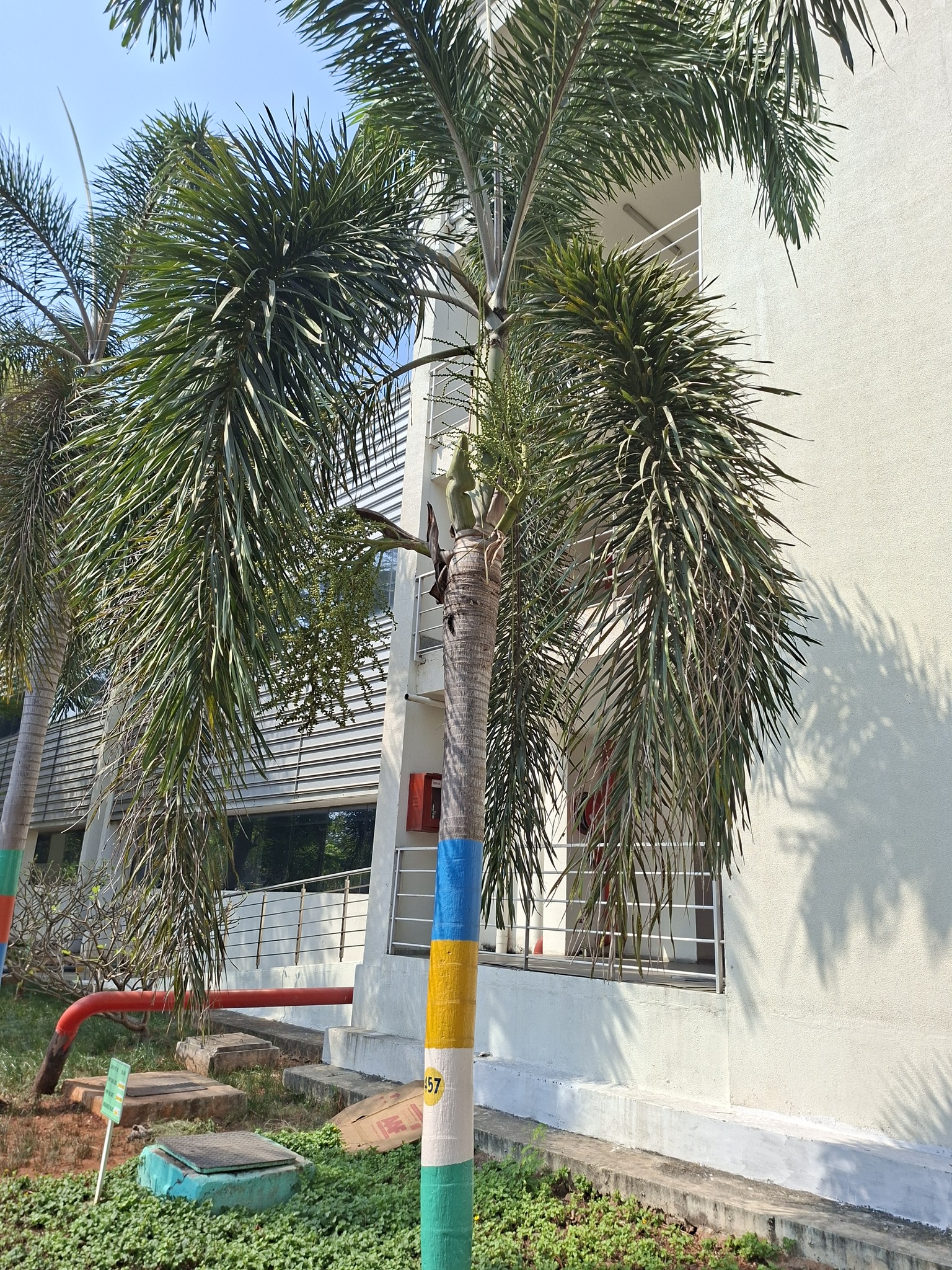
The Foxtail Palm is a solitary, medium-sized palm native exclusively to the rocky, granite hills of the Cape Melville Range in Queensland, Australia. Scientifically known as Wodyetia bifurcata, it is the only species in its genus and was unknown to the wider botanical world until 1978.
This species is a reliable choice for warm climates because it grows roughly 1 meter (3 feet) per year and features a self-cleaning habit. It is more drought-tolerant than the queen palm (Syagrus romanzoffiana) and handles wind better than many other tropical palms.
Key Facts
- Light: Full sun to very bright indirect light
- Water: Moderate; drought-tolerant once established
- Soil: Well-drained, sandy or loamy mixes
- Hardiness: USDA Zones 10-11; damaged below -1 °C (30 °F)
- Height: Reaches 10-12 m (33-40 ft) at maturity
Is the Foxtail Palm Right for Your Garden?
The Foxtail Palm is best suited for gardeners in tropical or subtropical climates who want a fast-growing focal point. It requires a location with plenty of vertical space, as the canopy can spread up to 4.5 m (15 ft) wide. Because it is a solitary palm, it does not produce suckers or clumps, making it a predictable choice for planting near walkways or pools.
You should choose this palm if you prefer low-maintenance plants, as the old fronds fall off on their own without the need for manual pruning. However, it is not suitable for regions with regular frost or hard freezes. In cooler areas, it can be kept in a large container for several years, though its growth will be significantly restricted.
- Best for USDA Zones 10 and 11
- Requires at least 6 hours of direct sun
- Needs protection from cold northern winds
- Suits large residential lots or commercial landscapes
Identifying the Foxtail Palm
The Foxtail Palm is identified by its plumose fronds, where the narrow leaflets radiate out from the leaf stem in all directions. This creates a rounded, bushy appearance similar to a fox’s tail, which distinguishes it from the flat fronds of a coconut palm (Cocos nucifera). A mature frond typically measures 2.5-3 m (8-10 ft) in length.
The trunk is light grey, smooth, and slightly swollen at the base or in the middle, resembling a spindle. It features distinct horizontal rings, which are scars left by former leaf attachments. Above the trunk sits a smooth, green crownshaft from which the 8-10 active fronds emerge.
- Leaflets: 15-45 cm (6-18 in) long, divided into segments
- Trunk: 25-40 cm (10-16 in) in diameter
- Crown: Typically holds 8 to 12 bushy fronds
- Habit: Strictly solitary and upright
How Tall Does a Foxtail Palm Tree Get?
A mature Foxtail Palm typically reaches a height of 10 to 12 meters (33 to 40 feet) in ideal tropical conditions. Under cultivation in suburban gardens, it often stays slightly shorter, topping out around 9 m (30 ft). It is considered a fast grower, often adding 60-90 cm (2-3 ft) of height annually during its first decade.
The spread of the canopy is roughly one-third of the total height, usually between 3 and 4.5 m (10-15 ft). Because the root system is relatively non-invasive, it can be planted within 2.5 m (8 ft) of a house or wall, provided the canopy has room to expand. If grown in a pot, the palm will rarely exceed 3 m (10 ft) due to root restriction.
Choosing the Best Planting Site
The Foxtail Palm must be planted in full sun to maintain its dense, bushy foliage. While it can tolerate partial shade when young, a lack of light will cause the fronds to stretch and become sparse. In coastal areas like Florida or Queensland, it shows high tolerance for salt spray, making it a viable choice for beachfront properties.
Soil drainage is the most critical factor for this species; it will fail in heavy clay or boggy soil. If your garden has poor drainage, plant the palm on a mound or in a raised bed. It thrives in slightly acidic to neutral soil (pH 6.0 to 7.0) and can struggle in highly alkaline soils where micronutrients like manganese become unavailable.
- Avoid low spots where water collects after rain
- Provide 3-5 meters of clearance from other large trees
- Choose a site sheltered from the strongest winter winds
- Ensure the site allows for the 4.5-meter canopy spread
How to Plant Foxtail Palm Seeds
Germinating Foxtail Palm seeds requires a consistent temperature of 30-35 °C (86-95 °F). You must use fresh, ripe seeds, which are identified by their orange-to-red outer husks. Remove the fleshy fruit completely before planting, as the pulp contains inhibitors that prevent germination and can cause skin irritation.
Soak the cleaned, woody seeds in warm water for 48 to 72 hours, changing the water daily. Plant them in a deep container filled with a mix of 50% peat moss and 50% perlite. Bury the seed so it is just barely covered by the substrate and keep the medium moist but never soggy. Germination usually occurs within 1 to 3 months.
- Use gloves when handling the red fruit pulp
- Apply bottom heat with a seedling mat for better results
- Transplant into a 3-liter (1-gallon) pot once the first leaf appears
- Expect a 50-80% success rate with fresh seeds
Watering and Feeding Requirements
Established Foxtail Palms need deep watering once per week during the dry season. While they are more drought-tolerant than the majestic palm (Ravenea rivularis), consistent moisture results in faster growth and greener fronds. For newly planted trees, water every 2-3 days for the first month to ensure the root ball does not dry out.
Fertilization is necessary to prevent common nutrient deficiencies in sandy soils. Use a slow-release palm fertilizer with an N-P-K ratio of 8-2-12 or similar, ensuring it contains magnesium and micronutrients like manganese and boron. Apply the fertilizer three times per year: in early spring, mid-summer, and early autumn.
- Apply fertilizer to the entire area under the canopy
- Keep mulch 15 cm (6 in) away from the trunk to prevent rot
- Water thoroughly after every fertilizer application
- Reduce watering by 50% during the winter months
How to Trim Foxtail Palm
You should only trim a Foxtail Palm when a frond is entirely brown and dead. This species is self-cleaning, meaning the old fronds will naturally detach and fall from the crownshaft without help. Trimming green or partially yellow fronds deprives the palm of stored nutrients and can stress the tree.
Never use climbing spikes to prune a palm, as the wounds in the trunk do not heal and provide entry points for diseases like Ganoderma. If a fallen frond gets stuck in the canopy, it can be gently pulled down, but avoid cutting into the green crownshaft. The fruit clusters can also be removed if you wish to prevent seedlings from sprouting or to reduce the mess on the ground.
Managing Pests and Diseases
The most serious threat to the Foxtail Palm is Ganoderma butt rot, a soil-borne fungus that causes the lower trunk to decay. There is no cure for this disease; infected trees must be removed and the site should not be replanted with another palm. You can identify it by the appearance of woody, shelf-like mushrooms (conks) at the base of the trunk.
Leaf spot fungi can occur during humid, rainy seasons, appearing as small brown lesions on the leaflets. This is usually aesthetic and rarely kills the tree, but it can be managed by improving air circulation. Pests like mealybugs or palm aphids may occasionally gather on the undersides of the leaflets, especially on indoor specimens or young plants.
- Potassium deficiency: Yellow or orange spotting on older fronds
- Boron deficiency: New leaves are small, crumpled, or fail to open
- Mealybugs: White, cottony masses in the leaf axils
- Spider mites: Fine webbing and bronzing of the foliage
Protecting Foxtail Palms from Freeze
Foxtail Palms will suffer significant foliage damage at temperatures below -1 °C (30 °F). If a freeze is predicted, you should wrap the trunk and the base of the crownshaft with burlap or frost blankets. For smaller palms, a temporary frame covered with cloth can trap heat from the ground, but avoid using plastic, which can trap moisture and cause rot.
If your palm is damaged by a freeze, do not prune the brown fronds immediately. Wait until the warm weather of spring returns to see if the central
Landscape Uses for Wodyetia bifurcata
The Foxtail Palm is most effective when planted in groups of three at varying heights to create a tiered tropical look. Because of its neat, symmetrical growth, it is frequently used as a street tree or to line long driveways. Its non-invasive roots make it safe for planting near sidewalks, patios, and underground utility lines.
In smaller gardens, it serves as an excellent specimen tree that provides light shade without completely blocking the sun for understory plants. It pairs well with low-growing tropicals like the bird of paradise (Strelitzia reginae) or colorful bromeliads. Its salt tolerance also makes it a staple for coastal landscapes where other palms might struggle with the air quality.
Year-Round Care for Foxtail Palms
| Spring | Apply a slow-release palm fertilizer with micronutrients. Increase watering frequency as new growth emerges and temperatures rise. |
|---|---|
| Summer | Check for pests like mealybugs during high humidity. Ensure deep watering once a week if rainfall is insufficient. |
| Autumn | Apply the final fertilizer dose of the year. Remove fallen fruit to prevent unwanted seedlings from sprouting in the garden. |
| Winter | Reduce watering to once every two weeks. Monitor weather for freeze warnings and have burlap or frost blankets ready for protection. |
Foxtail Palm Health Issues and Fixes
| What you see | Likely cause | What to do |
|---|---|---|
| Yellowing tips on old fronds | Potassium deficiency | Apply a high-potassium palm fertilizer (8-2-12) to the soil under the canopy. |
| New leaves are stunted and frizzled | Manganese or Boron deficiency | Check soil pH and apply a micronutrient drench if the pH is above 7.5. |
| Mushrooms growing at the base | Ganoderma butt rot | Remove the tree immediately as there is no cure and it may become unstable. |
| White cottony spots on leaves | Mealybugs | Spray the undersides of the fronds with insecticidal soap or neem oil. |
Frequently Asked Questions
Can foxtail palms grow indoors?
Yes, but they require very high light, such as a conservatory or a south-facing window. They will eventually outgrow most indoor spaces and must be transitioned to a very large pot or the ground.
Are foxtail palm fruits edible?
No, the fruits are not edible and contain calcium oxalate crystals that cause irritation. They are primarily grown for decoration or seed production.
How fast do foxtail palms grow?
In ideal tropical conditions, they grow quickly, adding about 60-90 cm (2-3 feet) of height per year. Growth slows significantly in cooler climates or when pot-bound.
Why are my foxtail palm leaves turning brown?
Brown leaves are usually part of the natural self-cleaning process if they are the oldest fronds. If the new growth is brown, it may indicate overwatering, root rot, or severe nutrient deficiency.
Is the foxtail palm messy?
They are considered low-mess because they are self-cleaning, though the large fallen fronds and heavy fruit clusters must be picked up from the ground periodically.
Sources & Verification
Taxonomy and distribution are checked against the databases below. Care guidance is written for cultivated species only and reviewed by our editor. How We Build Plant Profiles →