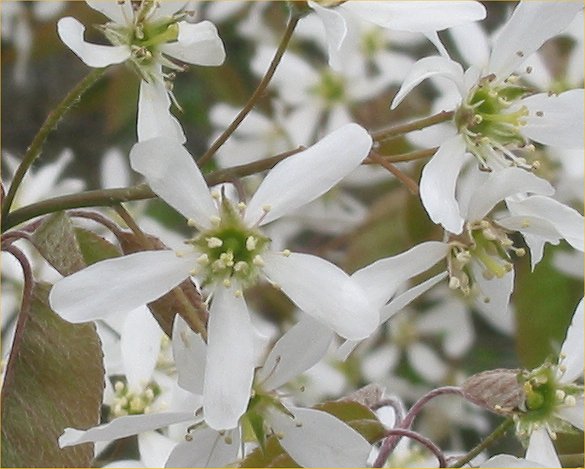
Juneberry (Amelanchier lamarckii) is a deciduous small tree or multi-stemmed shrub of North American origin, recognized by copper young leaves that emerge alongside five-petaled white flowers in spring. It produces clusters of sweet, dark purple pomes in early summer followed by intense orange autumn foliage.
This species requires slightly acidic to neutral soil and fails quickly on shallow, highly alkaline chalk where iron chlorosis turns the leaves yellow.
Key Facts
- Mature height: 4–6 m (13–20 ft) tall
- Fruiting month: June to July
- Light: Full sun to partial shade
- Soil pH: 5.5–7.0 (intolerant of shallow chalk)
- Water: Moderate; weekly in dry spells
- Hardiness: USDA zones 4–8 (hardy to -30 °C)
Is Juneberry Right for Your Garden?
Juneberry fits gardens looking for a compact multi-stem tree that provides four distinct seasons of display without outgrowing small boundaries. It tops out at a manageable height and creates light, dappled shade rather than dense shade.
You will succeed with this tree if your garden soil is moisture-retentive but well-drained. It suits courtyard borders, urban gardens, and wildlife screens because its root system is non-invasive and does not lift standard paving slabs.
Avoid planting this tree in:
- Shallow chalk soils where pH levels exceed 7.5
- Permanently waterlogged bogs or heavy, compacted clays without drainage
- Deep shade underneath mature forest canopies
Identifying Lamarck’s Serviceberry
Look for coppery-pink unfurling leaves that emerge simultaneously with loose racemes of snowy white, five-petaled flowers in April. Each flower measures 2–3 cm (0.8–1.2 in) across and bears linear, widely spaced petals.
Mature summer leaves are finely toothed, elliptical, and 4–8 cm (1.6–3.1 in) long, turning dull green on top with paler undersides. The smooth, silvery-grey bark develops thin, darker vertical fissures as the tree ages.
In late June, the green flower bases swell into spherical berries measuring 1 cm (0.4 in) across. These fruits progress from green to bright crimson before ripening to a deep purple-black coated with a light waxy bloom.
Mature Size and Growth Rate
Juneberry grows at a rate of 30–45 cm (12–18 in) per year until reaching its average mature height of 5 m (16 ft). It frequently forms a vase-shaped, multi-stemmed outline spreading 3–5 m (10–16 ft) across.
If trained as a clear-stem standard tree, the crown stays oval and narrow for the first 10 years before spreading. Multi-stem forms broaden earlier, sending up occasional basal shoots that widen the footprint.
Root depth reaches roughly 60–90 cm (24–35 in), spreading slightly beyond the perimeter of the drip line. This relatively shallow, fibrous root structure makes specimen trees straightforward to establish from rootballs or bare-root stock.
Sun and Soil Requirements for Juneberry
Plant Juneberry in full sun to partial shade with an acidic to neutral soil pH between 5.5 and 7.0. While flowering occurs in partial shade, autumn leaf colour and fruit yields peak when the crown receives at least 6 hours of direct sun daily.
The root system requires steady access to soil moisture through early summer while berries form. Sandy soils need organic amendments to hold water, while heavy clays should be worked with grit to avoid standing water around the crown.
If your soil turns hydrangea flowers pink, it may be too alkaline for this tree. In high-calcium soils, pair it instead with downy serviceberry (Amelanchier arborea) or common hawthorn (Crataegus monogyna), which tolerate chalk better.
When and How to Plant Juneberry
The best window to plant Juneberry is from November to March while the tree is dormant and bare-root specimens are available. Container-grown trees can go into the ground at any time from autumn through late spring, provided the soil is frost-free.
Follow these steps to establish the root system:
- Dig a square hole twice as wide as the root mass and equal in depth.
- Loosen the sides of the pit with a fork to allow lateral roots to penetrate.
- Position the tree so the root flare sits level with the surrounding soil surface.
- Backfill with native soil mixed with leaf mould, firming gently to remove air pockets.
- Stake low at a 45-degree angle on the windward side for the first 2 seasons.
- Apply a 7 cm (3 in) layer of composted pine bark, keeping the mulch 10 cm (4 in) clear of the stem.
Watering and Feeding Routine
Give young trees 15–20 litres (4–5 gal) of water weekly throughout their first two growing seasons whenever rainfall drops below 25 mm (1 in). Mature trees withstand short dry spells but need supplemental irrigation in hot summers to prevent berry shrivel.
Feed established trees annually in late March using a general, balanced slow-release fertiliser or an organic top-dressing of well-rotted farmyard manure. Avoid high-nitrogen feeds, which encourage sappy growth that is susceptible to fungal blights.
If foliage develops yellowing between green veins in midsummer, apply sequestered iron chelates around the root zone to correct the resulting nutrient lockout.
How to Prune Amelanchier lamarckii
Prune Juneberry lightly in late winter while dormant to preserve flower buds, which are set on the previous year’s growth. Heavy pruning is unnecessary and damages the natural, open vase-like structure of the branches.
Routine maintenance pruning requires only three targets:
- Remove crossing, rubbing, or dead branches right back to an outward-facing bud.
- Cut out low suckers if you want a clear single trunk.
- Thin out 1 or 2 of the oldest central stems on mature multi-stems every 3 years to let in light.
Never shear the top branches flat or practice pollarding on this species, as it produces unsightly water shoots that spoil the crown’s shape.
Common Pests and Diseases
The primary issue gardeners encounter is fireblight and cedar-apple rust, which can damage leaves and shoots during damp spring weather. Inspect the foliage and bark regularly to identify issues before they compromise tree vigour.
- Fireblight (Erwinia amylovora): Shoots blacken and bend into a shepherd’s crook; prune infected wood 30 cm (12 in) below the strike and burn the debris.
- Cedar-apple rust (Gymnosporangium species): Yellow-orange spots on the upper leaf surface; clear fallen leaves in autumn to disrupt the spore cycle.
- Powdery mildew: White powdery patches on young foliage in humid, stagnant air; thin crowded inner branches to improve airflow.
- Birds eating green fruit: Blackbirds and thrushes strip fruit crops; net bushes early in June if harvesting berries for the kitchen.
Winter Hardiness and Care
Juneberry survives sub-zero temperatures down to -30 °C (-22 °F) without requiring any artificial wrapping or shelter. Cold winter temperatures are necessary to break bud dormancy and trigger a synchronous spring blossom display.
Containerized specimens need protection against root-ball freezing. Wrap pots in bubble wrap or hessian if temperatures remain below -5 °C (23 °F) for extended stretches, or move containers against a sheltered house wall.
Snow loads rarely snap the flexible lateral branches. Brush off heavy, wet accumulations of snow from multi-stem crowns to prevent stems from splaying outward permanently.
Harvesting and Garden Uses
Pick the berries when they turn black-purple and yield to gentle pressure in late June or early July. The fruit tastes like a cross between a blueberry and a sweet cherry, with a subtle almond aftertaste derived from the soft, edible seeds.
Use the fruit fresh in pies, preserves, and baking, or freeze them on trays for later use. In landscaping, plant Juneberry alongside spring bulbs like wood anemone (Anemone nemorosa) or beneath larger trees like hazel (Corylus avellana) and crabapple (Malus sylvestris).
It makes an effective informal boundary screen when planted 1.5 m (5 ft) apart, filtering strong winds while feeding pollinating bees in April and birds in midsummer.
Frequently Asked Questions
What is a juneberry?
A juneberry is a deciduous shrub or small tree belonging to the genus Amelanchier within the rose family, known for white spring flowers, brilliant autumn foliage, and small, sweet edible purple fruits that ripen in June.
Is serviceberry the same as juneberry?
Yes, serviceberry and juneberry are common names for plants in the genus Amelanchier, with 'juneberry' specifically referring to their early-summer harvest window. Regional names also include shadbush, sugarplum, and saskatoon.
Why is Juneberry used in Red Bull?
Red Bull introduced a 'Juneberry' Summer Edition energy drink flavoured with the sweet, dark-berry taste of Amelanchier fruit, which resembles a blend of blueberry, red grape, and almond.
When should I plant a juneberry tree?
Plant bare-root juneberry trees between November and March during winter dormancy, or plant potted specimens in early autumn while the soil is warm and autumn rains assist root establishment.
Can you eat juneberries straight from the tree?
Yes, ripe dark purple juneberries are completely safe and sweet to eat fresh off the branch. While raw seeds contain trace amounts of cyanogenic glycosides, they cause no harm when eaten in normal culinary quantities.
Information about traditional or historical uses is provided for educational interest only and is not medical advice. Do not use any plant to treat a condition without speaking to a qualified professional.
Sources & Verification
Taxonomy and distribution are checked against the databases below. Care guidance is written for cultivated species only and reviewed by our editor. How We Build Plant Profiles →
- RHS PlantsMorphology, cultivation notes, and Award of Garden Merit confirmation
- Kew Plants of the World OnlineTaxonomic status and geographical distribution
- NC State Extension Gardener Plant ToolboxCultural needs, soil tolerances, and pest resistance
- GBIF — Global Biodiversity Information Facilitytaxonomy, synonyms, occurrence records
- Wikipediageneral reference