
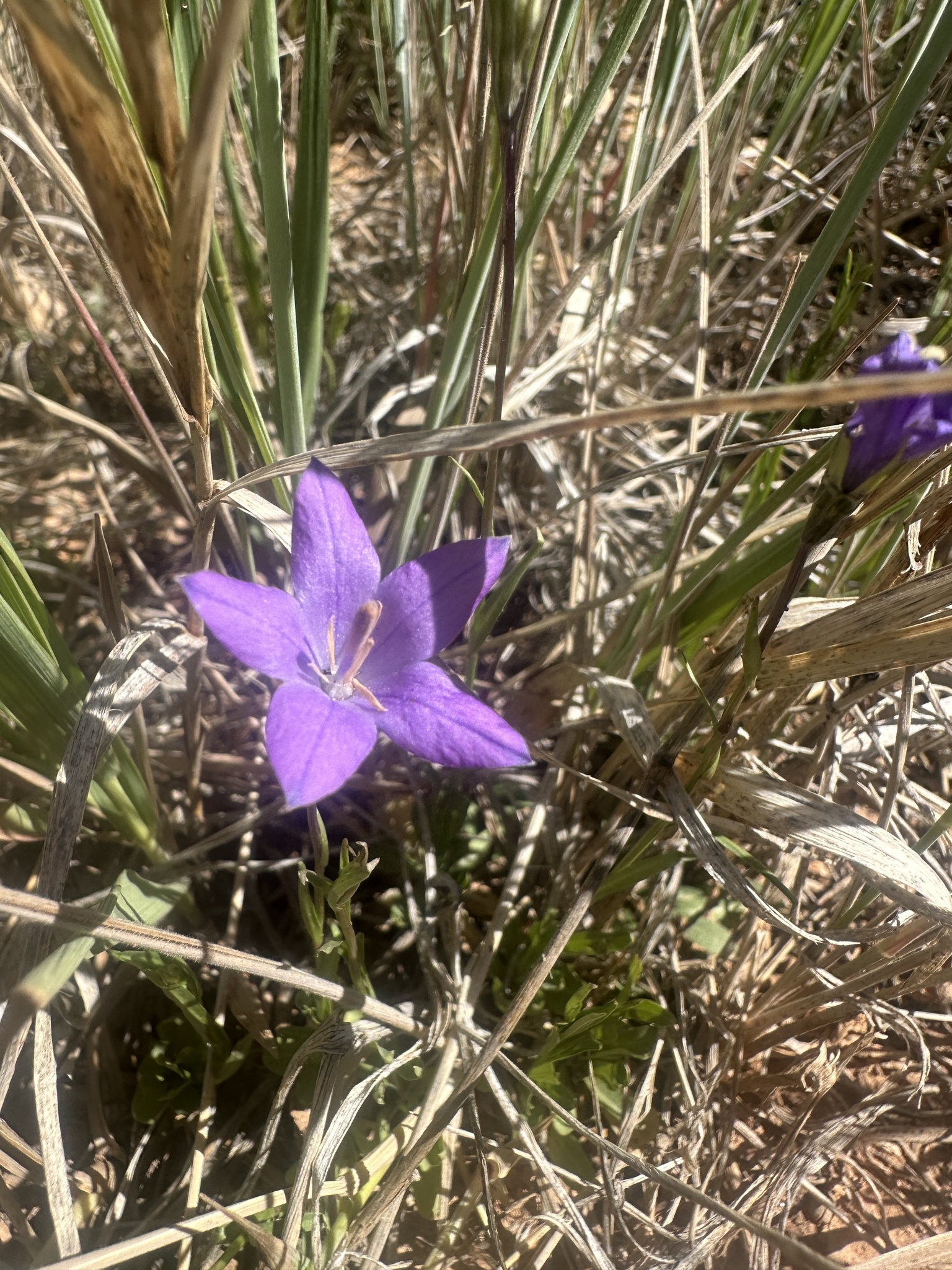
Parry’s bellflower (Campanula parryi) is a perennial wildflower native to subalpine meadows and moist pine woodlands of the southern Rocky Mountains. It is recognized by its slender stem bearing a solitary, upward-facing periwinkle blossom.
This species occurs in scattered patches across high-elevation habitats rather than forming dense colonies. Hikers typically observe it flowering between July and August along stream banks and damp slopes.
Key Facts
- Plant Type: Native herbaceous perennial
- Height: 5 to 30 cm (2 to 12 in)
- Bloom Time: July to August
- Flower Color: Periwinkle blue to deep purple
- Toxicity: Non-toxic to humans and pets
- Native Habitat: Montane and subalpine meadows
Understanding Parry’s Bellflower in the Wild
Parry’s bellflower thrives in moist, high-elevation environments where seasonal snowmelt supplies consistent soil moisture during early summer growth. It colonizes sunny openings within montane clearings where competing vegetation remains sparse.
Unlike spreading groundcover species, this plant grows as individual stems or small groups arising from slender rootstocks. Finding it requires looking closely along moist grassy benches and stream borders in subalpine regions.
How to Identify Campanula parryi
Parry’s bellflower reaches a height of 5 to 30 cm (2 to 12 in) with thin, unbranched stems and solitary upward-facing flowers. The blossoms measure 1.5 to 2.5 cm (0.6 to 1.0 in) across, featuring five petals fused into a wide bell shape with pointed, spreading lobes.
Key diagnostic features include:
- Leaves: Narrow, linear to narrowly lanceolate, measuring 2 to 6 cm (0.8 to 2.4 in) long with smooth or lightly toothed margins.
- Stems: Slender, erect, green to reddish, usually bearing a single terminal flower.
- Flowers: Solitary, periwinkle blue to violet-purple, pointing directly upward rather than nodding.
- Fruit: Small erect capsule opening by basal pores to release tiny seeds in autumn.
Native Habitat and Geographical Range
Parry’s bellflower occurs across the southern Rocky Mountain states at elevations between 2,100 and 3,400 m (7,000 and 11,000 ft). Its range includes Colorado, New Mexico, Utah, Arizona, and Wyoming.
The species inhabits open subalpine parks, moist ponderosa pine and lodgepole pine clearings, grassy tundra margins, and sunny gravel bars along mountain creeks. It requires full sunlight to partial shade combined with soils that retain moisture through early summer.
Ecological Role and Pollinators
The open bell shape of Parry’s bellflower provides accessible nectar and pollen for native montane bumblebees and solitary bees. Small butterflies and hoverflies also visit the upward-facing blooms during peak midsummer flowering.
Because it blooms when high-altitude insect activity peaks in July and August, it serves as a reliable food source for pollinators in upper montane ecosystems. The plant’s seeds are subsequently consumed by small high-altitude foraging birds and field mice.
Population Status and Environmental Threats
Parry’s bellflower maintains stable populations across its range, though it remains localized and sparse within suitable habitats. It is not currently listed as federally endangered or threatened in the United States.
Local pressures on populations stem primarily from environmental changes in subalpine zones:
- Hydrological changes: Earlier snowmelt reduces soil moisture during the summer blooming window.
- Trail disturbance: Severe foot traffic near mountain streams damages fragile root systems.
- Overgrazing: Heavy livestock or wild ungulate grazing in subalpine meadows reduces seed production.
Traditional Uses and Cultural Context
Indigenous peoples of the Rocky Mountain region traditionally utilized various native bellflower species for ethnobotanical applications. Roots of several Campanula species were occasionally harvested for traditional herbal preparations or as emergency forage.
Modern field botanists value Parry’s bellflower primarily as an indicator species for intact, high-quality subalpine meadow ecosystems. It is rarely cultivated in gardens due to its specialized alpine moisture and temperature requirements.
Distinguishing Parry’s Bellflower from Similar Species
Parry’s bellflower is distinguished from other native bellflowers by its single, upward-facing blossom and narrow linear leaves. Co-occurring members of the genus differ significantly in flower posture and foliage shape.
Compare with these native species:
- Harebell (Campanula rotundifolia): Displays multiple nodding, downward-curving flowers on branched stems with rounded basal leaves.
- Alpine bellflower (Campanula uniflora): Smaller plant under 10 cm (4 in) tall with a narrow, funnel-shaped dark blue flower found at higher alpine tundra elevations.
- Rough bellflower (Campanula scabrella): Features rough, finely hairy stems and leaves, adapted to drier, rocky ridges.
- Alaska bellflower (Campanula lasiocarpa): Has distinctly toothed leaf margins and a larger flower relative to its small stem size.
Frequently Asked Questions
Is Campanula parryi toxic to dogs, cats, or horses?
No, Parry's bellflower is non-toxic to dogs, cats, horses, and humans. Members of the genus Campanula contain no known systemic toxins harmful to domestic animals.
How long does Parry's bellflower bloom in the wild?
Parry's bellflower blooms for 3 to 5 weeks during mid to late summer, typically between July and August depending on elevation and snowmelt timing. Individual flowers remain open for about 5 to 8 days.
Where can you see Parry's bellflower in nature?
You can spot Parry's bellflower in high-elevation subalpine meadows, sunny streambanks, and moist pine woods across Colorado, New Mexico, Utah, Arizona, and Wyoming at elevations above 2,100 m (7,000 ft).
Can you grow Parry's bellflower in a home garden?
Parry's bellflower is difficult to cultivate outside its native montane climate because it requires cool summer temperatures, high light intensity, and damp, fast-draining alpine soil. It rarely thrives in hot lowland gardens.
Information about traditional or historical uses is provided for educational interest only and is not medical advice. Do not use any plant to treat a condition without speaking to a qualified professional.
Sources & Verification
Taxonomy and distribution are checked against the databases below. Care guidance is written for cultivated species only and reviewed by our editor. How We Build Plant Profiles →
- Global Biodiversity Information Facility (GBIF)Occurrence data and taxonomic status for Campanula parryi.
- USDA PLANTS DatabaseDistribution and native status in North American states.
- Flora of North AmericaBotanical description, leaf morphology, and elevation range.
- Plants of the World Online (Kew)accepted name, native range
- Wikipediageneral reference
More in Campanula
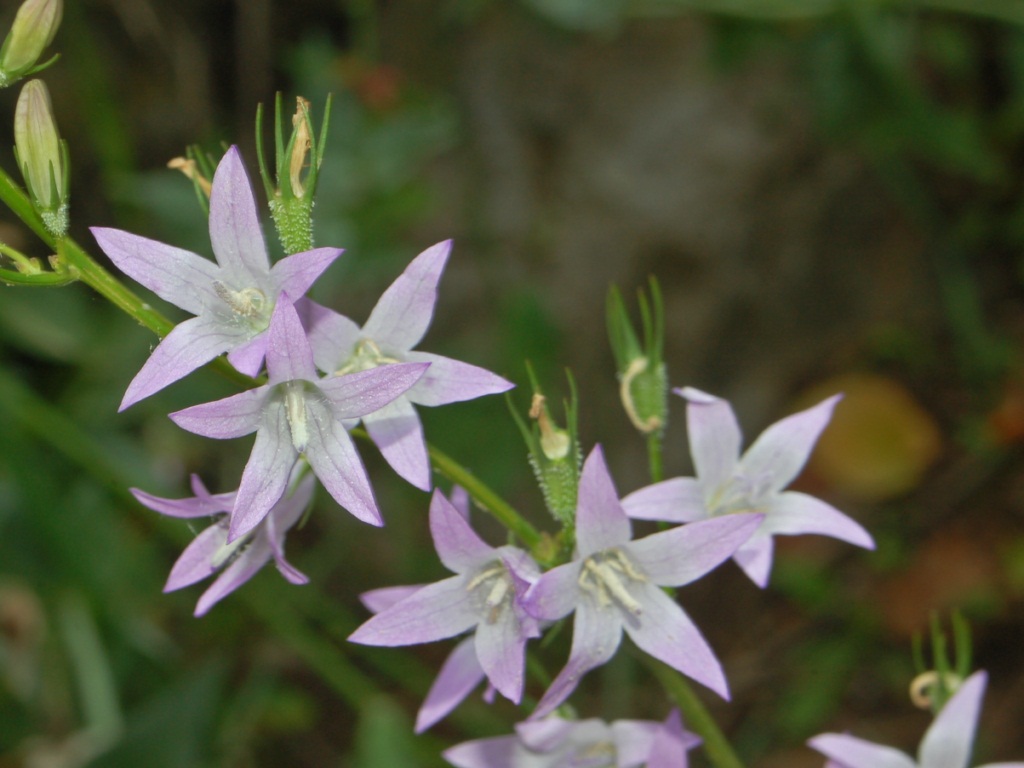
Rampion Bellflower
Campanula rapunculus
☀️ Full Sun 💧 Moderate

Carpathian Harebell
Campanula carpatica
☀️ Full Sun 💧 Moderate

Peach-Leaved Bellflower
Campanula persicifolia
☀️ Partial Sun 💧 Moderate

Canterbury Bells
Campanula medium
☀️ Partial Sun 💧 Moderate

Spotted Bellflower
Campanula punctata
☀️ Partial Sun 💧 Moderate