
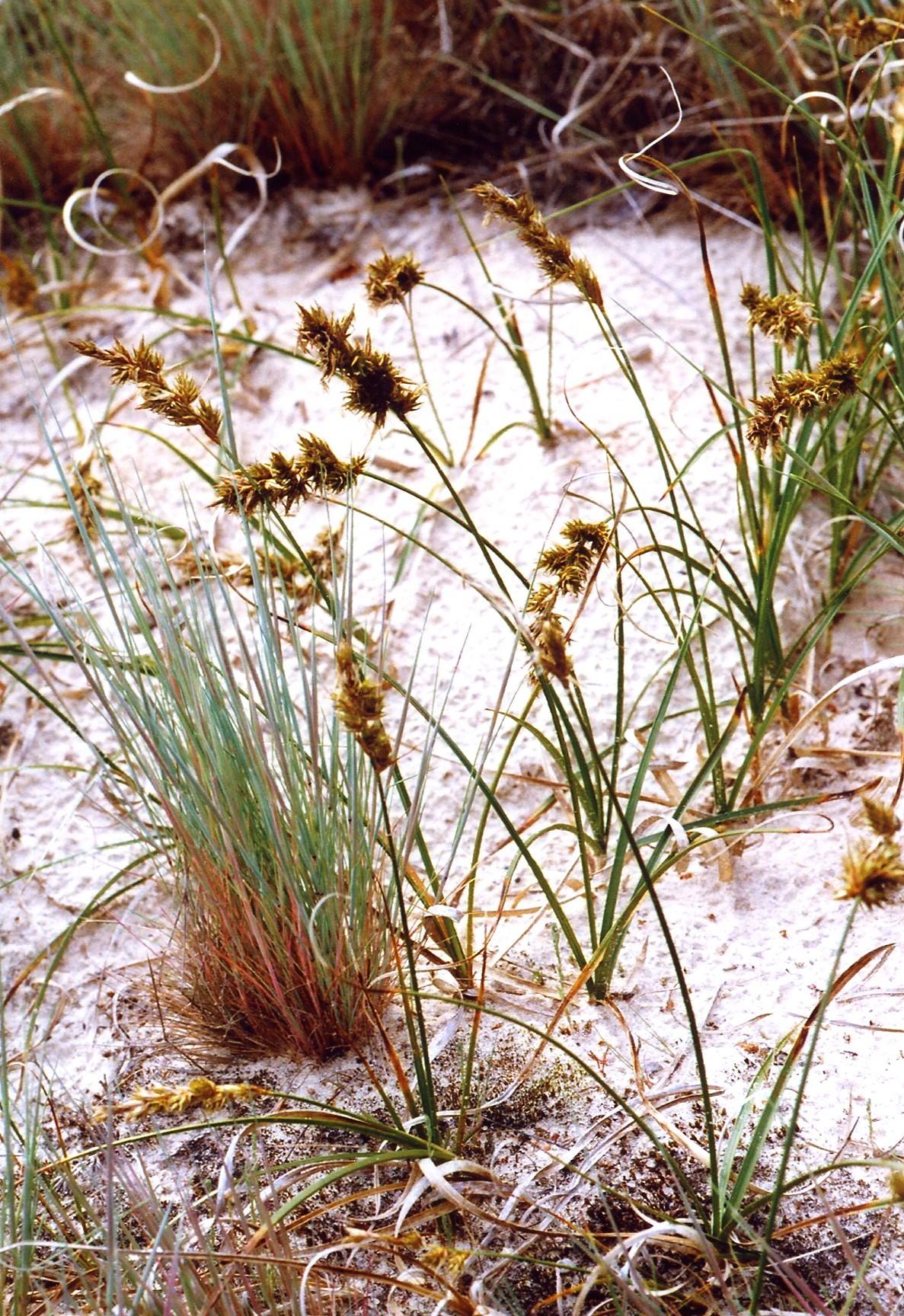
Sand sedge (Carex arenaria) is a perennial sedge native to European coastal dunes and sandy inland plains, recognized by its shoots that emerge in straight, soldier-like lines. It spreads through vigorous horizontal underground stems that weave through shifting substrate.
A single clonal network can travel more than 10 m (33 ft) across mobile sand, binding dunes where looser root structures wash or blow away.
Key Facts
- Plant type: Perennial rhizomatous wild sedge
- Native range: Coastal Europe, Baltic, North Sea
- Soil preference: Pure sand, acidic to neutral
- Key feature: Long horizontal rhizomes forming linear shoots
- Dune role: Pioneers and stabilizes shifting sands
- Stem shape: Solid and sharply triangular
Encountering Sand Sedge in Coastal Environments
Sand sedge stands out in maritime dunes by marching across bare ground in unbroken straight lines rather than forming rounded tufts or mounded cushions.
You will usually spot it in the semi-fixed transition zone known as yellow dunes, positioned just inland from primary marram grass colonies. As you walk the dunes, look for slender grass-like blades popping up every few centimetres in a tidy, ruler-straight row. This linear growth reveals the exact path of a subterranean runner tracking through the sand beneath your feet.
It withstands salt-laden sea gales, periodic sand burial, and sharp summer droughts that would wither inland grasses. The plant handles these extremes because its underground stem retains moisture and redistributes water between interconnected shoots across nutrient-poor sand.
How to Identify Carex arenaria
You can identify Carex arenaria by its triangular solid stems reaching 15–40 cm (6–16 in) tall and its strings of aerial shoots aligned along creeping horizontal rhizomes.
The leaves are stiff, slender, and measure 1.5–3 mm (0.06–0.12 in) wide. They curve outward toward the tips and feature fine, rough edges that feel abrasive if you rub your finger upward. Between May and July, flowering spikes form at the top of the stems, carrying dense, rusty brown, overlapping scales.
- Stems: Solid, sharply three-sided, rough to the touch along the upper corners.
- Shoots: Spaced evenly in clean lines, rarely clumping together.
- Flower spike: Slender and oblong, 2–5 cm (0.8–2 in) long, with male florets at the top and female florets at the base.
- Fruit (perigynium): Greenish-brown, strongly veined, flanked by distinct papery wings along the top half.
Where Sand Sedge Grows
Sand sedge grows primarily in well-drained coastal sand dunes, sandy heaths, and inland blowout plains across Northern and Western Europe.
It thrives best in coarse, loose sands where organic matter is almost non-existent. While its main strongholds are the North Sea and Baltic coastlines, ancient relict populations persist inland on post-glacial sandy heaths in Germany, the Netherlands, and Poland.
The plant cannot tolerate waterlogged soils, dense clay, or heavy tree shade. When succession causes shrubs or dense pine canopies to close overhead, sand sedge gradually declines and yields to shade-tolerant woodland species.
Ecological Role and Dune Stabilization
The tough, cord-like underground rhizomes of sand sedge play a major role in stabilizing shifting sand dunes against coastal wind erosion.
Its runners travel 5–20 cm (2–8 in) below the surface, developing a dense underground web. Deep adventitious roots drop downward from each node, anchoring the plant into damp subterranean sand layers while catching organic debris blown across the surface.
By knitting together loose sand grains, the species creates stable microhabitats. This groundwork allows mosses, lichens, and dune wildflowers like sea holly (Eryngium maritimum) and sand pansy (Viola tricolor subsp. curtisii) to establish in the anchored soil.
Growth Cycle and Perennial Habit
Sand sedge is a long-lived herbaceous perennial that remains anchored in the dune year after year through its cold-hardy underground rhizome.
Although upper foliage often turns pale straw-yellow during freezing winter weather, the underground nodes stay fully alive. In early spring, warmth triggers new upright green shoots from terminal buds along the runner, expanding the clone outwards by up to 1–2 m (3.3–6.6 ft) per year.
Older sections of the rhizome eventually break down after several seasons, naturally dividing large clones into independent daughter plants without stopping their continuous march across the open sand.
Traditional Herbal Uses and German-Sarsaparilla
In European folk medicine, the dried creeping rhizome of sand sedge was traditionally collected as German-sarsaparilla (Rhizoma Caricis) to prepare cleansing herbal teas and tonics.
Apothecaries historically prescribed decoctions of the root as a substitute for true tropical sarsaparilla (Smilax species) because both plants contain bitter saponins. It was traditionally used as a mild diuretic, a sweat-inducing remedy, and a treatment for gout, rheumatism, and chronic skin eruptions.
In German and Polish folk traditions, concentrated extracts were compounded into topical ointments known as Carex arenaria Salbe to soothe irritated skin. Modern herbalism rarely uses the plant, as current evidence of clinical efficacy is lacking.
Geographic Distribution and Conservation Status
Sand sedge holds a global conservation status of Least Concern (LC) on the IUCN Red List due to its large populations and wide range across coastal Europe.
Its native territory stretches from the Atlantic shores of Portugal and Spain, up through the British Isles and France, into southern Scandinavia, and east along the Baltic Sea. Introduced populations have also established in eastern North America, notably on coastal beaches in Massachusetts, Virginia, and Maryland.
While maritime populations remain widespread, inland populations in central European sand plains face threats from scrub encroachment, commercial pine forestry, and agricultural nitrogen deposition that encourages invasive grasses.
Distinguishing Sand Sedge from Similar Dune Plants
Sand sedge is easily distinguished from marram grass (Ammophila arenaria) by its solid triangular stems and low-growing, linear habit rather than tall, rounded tufts.
Several other grass-like plants share the same sandy habitats, but specific physical details set them apart:
- Marram grass (Ammophila arenaria): Hollow, round stems forming massive clumps up to 120 cm (47 in) tall with pale cylindrical flower heads.
- Early sedge (Carex praecox): Grows in inland dry pastures, stays under 20 cm (8 in) tall, and produces short curved rhizomes rather than straight lines.
- Brown sedge (Carex disticha): Prefers damp, marshy soils rather than dry shifting dunes, with longer flower heads up to 7 cm (2.8 in).
- Sand couch (Elymus farctus): A true grass featuring jointed stems, chalky blue-grey leaves, and flat, two-ranked seed spikes.
Frequently Asked Questions
Is Carex a perennial?
Yes, all species of Carex, including sand sedge (Carex arenaria), are perennials. They persist through multiple seasons using hardy rootstocks, rhizomes, or tussocks that regenerate fresh foliage every spring.
What is the common name of Carex arenaria?
The accepted English common name is sand sedge. In historical herbal literature, it is frequently recorded as German-sarsaparilla, while regional European names include Zandzegge in Dutch, Sand-Segge in German, and Turzyca piaskowa in Polish.
What was Carex arenaria Salbe traditionally used for?
Carex arenaria Salbe was an old Central European folk ointment formulated from the plant's saponin-rich rhizomes. It was traditionally applied topically to calm dry skin, rashes, and eczema, though it is not recognized as an approved pharmaceutical remedy today.
What are the common types of Carex?
The genus Carex includes over 2,000 distinct sedge species worldwide. Major ecological types include dune-stabilizing runners like sand sedge, ornamental shade tufts like Japanese sedge (Carex oshimensis), and wetland clump-formers like pendulous sedge (Carex pendula).
How does sand sedge spread across dunes?
Sand sedge spreads primarily by long horizontal underground stems called rhizomes that advance through the sand. These runners send up single-file aerial shoots every few centimetres, allowing the plant to rapidly colonize bare dunes.
Information about traditional or historical uses is provided for educational interest only and is not medical advice. Do not use any plant to treat a condition without speaking to a qualified professional.
Sources & Verification
Taxonomy and distribution are checked against the databases below. Care guidance is written for cultivated species only and reviewed by our editor. How We Build Plant Profiles →
More in Carex

Greater Tussock-Sedge
Carex paniculata
☀️ Partial Sun 💧 High

Carnation Sedge
Carex panicea

Cyperus Sedge
Carex pseudocyperus
☀️ Full Sun 💧 High

Mud Sedge
Carex limosa
💧 Aquatic

Japanese Sedge
Carex morrowii
☀️ Partial Shade 💧 High

Creeping Broad-Leaved Sedge
Carex siderosticta
☀️ Partial Shade 💧 High