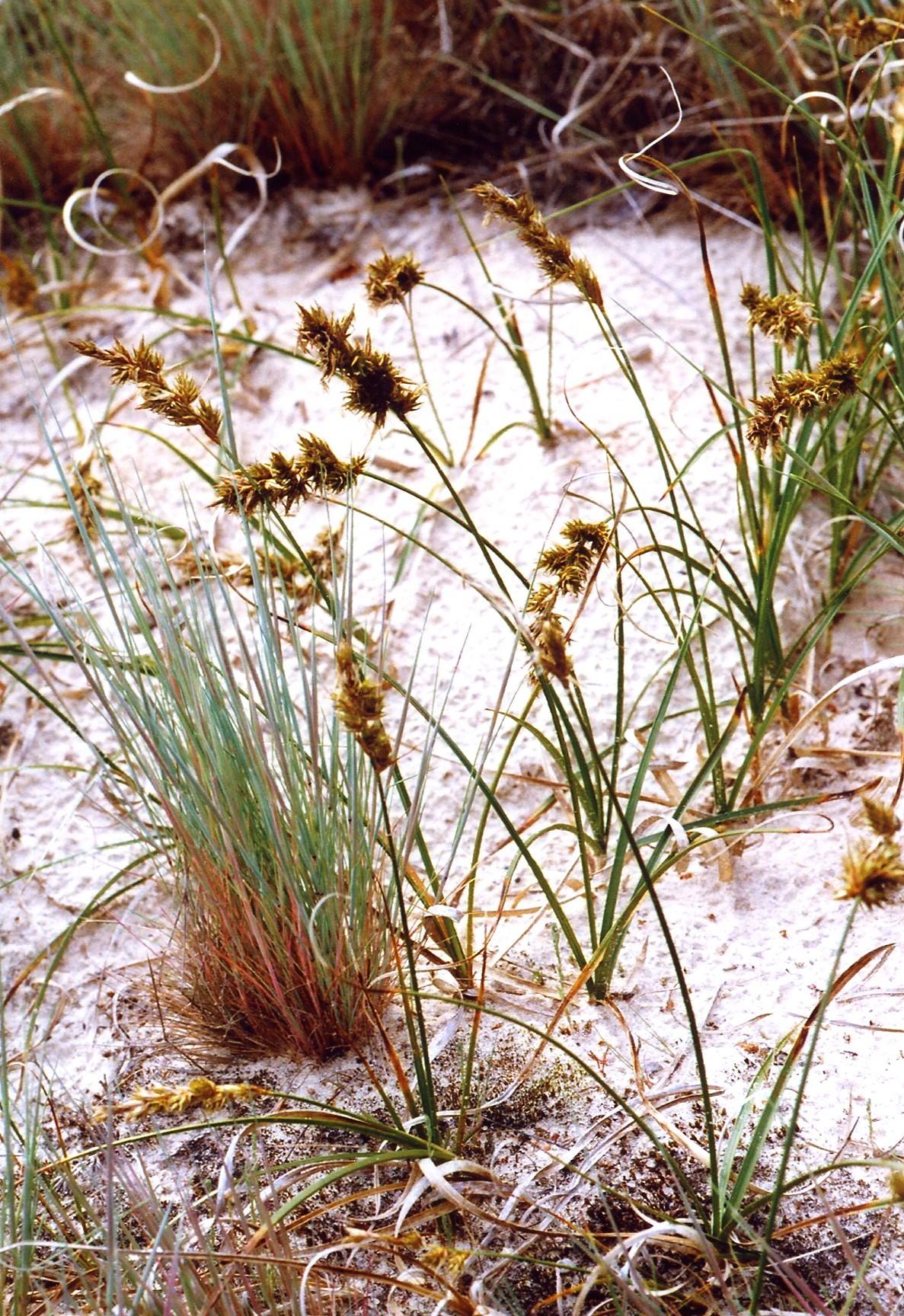
Bladder sedge is a perennial wetland species native to the Holarctic region, including North America, Europe, and Asia, where it grows in dense clumps. Known scientifically as Carex vesicaria, it is distinguished by its yellowish-green foliage and distinctive inflated fruit sacs that aid in water dispersal.
This species thrives in marshes and along lake margins where water levels fluctuate throughout the year. It is often confused with the bottle sedge (Carex rostrata), but it lacks the glaucous, blue-green leaf tone of its relative and features sharper-angled stems.
Key Facts
- Water: High (obligate wetland species)
- Light: Full sun to partial shade
- Habitat: Marshes, fens, and lake margins
- Height: 30-100 cm (1-3.3 ft)
- Bloom: Late spring to summer
- Hardiness: USDA zones 3 to 8
Where Bladder Sedge Grows Best
Bladder sedge is a clump-forming perennial that thrives in saturated soils and shallow standing water. It is most frequently found in boreal and temperate climates across the northern hemisphere, particularly in areas with acidic to neutral soil chemistry. Because it spreads via short rhizomes, it forms stable colonies that help stabilize shorelines against erosion.
In North America, this species is common in the Great Lakes region and throughout Canada. It requires a site that remains consistently wet, as it cannot tolerate prolonged drought or dry upland soils. It is often found growing alongside other wetland specialists like the common cattail (Typha latifolia).
- Prefers water depths of 0-15 cm (0-6 in)
- Thrives in organic-rich muck or silty soils
- Requires at least 4-6 hours of direct sunlight
- Found at elevations from sea level to 3,000 m (9,800 ft)
How to Identify Carex vesicaria
Bladder sedge is identified by its sharply triangular stems and its distinctive, inflated seed pods known as perigynia. The stems are typically 30-100 cm (1-3.3 ft) tall and feel rough to the touch just below the flower spikes. The leaves are yellowish-green, 3-8 mm (0.1-0.3 in) wide, and often feature a distinct M-shape in cross-section.
The flowering structure consists of 2-4 narrow male spikes at the top and 2-3 thicker female spikes below. The female spikes are 2-7 cm (0.8-2.8 in) long and contain the inflated perigynia, which are 4-8 mm (0.15-0.3 in) long. These sacs are shiny, yellowish-brown when mature, and taper abruptly to a short beak.
- Stems are strictly 3-angled and upright
- Leaves are longer than the flowering stems
- Perigynia are spaced loosely on the spike
- Roots are reddish-brown and fibrous
Natural Habitat and Wetland Indicator Status
The official wetland indicator status for bladder sedge is OBL (Obligate Wetland), meaning it almost always occurs in wetlands under natural conditions. It is a key component of fen and marsh communities where it occupies the transition zone between open water and drier ground. This species is highly adapted to seasonal flooding and can survive with its root system submerged for several months.
In Europe and Asia, it is a frequent member of the Magnocaricion alliance, which consists of large-sedge communities. It often grows in association with the water horsetail (Equisetum fluviatile) and the marsh cinquefoil (Comarum palustre). These habitats are characterized by high water tables and slow-moving or stagnant water.
Ecological Role in Wetland Ecosystems
Bladder sedge provides essential cover and nesting material for various wetland birds and amphibians. The dense clumps offer protection for waterfowl such as mallards and teals, while the submerged portions of the plant serve as a substrate for aquatic insects. The seeds are a minor food source for small mammals and some species of marsh-dwelling songbirds.
The plant also plays a role in nutrient cycling within its ecosystem. By absorbing nitrogen and phosphorus from the water and soil, it helps maintain water quality in sensitive fens and bogs. Its extensive root system prevents soil loss during heavy rain events or spring snowmelts.
- Provides habitat for the sedge warbler
- Host plant for several species of skipper butterflies
- Roots help filter heavy metals from runoff
- Decomposing leaves provide detritus for aquatic fungi
Historical and Traditional Uses of Bladder Sedge
Bladder sedge was traditionally used by the Sami people of Scandinavia to insulate footwear for winter travel. The dried leaves, known as ‘skohö’, were harvested in late summer, beaten until soft, and stuffed into boots to provide warmth and moisture-wicking properties. This practice was essential for survival in Arctic environments before the advent of modern synthetic insulation.
In North America, various indigenous groups used the long, tough leaves for basketry and weaving mats. The leaves were harvested, dried, and sometimes dyed to create functional containers. While not a primary food source, the plant was a vital material resource for communities living near large wetland complexes.
Similar Species and Distinguishing Features
Bladder sedge is most frequently confused with the bottle sedge (Carex rostrata), which shares a similar wetland habitat. You can tell them apart by looking at the leaves; the bottle sedge has glaucous, blue-green leaves that are channeled or U-shaped, whereas the bladder sedge has flat, yellowish-green leaves. Additionally, the stems of the bladder sedge are much sharper and more distinctly triangular.
Another similar species is the hop sedge (Carex lupulina), which has much larger, more crowded perigynia that can reach 10-20 mm (0.4-0.8 in) in length. The greater bladder sedge (Carex rhynchophysa) is also similar but features wider leaves, often exceeding 10 mm (0.4 in), and more numerous female spikes.
- Carex rostrata: Blue-green, narrow leaves
- Carex lupulina: Very large, hop-like spikes
- Carex rhynchophysa: Wider leaves and more spikes
- Carex utriculata: Similar but with more cylindrical spikes
Frequently Asked Questions
What is bladder sedge?
Bladder sedge is a perennial, grass-like wetland plant in the genus Carex, known for its inflated seed sacs that look like tiny bladders. It grows in clumps across the northern hemisphere and is an important species for wetland ecology.
What is the wetland indicator status of Carex vesicaria?
The wetland indicator status is OBL (Obligate Wetland), which means it is found in wetlands more than 99% of the time. It requires saturated soils and cannot survive in dry upland environments.
Is bladder sedge the same as the Carex brand?
No, Carex is a botanical genus containing over 2,000 species of sedges and is entirely unrelated to the healthcare and medical supply brand of the same name.
How do you tell bladder sedge from bottle sedge?
Bladder sedge has flat, yellowish-green leaves and sharply triangular stems, while bottle sedge (Carex rostrata) has blue-green, U-shaped leaves and more rounded stems.
What is bladder care in a botanical context?
In botany, 'bladder care' is not a standard term; the name refers to the inflated perigynia (seed sacs) of the plant, which are an evolutionary adaptation for seed dispersal via water.
Information about traditional or historical uses is provided for educational interest only and is not medical advice. Do not use any plant to treat a condition without speaking to a qualified professional.
Sources & Verification
Taxonomy and distribution are checked against the databases below. Care guidance is written for cultivated species only and reviewed by our editor. How We Build Plant Profiles →