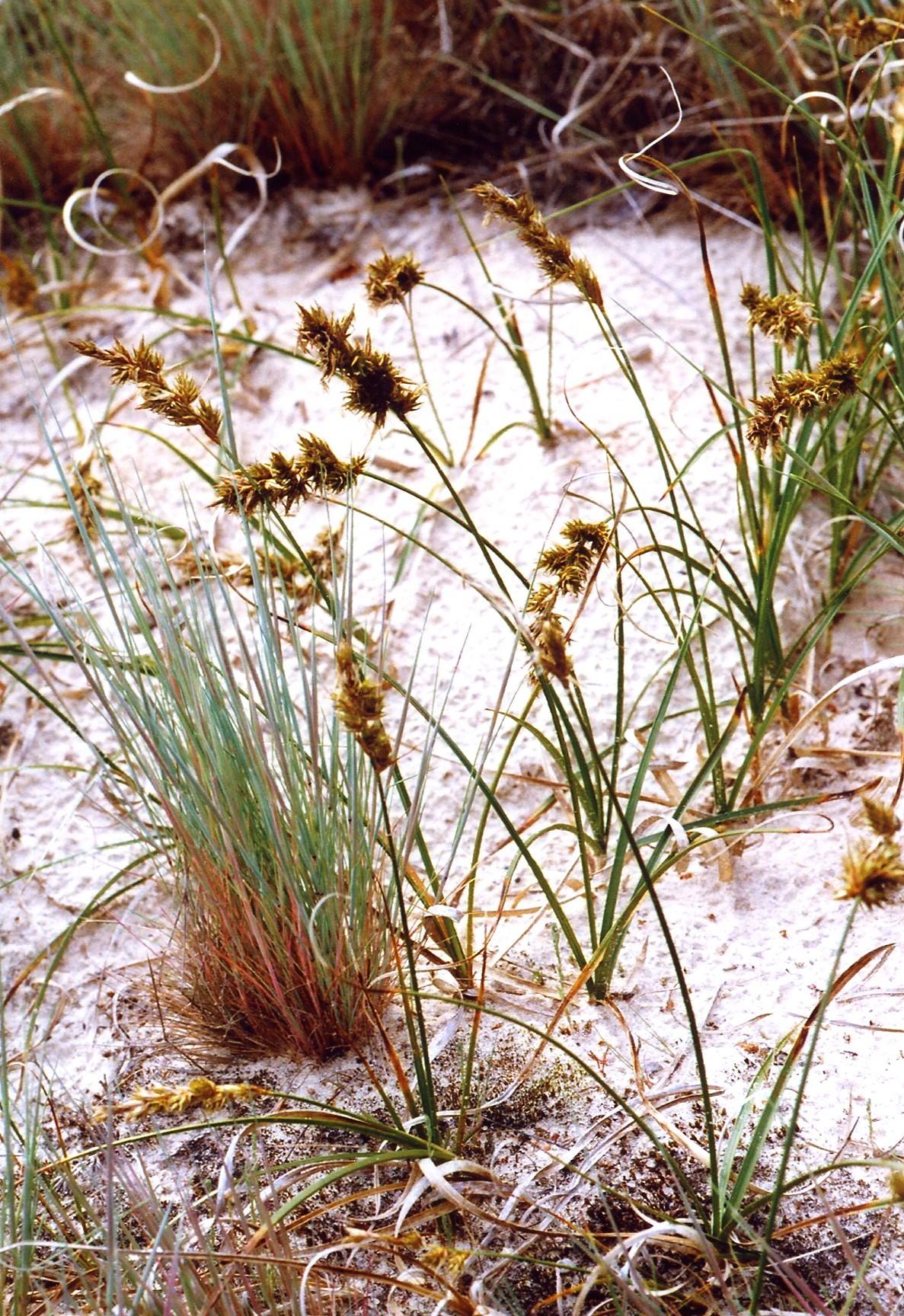
Tufted sedge (Carex elata) is a long-lived, perennial wetland sedge native to Europe, Turkey, Iran, and North Africa that forms substantial, raised foliage tussocks. It features narrow, arching, sharp-edged leaves and upright dark flowering spikes that emerge above marshy ground.
This plant requires permanent soil moisture or shallow standing water up to 8 cm (3 in) deep to thrive, collapsing rapidly if the root zone dries out completely during warm weather.
Key Facts
- Plant type: Deciduous herbaceous perennial sedge
- Water needs: Consistently wet, boggy soil or shallow water
- Light: Full sun to partial shade
- Mature size: 60–100 cm (24–40 in) tall and wide
- Hardiness: USDA Zones 5–9 (RHS H6)
- Bloom time: May to June
Growing Tufted Sedge in the Garden
Tufted sedge succeeds best in bog gardens, pond margins, and wet meadows where the ground never dries out. It forms structural tussocks over several seasons without spreading by invasive running runners.
The plant suits damp hollows and clay basins where conventional ornamental grasses rot from excess moisture. The cultivated golden form needs constant water to prevent leaf scorch in sunny borders.
- Requires constantly moist, muddy, or submerged ground
- Forms tidy, non-invasive clumps over time
- Tolerates water saturation where common grasses fail
- Reaches full mature size within 3 to 4 years
Tufted Sedge Botanical Identification and Form
Tufted sedge forms a dense, elevated pedestal tussock reaching 60 to 100 cm (24 to 40 in) in foliage height with a similar spread. The triangular stems bear glaucous-green, rough-keeled leaves measuring 4 to 6 mm (0.15 to 0.24 in) in width.
Lower leaf sheaths develop a distinct blackish-brown or reddish coloration that splits into a reticulated fibrous network against the tussock base. The leaf tips arch gently outward, creating an open fountain habit.
- Stem structure: sharply three-angled, rough to the touch near the top
- Leaf blades: linear, channelled, tapering to a fine point
- Base: dark, fibrous remnants forming woody tussocks up to 50 cm high in wild mires
- Root structure: dense fibrous rhizome system anchoring firmly into mud
Best Planting Site and Light Conditions
Situate tufted sedge in full sun to dappled partial shade where the soil maintains continuous saturation. In cool temperate climates, uninterrupted sun yields the brightest foliage colour on golden cultivars.
In hot regions with summer temperatures exceeding 30 °C (86 °F), provide midday shade to protect the leaf blades from drying out. Avoid open, dry ridges or freely draining sandy beds where moisture drops between rains.
- Full sun: provides the best yellow colour on variegated and gold forms
- Partial shade: protects wild-type blue-green foliage from intense heat
- Water depth: plants tolerate standing water from 0 to 8 cm (0 to 3 in) over the crown
- Wind exposure: leaves resist lashing winds along exposed pond banks
How to Plant Carex elata
Plant tufted sedge between March and May so roots establish in warming, saturated soil before summer heat. Space individual plants 60 to 75 cm (24 to 30 in) apart to give mature clumps room to arch.
Set the crown level with the natural soil surface or submerge it beneath no more than 5 to 8 cm (2 to 3 in) of water along pond shelves. Press the surrounding mud firmly around the root ball to eliminate trapped air pockets.
- Dig a planting hole twice the width of the container root system
- Incorporate leaf mould or pond soil into low-nutrient grit
- Firm wet soil around the crown to anchor the plant against floating
- Water thoroughly immediately after planting if setting into wet borders
Water and Fertilizer Requirements
Keep the soil consistently wet or flooded at all times throughout the active growing period. If planted in regular garden soil outside a pond shelf, apply 25 to 40 mm (1 to 1.5 in) of water weekly.
Tufted sedge demands minimal supplemental nutrition in rich organic soils or established pond silt. An excess of nitrogen fertilizer stimulates weak, sprawling foliage that collapses under wind.
- Water level: maintain shallow flooding or saturated mud from spring to autumn
- Container plants: set pots in water trays filled with 3 to 5 cm (1 to 2 in) of water
- Feeding: top-dress with composted leaf mould in early spring
- Fertilizer rate: avoid concentrated chemical fertilizers in natural ponds
Pruning and Cutting Back Tufted Sedge
Cut foliage down to 5 to 8 cm (2 to 3 in) above the crown in late winter or early spring before fresh shoots emerge. This clearing removes discoloured, weather-worn leaves and exposes new spring growth.
Use sharp hedge shears or hand pruners, as the fibrous stems and siliceous leaves dull blades quickly. Wear protective gardening gloves to prevent minor cuts from the serrated leaf margins.
- Timing: prune between February and early March in temperate zones
- Technique: bundle old leaves with one hand and shear across the base
- Safety: wear leather gloves to guard against sharp leaf blades
- Cleanup: clear debris away from the crown to let sunlight reach new buds
How to Propagate Carex elata
Propagate tufted sedge by crown division in mid-spring as active root growth restarts. Lift mature tussocks every 4 to 6 years when the center becomes hollow or overly congested.
Slice the tough, fibrous root clump into sections using a sharpened spade or garden axe. Ensure each division retains at least three healthy leaf shoots and a generous mass of roots.
- Lift the clump carefully with a spade to preserve deep root fibers
- Slice the woody root plate into 2 to 4 equal sections
- Discard dead or woody core sections from aged tussocks
- Replant divisions directly into saturated soil and keep flooded for two weeks
Pests, Diseases, and Browning Tips
Foliage browning on tufted sedge stems almost exclusively from soil dehydration or direct summer scorch rather than disease. If water levels drop, leaf margins turn straw-coloured and curl lengthwise.
The tufted sedge moth (Phragmatiphila nexa) uses the plant as a larval host in native European wetland habitats, though damage rarely threatens garden plants. Slugs and snails occasionally graze emerging spring foliage but rarely disfigure established clumps.
- Tip burn: increase water levels immediately to submerge the root zone
- Aphids: rinse colonies off flower spikes with a firm jet of pond water
- Rust fungus: thin congested clumps to improve air circulation around leaves
- Crown rot: ensure plants sit in standing water only during active growth, not stagnant freezing slush
Tufted Sedge Winter Hardiness and Protection
Tufted sedge is winter hardy down to -20 °C (-4 °F), matching USDA Zone 5 and RHS H6 ratings. The foliage naturally dies back or collapses into a straw-coloured mound that insulates the crown against freeze-thaw cycles.
Leave the dried top growth intact over the winter to protect the growing points from prolonged sub-zero winds. For container-grown plants set in shallow water basins, sink the pots deeper into the water line or shelter them from freezing solid.
- Hardiness rating: fully hardy across northern and central Europe and North America
- Crown insulation: retain old leaves until late winter to deflect frost
- Pond placement: lower shallow aquatic baskets beneath ice level if water freezes solid
- Container care: protect pots from freezing through in exposed courtyards
Carex elata Bloom Period and Flower Spikes
Tufted sedge blooms from May to June, producing upright cylindrical spikes that rise above or among the foliage. The inflorescence holds 1 to 3 male spikes at the terminal tip above 2 to 4 female spikes lower on the stem.
The female spikes are 3 to 7 cm (1.2 to 2.8 in) long, densely packed with dark brown or blackish glumes that contrast against bright green developing utricles. While grown primarily for its structural foliage, the dark flower heads provide distinct wetland character.
- Bloom time: mid-spring through early summer
- Male spikes: slender, erect, red-brown, shedding yellow pollen on the wind
- Female spikes: thick, cylindrical, held stiffly erect on short stalks
- Seed formation: small greenish-brown nutlets ripen by late July
Seasonal Tasks for Carex elata
| Spring | Cut back old, faded foliage to 5–8 cm (2–3 in) above the ground in March. Divide congested clumps every 4–5 years and top-dress garden beds with well-rotted leaf mould. |
|---|---|
| Summer | Maintain water levels so the crown stays submerged or the soil remains thoroughly saturated. Trim off spent flower spikes in July if a neat appearance is desired. |
| Autumn | Rake falling tree leaves off the crown to prevent smothering in stagnant water. Ensure pond margins remain hydrated before the ground freezes. |
| Winter | Leave dead foliage standing to protect the crown from frost and cold winds. Lower shallow potted specimens into deeper water if pond surfaces freeze solid. |
Troubleshooting Common Tufted Sedge Problems
| What you see | Likely cause | What to do |
|---|---|---|
| Leaf tips turn brown and crispy | Soil moisture deficit or hot, dry winds | Raise water levels to submerge the root crown or move container to a shaded, wind-sheltered spot. |
| Golden leaves turn dull green | Excessive shade or excessive nitrogen fertilizer | Move the plant into brighter sunlight and stop applying high-nitrogen plant foods. |
| Clump dies out in the center | Tussock congestion in aged clumps | Lift the plant in spring, discard the woody core, and replant outer divisions. |
| Foliage collapses and rots at soil level | Stagnant, deoxygenated mud combined with winter freezing | Improve water flow around roots and cut away decaying foliage in early spring. |
Tufted Sedge Cultivars
- ‘Aurea’ (Bowles’ Golden Sedge) – bright yellow foliage with fine green margins
- ‘Knightshayes’ – clear golden leaves that hold color throughout summer
Companion Plants for Carex elata
Pair tufted sedge with broad-leaved wetland perennials such as marsh marigold (Caltha palustris) and yellow flag iris (Iris pseudacorus). The fine, grassy texture of the sedge balances the bold foliage of water-loving plants.
For striking foliage contrasts in bog borders, combine it with royal fern (Osmunda regalis) and purple loosestrife (Lythrum salicaria). Its arching form also works well alongside moisture-loving rushes like soft rush (Juncus effusus).
- Caltha palustris: bright yellow early flowers against emerging sedge leaves
- Iris pseudacorus: upright sword-like foliage creating vertical contrast
- Osmunda regalis: large, coarse-textured fronds bordering pond banks
- Lythrum salicaria: tall purple spikes blooming as sedge flower heads mature
- Juncus effusus: round, structural green stems complementing weeping sedge blades
Frequently Asked Questions
What is the difference between tufted sedge and slender tufted sedge?
Tufted sedge (Carex elata) forms massive, high, stationary tussocks with stiff upright flower spikes, while slender tufted sedge (Carex acuta) spreads via creeping rhizomes and produces nodding female spikes.
How tall does Carex elata 'Aurea' grow?
Bowles' Golden Sedge typically reaches 60 to 75 cm (24 to 30 in) in height with an equal spread. It grows slightly more compactly than the wild green species.
Can tufted sedge grow fully submerged in a garden pond?
No, tufted sedge cannot grow completely submerged. It thrives with its roots in water, but the crown should be positioned in water no deeper than 8 cm (3 in) below the surface.
What is the tufted sedge moth?
The tufted sedge moth (Phragmatiphila nexa) is a nocturnal noctuid moth native to European fens whose caterpillars feed within the stems of Carex elata and related wetland sedges.
What is the native range of Carex elata?
Tufted sedge is native to most of Europe, extending eastward to Turkey, Iran, and Central Asia, as well as parts of the Atlas Mountains in North Africa, where it inhabits lake shores, fens, and floodplain marshes.
Sources & Verification
Taxonomy and distribution are checked against the databases below. Care guidance is written for cultivated species only and reviewed by our editor. How We Build Plant Profiles →
- Kew Plants of the World OnlineTaxonomic status and native distribution details.
- Royal Horticultural SocietyAward of Garden Merit details, hardiness ratings, and cultivation requirements.
- Missouri Botanical GardenGrowth habits, wet soil preferences, and cultural notes.
- GBIFOccurrence data and ecological range verification.
- Wikipediageneral reference