
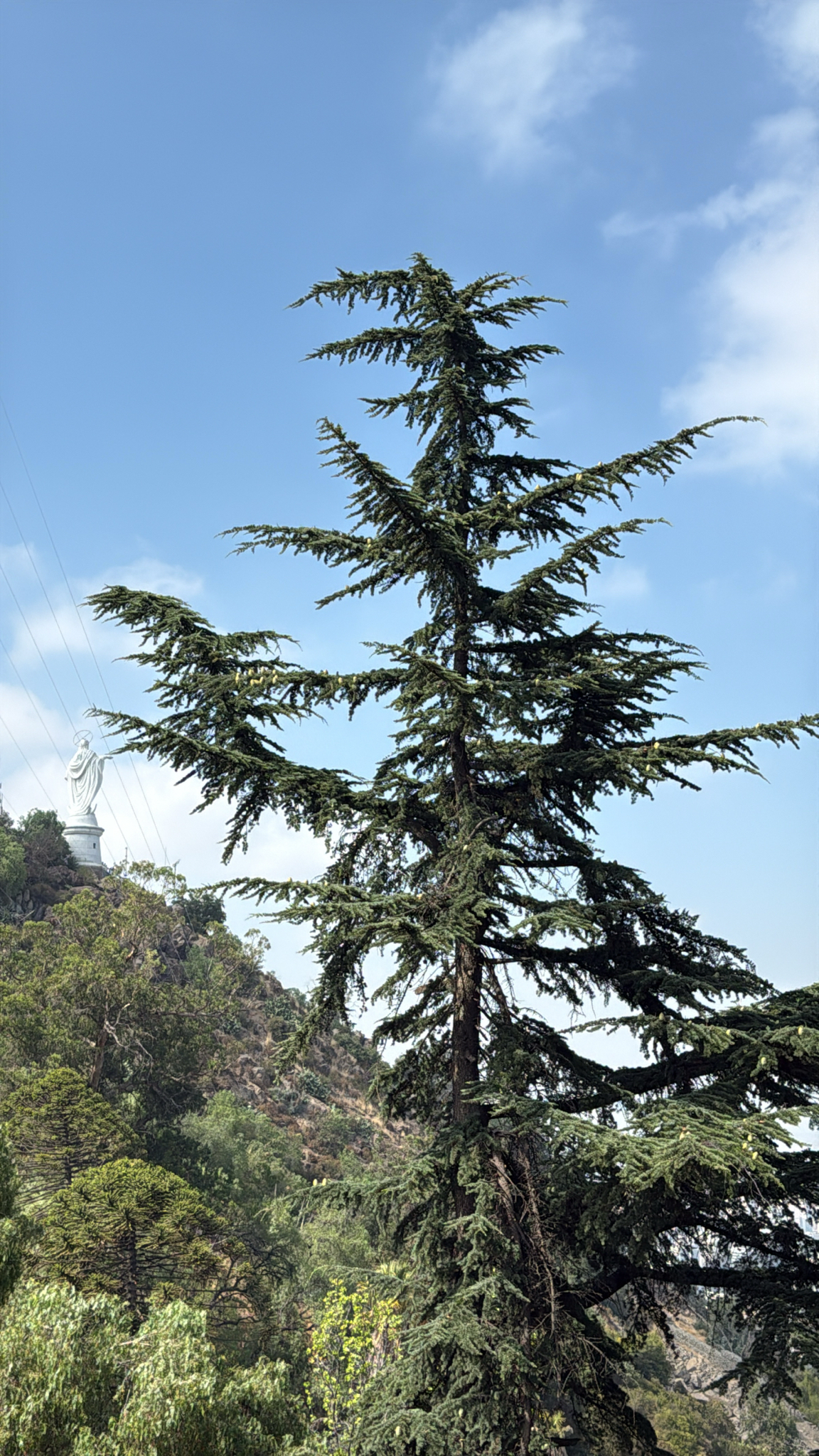
Deodar cedar (Cedrus deodara) is a massive evergreen conifer native to the western Himalayas, characterised by pendulous branch tips and fine needle clusters. Mature trees develop a pyramidal canopy that flattens across the top after several decades.
This species requires substantial ground space and will quickly overwhelm residential lots smaller than half an acre. In wet clay soils, young specimens suffer root rot and blow over in heavy wind.
Key Facts
- Growth rate: 60 to 90 cm (24 to 36 in) annually
- Mature height: 15 to 25 m (50 to 80 ft)
- Soil requirement: Deep, sharp-draining loam or sand
- Light: Full sun (minimum 6 hours daily)
- Hardiness: USDA Zones 7 through 9
- Foliage: Evergreen needles 2.5 to 5 cm (1 to 2 in)
Is Deodar Cedar Right for Your Yard?
Deodar cedar suits large open landscapes with at least 10 m (33 ft) of clearance away from structures and overhead power lines. A standard suburban front yard cannot sustain its spreading base, which routinely reaches 9 to 12 m (30 to 40 ft) in diameter.
Consider these pros and cons before planting:
- Pros: Exceptional drought tolerance once established, rapid annual canopy development, and fine aromatic wood naturally resistant to rot.
- Cons: Heavy needle cast smothers turf beneath the canopy, brittle branch wood breaks under heavy wet snow, and dense surface roots prevent lawn grass growth.
How to Identify Deodar Cedar
Deodar cedar is recognised by drooping branch tips and barrel-shaped upright cones that perch on top of horizontal branches. Unlike pines, needles emerge in dense whorls of 20 to 30 from short woody pegs along the mature stems.
Key diagnostic features include:
- Needles: Slender, soft needles measuring 2.5 to 5 cm (1 to 2 in) long, varying from bright green to blue-green.
- Cones: Female seed cones measure 7 to 10 cm (3 to 4 in) tall, starting green or purplish before turning reddish-brown and disintegrating on the branch at maturity.
- Leader stem: The central top shoot consistently nods or droops horizontally, unlike the rigid upright leader of Atlas cedar (Cedrus atlantica).
- Bark: Dark grey, smooth on young saplings, developing shallow fissures and scaly plates with age.
How Big Does a Deodar Cedar Get?
In cultivated landscapes, deodar cedar reaches 15 to 25 m (50 to 80 ft) tall and 9 to 12 m (30 to 40 ft) wide. In its native Himalayan range at elevations between 1,500 and 3,200 m (4,900 to 10,500 ft), wild trees reach heights exceeding 50 m (160 ft).
Young trees put on 60 to 90 cm (24 to 36 in) of vertical growth per year under full sun. This fast early pace continues for approximately 20 years before vertical progress slows and the crown broadens into a wide, flat-topped silhouette.
Best Soil and Sunlight Requirements
Plant deodar cedar in an open spot that receives at least 6 to 8 hours of direct sun every day. Shaded trees thin out rapidly, develop sparse lower limbs, and tilt toward available light.
Soil drainage determines survival:
- Texture: Porous loamy sand, gravelly slope soil, or rocky loam; dense, compacted clay holds too much standing water.
- Soil pH: Accepts a range between 6.0 and 7.5, performing well in mildly acidic to neutral soils.
- Drainage test: Dig a 30 cm (12 in) hole and fill it with water; the water must fully drain away within 2 hours.
How to Plant Deodar Cedar
Plant container-grown or balled-and-burlapped saplings in autumn to allow root establishment before summer heat. Dig a planting hole two to three times the width of the root ball, keeping the depth slightly shallower than the root mass itself.
Follow these planting steps:
- Position the root flare 2.5 to 5 cm (1 to 2 in) above the surrounding grade to avoid settling in wet soil.
- Slice through any circling root tips on container stock to redirect growth outward.
- Backfill using the native soil without adding rich compost or peat moss, which discourages root spread.
- Apply a 7 to 10 cm (3 to 4 in) layer of wood chips around the base, pulling it 15 cm (6 in) back from the trunk.
- Stake young trees loosely for only one growing season if planted in high-wind sites.
Deodar Cedar Care: Watering and Feeding
Water young trees with 38 litres (10 gal) of water weekly throughout their first two growing seasons whenever rainfall drops below 2.5 cm (1 in). Mature trees rarely require supplemental irrigation except during severe summer droughts.
Established trees do not need regular fertilizer applications. A top-dressing of organic compost applied within the drip line in early spring provides sufficient nitrogen without pushing soft, weak growth that snaps in windstorms.
How to Prune Deodar Cedar
Prune only in late winter while the tree remains dormant, removing dead, crossed, or diseased branches. Avoid cutting back terminal shoots on horizontal side branches, as this destroys the characteristic weeping habit.
Pruning guidelines:
- Never remove the central leader; cutting the top leads to multiple competing trunks that split under snow loads.
- Leave lower limbs intact to the ground for as long as possible to preserve the natural pyramidal shape.
- Clear broken storm debris with clean bypass loppers flush to the outside of the branch collar.
Pests, Diseases, and Tree Problems
The most destructive disease affecting this species is root rot caused by Phytophthora or honey fungus (Armillaria) in waterlogged soils. Symptoms appear as yellowing needles, widespread canopy dieback, and bark weeping resin near ground level.
Common pests and ailments to monitor:
- Giant conifer aphids: Clusters feed on twigs in spring, coating lower foliage with honeydew and black sooty mould; rinse off with strong water sprays.
- Sirococcus blight: Causes tip dieback and needle drop on new spring shoots during cool, wet weather; prune out diseased tips.
- Bagworms: Caterpillars construct spindle-shaped silk bags and strip needles; pick bags by hand in winter or spray Bacillus thuringiensis in late spring.
- Yellow needles: Common on inner foliage each autumn as older leaves naturally shed after three to four years.
Winter Hardiness and Cold Protection
Deodar cedar survives minimum temperatures down to -15 °C (5 °F) without damage, placing it securely in USDA Hardiness Zones 7 to 9. Prolonged cold spells below -18 °C (0 °F) scorch foliage and kill unhardened terminal shoots.
Heavy snowfall poses the greatest winter hazard. The wide, horizontal branches catch snow and snap easily; gently brush heavy snow accumulation off lower branches using an upward sweeping broom motion before it freezes solid.
Landscape Uses, Timber, and Bonsai
Deodar cedar serves primarily as a large specimen shade tree in public parks and expansive estates. Because of its spreading skirt of lower foliage, it also acts as a visual screen and windbreak on agricultural acreages.
Specialised uses include:
- Timber: Fine-grained, rot-resistant, and insect-repellent heartwood traditionally used in northern India for bridge building, railway sleepers, and temple construction.
- Bonsai: Trained into formal upright, slanting, or cascade styles; wire pliable young branches in late autumn and protect shallow root trays from winter frost below 0 °C (32 °F).
- Aromatherapy and oils: Distilled cedarwood oil extracted from wood waste is used in insect repellents and perfumery.
Seasonal Tasks for Deodar Cedar
| Spring | Inspect tips for aphids and bagworm larvae as new needles emerge. Apply a 5 cm (2 in) mulch ring around young trees, keeping it clear of the trunk. |
|---|---|
| Summer | Provide 38 litres (10 gal) of deep water every two weeks to newly planted trees during prolonged dry spells. Check for drought stress on saplings. |
| Autumn | Rake inner needle fall if turf smothering is a concern, or leave as natural mulch. Sow fresh seed cones after collecting them from branches. |
| Winter | Prune out dead, damaged, or storm-broken limbs while the tree is fully dormant. Brush heavy snow loads off horizontal branches to prevent snapping. |
Diagnosing Common Deodar Cedar Problems
| What you see | Likely cause | What to do |
|---|---|---|
| Branch tips wilting and turning brown in spring | Sirococcus tip blight or late spring frost | Prune off affected branch ends 5 cm (2 in) below dead wood with sterilized shears. |
| Rapid yellowing across entire canopy with basal resin bleeding | Phytophthora root rot from waterlogged soil | Eliminate standing water and reduce irrigation; improve drainage around the root zone. |
| Dense inner needle loss in late autumn | Natural seasonal senescence of 3-year-old needles | No action needed; this is standard annual shedding for true cedars. |
| Sticky foliage covered in dark grey soot | Aphid infestation producing honeydew | Wash needles with high-pressure hose water or treat with insecticidal soap. |
Selected Deodar Cedar Cultivars
- ‘Feelin’ Blue’ – dwarf spreading shrub with bright blue-grey foliage
- ‘Aurea’ – golden-yellow spring needles darkening to yellow-green
- ‘Kashmir’ – silvery blue-green foliage, hardier to -23 °C (-10 °F)
- ‘Pendula’ – strongly weeping form requiring staking for vertical height
- ‘Eisregen’ – pale silver needles, proven cold hardiness in Zone 6
Frequently Asked Questions
What is the difference between deodar cedar and cedar of Lebanon?
Deodar cedar (Cedrus deodara) has distinctly drooping branch tips and longer needles measuring 2.5 to 5 cm (1 to 2 in). Cedar of Lebanon (Cedrus libani) features rigid horizontal branches that do not weep, with shorter needles typically 1.5 to 3 cm (0.6 to 1.2 in) long.
How to pronounce deodar cedar?
Pronounce deodar cedar as day-oh-DAR SEE-der (or DEE-oh-dar). The name originates from the Sanskrit word devadāru, which translates as "timber of the gods".
How do you care for Feelin' Blue deodar cedar?
'Feelin' Blue' requires full sun and sharply drained soil, spreading 1.8 to 3 m (6 to 10 ft) wide while staying under 1 m (3.3 ft) tall. Water it weekly during its first summer, avoid high-nitrogen fertilizers, and never plant it in low spots where water pools.
How to germinate deodar cedar seeds?
Collect mature cones in late autumn, soak the extracted seeds in room-temperature water for 24 hours, and cold-stratify them in moist sand at 1 to 4 °C (34 to 40 °F) for 30 to 60 days. Sow stratified seeds 1 cm (0.4 in) deep in gritty compost at 18 to 21 °C (65 to 70 °F); germination takes 2 to 4 weeks.
Can deodar cedar be grown as a bonsai?
Yes, deodar cedar is grown as bonsai in formal upright, group, or weeping cascade forms. Wire branches in late autumn when sap flow slows, repot every 2 to 3 years in early spring into coarse inorganic substrate, and shield shallow pots from freezes below -2 °C (28 °F).
Information about traditional or historical uses is provided for educational interest only and is not medical advice. Do not use any plant to treat a condition without speaking to a qualified professional.
Sources & Verification
Taxonomy and distribution are checked against the databases below. Care guidance is written for cultivated species only and reviewed by our editor. How We Build Plant Profiles →
- Kew Plants of the World OnlineTaxonomic baseline and native distribution
- RHS GardeningCultivation, hardiness, and pruning recommendations
- Missouri Botanical GardenMorphological measurements, cultivars, and pest profiles
- IUCN Red List of Threatened SpeciesConservation assessment (Least Concern)
- GBIF — Global Biodiversity Information Facilitytaxonomy, synonyms, occurrence records
- Wikipediageneral reference

