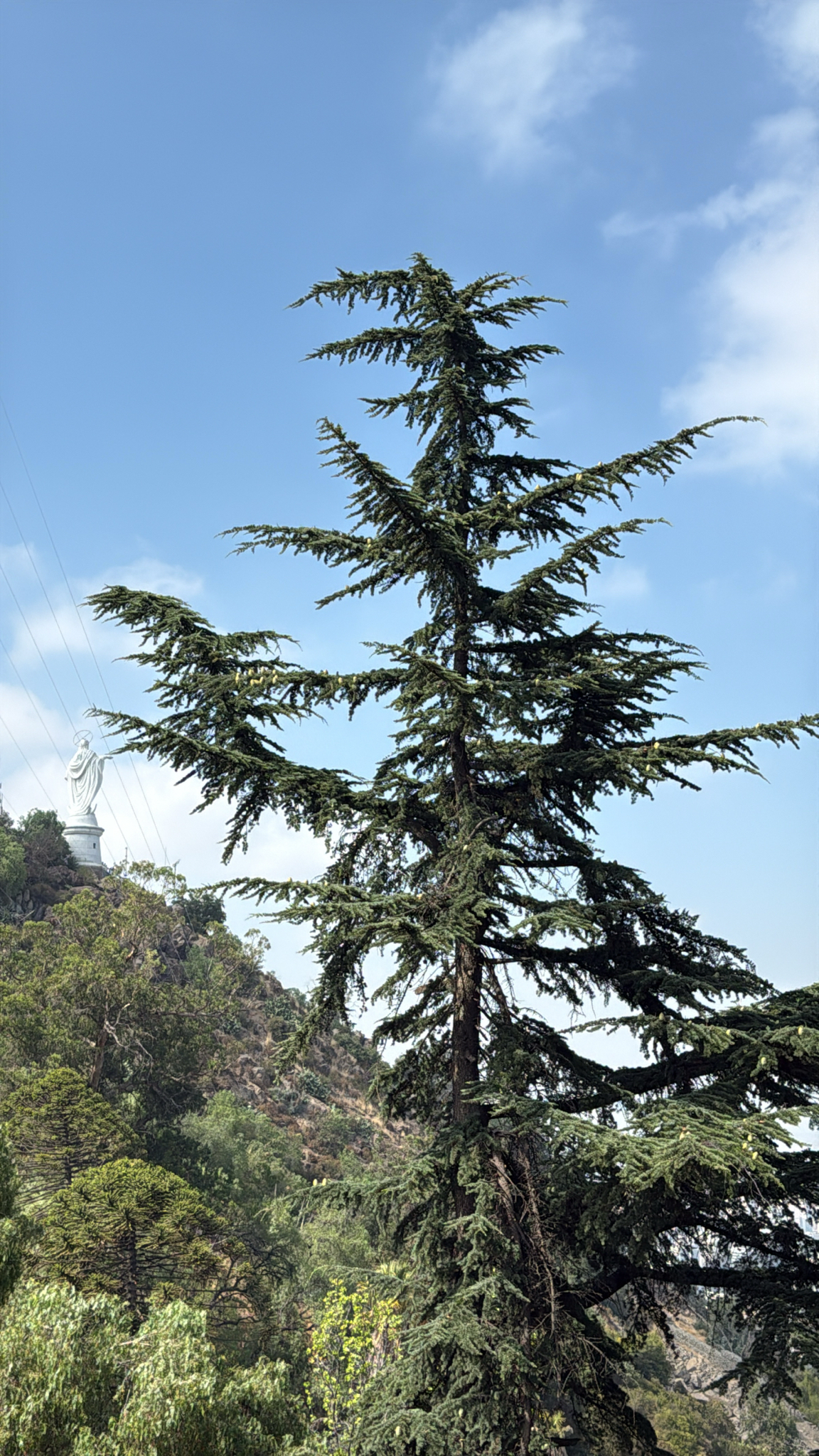
Cedar of Lebanon (Cedrus libani) is a long-lived evergreen conifer native to the mountain ranges of Lebanon, Syria, and southern Turkey, distinguished by wide tabular tiers of foliage at maturity.
A single specimen demands a horizontal clearance of at least 15 metres (50 ft), making it suited exclusively to parks, arboreta, and large rural landscapes with deep, free-draining soil.
Key Facts
- Mature height: 20–40 m (65–130 ft)
- Canopy spread: 15–25 m (50–82 ft)
- Hardiness: USDA Zones 5–9 (var. stenocoma hardy to Zone 5)
- Light: Full sun (minimum 6–8 hours daily)
- Soil: Well-drained loam, chalk, or gravel; pH 6.0–8.5
- Growth rate: 20–35 cm (8–14 in) per year
Is Cedar of Lebanon Right for Your Garden?
Cedar of Lebanon requires an immense open area of at least 15 to 25 metres (50 to 82 ft) of horizontal clearance free from overhead cables, building foundations, and boundary walls.
This tree suits estate grounds, public parks, and campus settings where it can stand unshaded for several centuries. Suburban gardens do not offer enough canopy space once the tree matures and begins developing its lateral tier branches.
Do not plant this conifer if your site features:
- Compact suburban boundaries or narrow perimeter fencing
- Waterlogged, heavy clay soil prone to winter ponding
- Dense overhead shade from older, established trees
- Proximity to paved driveways liable to root heave
Identifying Cedar of Lebanon: Needles, Cones, and Bark
You can identify mature specimens by their flat-topped tabular canopy and stiff, needle-filled spur shoots.
Needles measure 1.5–3.5 cm (0.6–1.4 in) in length, displaying a deep green to glaucous-grey colour. They appear singly on young leading shoots, but grow in dense rosettes of 15–35 needles on older woody short shoots. The bark starts smooth and silver-grey on saplings, deepening into dark grey-brown with thick, scaly vertical ridges separated by deep fissures as it ages.
Reproductive cones distinguish this species from typical pines:
- Female seed cones: Barrel-shaped, upright, 8–12 cm (3–5 in) long and 4–6 cm (1.6–2.4 in) wide
- Cone development: Green when young, turning dull grey-brown at maturity after 24 months
- Cone behaviour: Shed scales while upright on branches, leaving a bare central spike behind
- Male pollen cones: Slender, cylindrical, 4–5 cm (1.6–2 in) long, releasing pollen in autumn
Mature Size and Growth Rate
A healthy Cedar of Lebanon reaches 20 to 40 metres (65 to 130 ft) in height with an expansive lateral spread often equal to two-thirds of its stature.
Growth is slow to moderate, typically adding 20–35 cm (8–14 in) of vertical height each year during its first three decades. Young trees maintain a stiff, pyramidal silhouette for their first 25–40 years before lateral branches thicken, spread horizontally, and flatten the upper canopy into the characteristic architectural tiers.
Sunlight, Soil, and Planting Site Selection
This conifer requires full sun all day, receiving no fewer than 6 to 8 hours of unfiltered sunlight through every season.
In its native habitat across the Mount Lebanon and Taurus ranges, the tree anchors into dry, fractured limestone hillsides at elevations between 1,000 and 2,100 metres (3,300 and 6,900 ft). It tolerates high-pH soils, chalk, and thin gravelly loam with ease, but perishes in stagnant moisture.
Ideal site parameters include:
- Unimpeded solar exposure clear of tall buildings or competing woodland
- Deep soil profiles that allow vertical taproot penetration
- Naturally free-draining ground with a pH between 6.0 and 8.5
- Shelter from freezing eastern gales if growing in marginal USDA Zone 5 climates
How to Plant a Cedar of Lebanon
Plant container-grown or balled-and-burlapped specimens in autumn or early spring while the tree is dormant and the soil retains moderate warmth.
Excavate a planting hole three times wider than the root ball, keeping the depth exactly level with the root flare. Setting the flare below grade leads to collar rot and eventual tree loss. Backfill using the native soil without adding peat or artificial compost amendments, ensuring firm soil-to-root contact without heavy compaction.
Key planting steps:
- Loosen any circling container roots by teasing outer fibres outward
- Drive low timber stakes angled away from the stem to secure the base without girdling
- Saturate the backfill with 40–60 L (10–16 gal) of water immediately after planting
- Apply a 7 cm (3 in) layer of shredded wood mulch, keeping it 10 cm (4 in) clear of the trunk
Cedar of Lebanon Care: Water and Fertilizer Needs
Young trees require weekly deep soakings of 20 to 30 litres during their first two summers, after which established root networks withstand extended summer droughts.
Never supply supplemental irrigation to an established specimen older than five years unless experiencing severe regional drought lasting longer than eight weeks. Wet root plates encourage fungal pathogens like armillaria honey fungus.
Fertilizer application is rarely necessary in garden soils. If establishing on impoverished sand, top-dress the root zone in early spring with a balanced, slow-release organic fertilizer at 50 g per square metre, keeping granular feeds away from direct trunk contact.
Pruning and Structural Training
Prune only during late autumn or mid-winter to remove damaged, crossing, or competing co-dominant leaders while fungal spores are inactive.
Do not attempt to top or shape the tree. In its youth, maintain a single straight central leader to establish a strong central spine. Heavy lower lateral branches should remain intact whenever possible, as removing mature limbs leaves substantial wounds that do not compartmentalise quickly and open entry points for wood decay fungi.
Essential pruning rules:
- Cut cleanly just outside the branch bark ridge without flush-cutting into the trunk
- Eliminate secondary co-dominant stems within the first 10 years of growth
- Clear broken or dead timber following heavy snow or ice storms
- Never shear needles or hedge branches, as old wood lacks dormant buds to regenerate
Common Cedar Pests and Diseases
The cedar aphid (Cinara cedri) and root rots caused by Phytophthora species represent the two primary threats to tree health.
Cedar aphids feed on sap from young shoots in late spring and early summer, exuding large quantities of honeydew that colonises with black sooty mould and triggers needle loss. Heavy infestations on young saplings require applications of horticultural oil or insecticidal soap sprays before needle damage turns severe.
Watch for the following symptoms:
- Needle yellowing and branch dieback: Often caused by poor drainage or root fungal infection
- Sooty mould on inner foliage: Symptom of active cedar aphid colonisation
- Honey-coloured toadstools at tree base: Indicates honey fungus (Armillaria mellea) attack
- White, cottony tufts on bark: Indicates cedar adelgid or scale insect presence
Winter Hardiness and Protecting Branches from Snow
Mature trees withstand freezing temperatures down to -20 °C (-4 °F), but the broad horizontal boughs remain vulnerable to mechanical breakage under wet snow.
The flat, tabular scaffolding branches accumulate large volumes of uncompacted snow. During heavy, wet snowfall events, dislodge fresh accumulations from reachable lower limbs using a long, soft-headed broom or telescopic pole by tapping upward against branch undersides.
For growers in USDA Zone 5, plant Cedrus libani var. stenocoma, which hails from the high elevations of south-western Anatolia and exhibits greater cold resistance alongside a narrower, upright crown that sheds snow more effectively.
Landscape Uses and Related Conifers
Cedar of Lebanon is used primarily as an isolated specimen lawn tree on large country estates, arboreta, and institutional grounds.
In broad parklands, landscape designers place it alongside other expansive canopy trees including atlas cedar (Cedrus atlantica), deodar cedar (Cedrus deodara), and European beech (Fagus sylvatica). Unlike true cedar, western redcedar (Thuja plicata) belongs to the cypress family (Cupressaceae) and produces soft, scale-like leaves rather than clustered needle rosettes.
Frequently Asked Questions
Why is the Cedar of Lebanon mentioned in the Bible?
The tree is referenced dozens of times in the Bible (such as Psalm 92:12 and 1 Kings 5) as a symbol of strength, uprightness, and majesty. King Solomon imported timber from the mountains of Lebanon to build the First Temple and palace in Jerusalem due to the wood's straight grain, rot resistance, and cedar fragrance.
Why is it called Cedars of Lebanon State Park in Tennessee?
Early settlers in Middle Tennessee mistook the abundant native eastern redcedar (Juniperus virginiana) for true cedar trees like the Cedar of Lebanon due to their aromatic heartwood, naming the limestone glade region after the biblical forests.
How to grow Cedar of Lebanon from seed?
Soak seeds in room-temperature water for 24 hours, then cold-stratify them in damp sand or peat at 1–4 °C (34–40 °F) for 30 to 60 days before sowing in deep pots filled with free-draining potting compost. Place pots in bright light at 18–21 °C (65–70 °F); germination typically occurs within 3 to 6 weeks.
Can you grow Cedar of Lebanon as a bonsai?
Yes, Cedar of Lebanon responds well to bonsai cultivation, particularly when trained in informal upright (moyogi) or formal upright (chokkan) styles. Dwarf varieties such as 'Green Prince' are preferred for their tighter needle nodes and slower internodal growth.
What are the historical benefits and uses of Cedar of Lebanon wood?
Ancient Phoenicians, Egyptians, and Romans used its rot-resistant, aromatic resinous timber for shipbuilding, structural beams, and sarcophagi. Modern commercial logging is strictly prohibited because remaining wild stands are protected conservation zones.
Sources & Verification
Taxonomy and distribution are checked against the databases below. Care guidance is written for cultivated species only and reviewed by our editor. How We Build Plant Profiles →
- Kew Plants of the World OnlineTaxonomy, distribution, and native habitat
- IUCN Red List of Threatened SpeciesConservation status and wild population threats
- Royal Horticultural SocietyCultivation profile and hardiness specifications
- Missouri Botanical GardenGarden dimensions, culture, and botanical features
- GBIF — Global Biodiversity Information Facilitytaxonomy, synonyms, occurrence records
- Wikipediageneral reference