
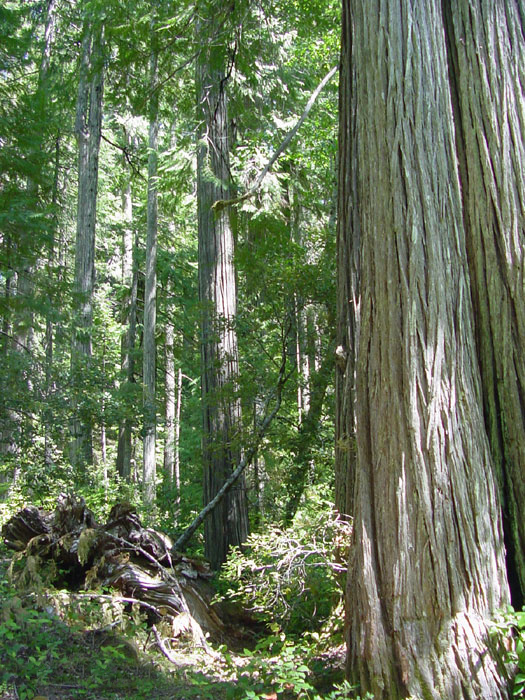
Lawson’s cypress (Chamaecyparis lawsoniana) is a massive evergreen conifer native to southwestern Oregon and northwestern California, easily recognised by its flattened, drooping sprays of blue-green foliage and aromatic resin. In wild habitats it grows along stream terraces, reaching soaring heights with a narrow, spire-like crown.
Gardeners grow compact cultivars as specimen trees, windbreaks, and formal hedges. The single most vital requirement for success is planting in sharply draining soil, as waterlogged roots rapidly succumb to fatal root rot.
Key Facts
- Soil: Moist, acidic to neutral, strictly well-drained
- Light: Full sun to partial shade
- Mature height: 2–15 m (6–50 ft) depending on cultivar
- Water: Regular moisture while young; avoid waterlogged ground
- Hardiness: USDA zones 5 to 8
Is Lawson’s Cypress Right for Your Garden?
Lawson’s cypress suits gardeners who need year-round screening, formal columnar architecture, or miniature conifer structure in borders, provided your site has freely draining soil. While wild specimens exceed 50 m (160 ft), garden selections range from 1 m (3.3 ft) dwarf globes to 10 m (33 ft) dense hedging columns.
You must pair cultivar selection directly with available space, as full-sized forms quickly overpower small suburban plots. These trees thrive in cool, humid temperate maritime climates and struggle in regions with prolonged hot, humid summers.
Identifying Foliage, Cones, and Bark
Lawson’s cypress is identified by its flattened, fern-like branch sprays with a distinctively nodding leading shoot at the top of the tree. The scale-like leaves measure 2–3 mm (0.08–0.12 in) long, display faint white X-shaped stomatal markings on their undersides, and release a pungent, parsley-and-resin fragrance when bruised.
Its structural characteristics include:
- Foliage: Tiny overlapping scales pressed tightly against flexible branchlets.
- Bark: Reddish-brown, fibrous, peeling in long vertical strips as the trunk thickens.
- Female cones: Spherical, 7–12 mm (0.3–0.5 in) across, maturing from green-blue to wrinkly brown with 8–10 peltate scales.
- Male cones: Minute, 3–4 mm (0.12–0.16 in) terminal clusters that appear crimson in late winter before shedding pollen.
- Habit: Pyramidal to narrowly columnar with drooping branchlet tips.
Light and Soil Requirements for Chamaecyparis lawsoniana
For vibrant foliage colour and compact branching, grow Lawson’s cypress in full sun to partial shade with at least 4 to 6 hours of direct light daily. Golden and blue cultivars such as ‘Ivonne’ or ‘Columnaris’ require full sun to retain intense pigmentation, whereas dark green types tolerate light canopy shade.
The root system requires deep, humus-rich soil with a pH of 5.0 to 6.8. Heavy clay soil without slope drainage causes root suffocation and invites destructive soil-borne pathogens within months.
How to Plant Lawson’s Cypress
Plant Lawson’s cypress during autumn or early spring while soil temperatures remain between 10–18 °C (50–65 °F) to allow root establishment before dry summer conditions arrive. Dig a hole twice the diameter of the root container but no deeper than the original root ball depth.
Follow these steps to establish healthy roots:
- Inspect root ball: Tease out circling peripheral roots gently to prevent girdling.
- Position the flare: Keep the root flare exactly level with or 2 cm (0.8 in) above existing ground level.
- Backfill: Refill with native topsoil without added rich composts to encourage outwards root exploration.
- Mulch: Spread a 5–7 cm (2–3 in) layer of shredded wood bark around the base, keeping 10 cm (4 in) clear of the trunk.
- Water thoroughly: Apply 15–20 L (4–5 gal) of water immediately to settle air pockets.
Watering and Feeding Routine
Water deeply whenever the top 5 cm (2 in) of surrounding soil feels dry to the touch during the first two growing seasons. Established specimens withstand short dry spells in temperate climates, but prolonged drought causes needle browning and branch dieback along the interior.
Feed in early spring using a balanced, slow-release conifer fertiliser with an NPK ratio close to 10-8-6. Apply granules evenly beneath the drip line at a rate of 50 g per square metre (1.5 oz per square yard), and cease all fertilising by late July to prevent soft frost-tender autumn shoots.
Pruning Lawson’s Cypress for Shape and Hedges
Prune only into green, active growth during midsummer, because Lawson’s cypress cannot generate new shoots from old, leafless brown wood. If you cut into bare interior branches, those brown gaps remain permanently visible for the life of the tree.
For hedge maintenance and shaping, follow these rules:
- Frequency: Trim once or twice per year between June and late August.
- Profile: Shear sides to a slight batter, keeping the base wider than the top to let sunlight reach lower branches.
- Leader management: Do not top the main central leader until the hedge or tree reaches your desired final height.
- Tool sanitation: Disinfect shears with 70% alcohol between plants to stop fungal transmission.
How to Propagate Lawson’s Cypress from Cuttings
Propagate Lawson’s cypress using semi-ripe heel cuttings taken in late summer or early autumn from firm, current-season side shoots. Cuttings rooted from lateral shoots typically retain true colour and growth characteristics of specific cultivars.
To root cuttings successfully:
- Take shoots: Strip 7–10 cm (2.8–4.0 in) side shoots with a small heel of older wood attached.
- Prepare stem: Remove lower foliage along the bottom 3 cm (1.2 in) of the cutting.
- Apply hormone: Dip the basal cut in 0.3% IBA rooting hormone powder.
- Pot up: Insert cuttings into a 50:50 blend of coarse perlite and peat or coir.
- Provide conditions: Maintain 18–21 °C (64–70 °F) bottom heat under high humidity; roots develop in 8–12 weeks.
Pests and Disease Problems
The single most destructive threat to Lawson’s cypress is Phytophthora lateralis, a waterborne fungal-like root rot that causes rapid, irreversible wilting and needle bronzing. Once infected via contaminated water or muddy footwear, trees cannot be cured and must be removed to protect nearby conifers.
Other common issues to monitor include:
- Cypress aphid (Cinara cupressi): Sucks sap in spring, causing sudden yellowing patches and black sooty mould.
- Juniper scale: Small circular white scales encrusting needles, treated by applying horticultural oils in early spring.
- Interior needle drop: Natural shedding of 3-year-old inner scales in autumn, which is normal and harmless.
- Windburn: Salt-laden winter winds dry foliage tips; prevent by planting behind shelterbelts.
Winter Care and Frost Protection
Lawson’s cypress tolerates temperatures down to -23 °C (-10 °F) without wood damage once fully dormant in USDA zones 5 to 8. However, heavy snow accumulations can bend or splay the upright branches of columnar cultivars such as ‘Columnaris’ or ‘Ellwoodii’.
Wrap vertical multi-stemmed cultivars loosely with soft jute twine in late autumn to hold branches close to the trunk under snow loads. Apply an extra 5 cm (2 in) layer of mulch over the root zone in November to insulate surface roots against rapid ground freeze-thaw cycles.
Cones and Seasonal Pollination
Lawson’s cypress does not produce true flowers, generating instead separate male and female cones on branch tips of the same tree in early spring. The male strobili emerge bright brick-red in March, turning yellowish as they release clouds of windblown pollen.
Female cones develop at branch ends as tiny, slate-blue globes. Following spring pollination, they expand over summer into 8 mm (0.3 in) woody cones that turn russet-brown by September, splitting open to release small winged seeds onto the ground.
Companion Plants for Lawson’s Cypress
Lawson’s cypress pairs best with acid-tolerant shrubs and perennials that share its preference for cool root runs and well-drained soil. The architectural evergreen foliage provides a clean background for seasonal woodland blooms.
Complementary garden companions include:
- Catawba rhododendron (Rhododendron catawbiense) for bold spring flowers against dark conifer needles.
- Mountain laurel (Kalmia latifolia) which thrives in the same acidic, moisture-retentive ground.
- Japanese painted fern (Athyrium niponicum) for delicate texture at the shaded base of mature specimens.
- Dwarf winterberry (Ilex verticillata) to supply bright red winter berries contrasting with blue foliage.
Frequently Asked Questions
How fast does a Lawson's cypress tree grow?
Lawson's cypress trees grow at a moderate rate of 30–60 cm (12–24 in) per year in garden settings. Dwarf selections such as 'Ellwoodii' grow much more slowly at roughly 5–10 cm (2–4 in) annually.
Can you use Chamaecyparis lawsoniana for bonsai?
Yes, dwarf varieties like Chamaecyparis lawsoniana 'Ellwoodii' and 'Minima Aurea' are commonly trained as bonsai due to their naturally compact foliage and flexible juvenile wood. Keep their shallow roots consistently moist and pinch new tip growth rather than cutting with shears to prevent foliage browning.
Why are the tips of my Lawson's cypress turning brown?
Brown foliage tips usually result from cold windburn, drought stress, or shearing too close to bare wood. Water thoroughly before winter freezes and erect burlap windbreaks if planted in wind-exposed locations.
Can you prune Lawson's cypress back to bare wood?
No, Lawson's cypress will not sprout new growth from old brown wood lacking green needles. Always leave ample green foliage on every stem when shaping hedges or trimming branches.
What is the difference between Lawson's cypress and Leyland cypress?
Lawson's cypress has fine, parsley-scented foliage, nodding branch tips, and smaller spherical cones, whereas Leyland cypress (Cupressus × leylandii) grows nearly twice as fast with coarser, unscented sprays and harsher flattened branches.
Sources & Verification
Taxonomy and distribution are checked against the databases below. Care guidance is written for cultivated species only and reviewed by our editor. How We Build Plant Profiles →
- Kew Plants of the World Onlinepowo.science.kew.org
- Royal Horticultural Societyrhs.org.uk
- IUCN Red List of Threatened Speciesiucnredlist.org
- North Carolina State Extension Gardener Plant Toolboxplants.ces.ncsu.edu
- GBIF — Global Biodiversity Information Facilitytaxonomy, synonyms, occurrence records
- Wikipediageneral reference
