
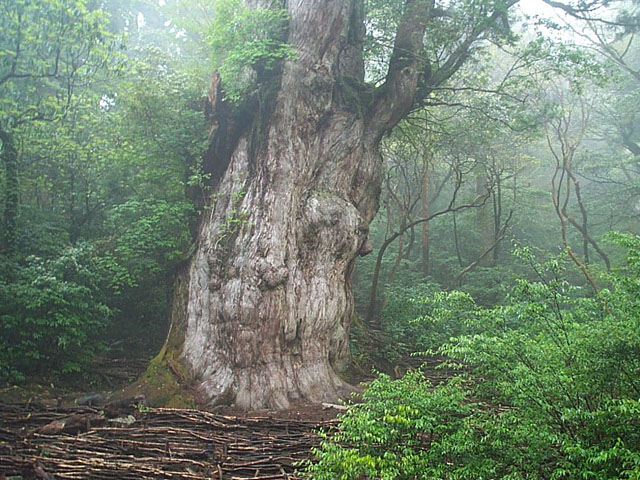
Japanese cedar (Cryptomeria japonica) is a large evergreen conifer native to Japan and southern China, where it forms dense high-altitude forests. It is distinguished by its reddish-brown shredding bark and awl-shaped needles that spiral around slender twigs.
Mature trees reach heights of 15 to 25 m (50 to 80 ft) in cultivation, requiring moist, acidic soil to prevent foliage desiccation. Dwarf cultivars suit smaller garden borders and container bonsai culture.
Key Facts
- Light: Full sun to light partial shade
- Water: 2.5 cm (1 in) weekly during establishment
- Soil pH: Acidic, 5.0 to 6.5
- Hardiness: USDA zones 5 through 9
- Growth rate: 30 to 60 cm (12 to 24 in) annually
Fitting Japanese Cedar into Your Garden
Japanese cedar thrives in medium-to-large landscapes and suburban gardens across USDA hardiness zones 5 to 9. Full-sized trees develop a narrow conical crown, while compact cultivars fit smaller borders.
The plant works well as a windbreak, specimen tree, or tall privacy screen. Standard trees reach heights of 15 to 25 m (50 to 80 ft) with a 6 to 8 m (20 to 26 ft) spread, whereas dwarf shrubs stay under 2 m (6.5 ft).
Identifying Japanese Cedar Leaves, Bark, and Cones
Japanese cedar features spirally arranged, awl-shaped needle leaves measuring 0.5 to 1.5 cm (0.2 to 0.6 in) long and reddish-brown peeling bark. The foliage turns deep bronze or plum during cold winter months.
Bark on mature trunks splits into long vertical strips that peel away cleanly. Globular seed cones measure 1.5 to 2.5 cm (0.6 to 1 in) across, turning from green to reddish-brown at maturity in autumn.
Ideal Sun, Soil, and Site Conditions
Japanese cedar requires a site with full sun to partial shade and shelter from dry, freezing winter winds. Dense shade thins foliage growth and weakens lower branches.
The tree demands acidic, deep soil rich in organic material with a pH between 5.0 and 6.5. Alkaline soils with a pH above 7.0 induce needle chlorosis and stunted shoot growth.
- Select a spot receiving at least 6 hours of direct sun daily.
- Ensure soil stays consistently moist without pooling stagnant water.
- Plant away from harsh wind corridors that cause winter foliage scorch.
- Avoid heavy alkaline clay unless amended with organic matter.
How to Plant Japanese Cedar Step-By-Step
Plant Japanese cedar during early spring or autumn when soil temperatures remain above 10 °C (50 °F). Planting during cool weather allows root expansion before summer heat arrives.
Dig a hole twice as wide as the root ball and equal in depth. Ensure the trunk root collar sits level with the surrounding soil to prevent stem rot.
- Position the root ball flush with the surrounding ground level.
- Backfill using excavate soil mixed with 25% compost or leaf mould.
- Water deeply with 20 L (5 gal) immediately after planting.
- Apply a 5 to 7 cm (2 to 3 in) layer of pine bark mulch around the base.
Watering and Fertilising Needs
Water young Japanese cedar trees weekly to supply 2.5 cm (1 in) of water whenever natural rainfall drops below that threshold. Established specimens handle short dry spells once root systems extend deep into the soil.
Apply a slow-release acidifying fertiliser like 10-8-6 in early April at a rate of 50 g per square metre (1.5 oz per sq yd). Avoid applying high-nitrogen fertiliser after July to prevent soft late-season growth that gets damaged by winter frosts.
- Check soil moisture at a depth of 5 cm (2 in) before irrigating.
- Mulch root zones annually in spring to conserve moisture.
- Cease supplemental feeding by mid-summer.
How to Prune Japanese Cedar
Prune Japanese cedar in late winter or early spring before new shoots break dormant buds. Full-sized landscape trees require little structural pruning beyond removing damaged branches.
Dwarf shrub varieties like ‘Globosa Nana’ and bonsai specimens benefit from light hand-pinching of soft new shoots. Never shear into bare interior wood lacking needles, as old stems will not re-sprout.
- Cut dead or crossing branches back to the main branch collar.
- Pinch new spring candles by hand rather than using shears.
- Limit pruning to 15% of live foliage in any single season.
Propagating Japanese Cedar from Cuttings
Propagate Japanese cedar by taking 10 to 15 cm (4 to 6 in) semi-ripe cuttings in late summer or early autumn. Cuttings taken from current-season growth with a heel of mature stem offer the highest rooting success rates.
Dip the lower stem in 0.3% IBA root hormone powder and insert into a medium of equal parts perlite and coarse sand. Maintain relative humidity above 80% and soil temperatures at 20 °C (68 °F) until roots form in 8 to 12 weeks.
Managing Pests and Needle Diseases
Protect Japanese cedar from spider mites and needle blight by maintaining stem airflow and consistent soil moisture during summer dry spells. Overhead watering increases fungal spore germination on crowded foliage.
Spider mites attack needles in hot weather above 27 °C (80 °F), causing fine stippling and yellow foliage. Cercospora needle blight causes lower needles to turn brown and drop prematurely during wet summers.
- Spider mites: spray undersides of foliage with strong water streams or insecticidal soap.
- Cercospora needle blight: apply copper fungicide at 14-day intervals during spring rains.
- Scale insects: scrape off small brown encrustations and treat with horticultural oil in May.
Winter Care and Seasonal Foliage Bronze
Protect young trees in zones 5 and 6 from severe winter desiccation by applying a 7 cm (3 in) mulch layer before the first hard freeze. Unprotected roots in shallow soil suffer damage when temperatures fall below -15 °C (5 °F).
Foliage naturally turns bronze, plum, or brownish-purple when temperatures drop below 0 °C (32 °F). This colour shift is a natural physiological response that protects leaf tissues from winter sunlight and reverses to bright green when temperatures warm in April.
Japanese Cedar Through the Seasons
| Spring | Apply 50 g per sq m (1.5 oz per sq yd) of acid fertiliser in early April. Prune dead branches and pinch back soft new growth candles on bonsai specimens. |
|---|---|
| Summer | Provide 2.5 cm (1 in) of water weekly during dry periods. Inspect needle undersides for spider mite infestations when temperatures exceed 27 °C (80 °F). |
| Autumn | Take 10 to 15 cm (4 to 6 in) semi-ripe cuttings for propagation in September. Replenish pine bark mulch to a depth of 7 cm (3 in) around the root zone. |
| Winter | Protect potted bonsai and young field plants from sub-zero winds below -5 °C (23 °F). Avoid pruning while stems are frozen. |
Common Japanese Cedar Problems Solved
| What you see | Likely cause | What to do |
|---|---|---|
| Foliage turns bronze or plum in winter | Natural cold response to freezing temperatures | Leave needles undisturbed; foliage naturally greens up in spring. |
| Browning needle tips in summer | Spider mite damage or severe drought stress | Spray foliage with water to dislodge mites and increase weekly irrigation. |
| Lower leaves brown and fall off in summer | Cercospora needle blight fungal infection | Apply copper fungicide spray every 14 days and rake away fallen needle debris. |
| Yellowing foliage and stunted shoot tips | Alkaline soil pH above 7.0 causing iron chlorosis | Amend soil with elemental sulphur or iron sulphate to reduce soil pH below 6.5. |
Popular Japanese Cedar Cultivars
- ‘Black Dragon’ – dense pyramid with dark green needles, reaching 2 to 3 m (6 to 10 ft)
- ‘Globosa Nana’ – compact spherical dwarf shrub growing to 1 m (3.3 ft) high and wide
- ‘Yoshino’ – fast-growing pyramidal tree holding bright green foliage through winter
- ‘Sekkan-sugi’ – creamy-yellow foliage tips on upright branches, reaching 3 to 5 m (10 to 16 ft)
- ‘Elegans’ – soft feathery foliage that turns deep plum-purple all winter
Best Companion Plants for Japanese Cedar
Pair Japanese cedar with acid-loving woodland plants like Japanese maple (Acer palmatum), Hinoki cypress (Chamaecyparis obtusa), and evergreen azalea (Rhododendron indicum). These species share identical soil acidity and moisture requirements.
Underplant tall upright cedars with low-growing shrubs such as mountain laurel (Kalmia latifolia) or dwarf Alberta spruce (Picea glauca ‘Conica’). Contrast cedar’s fine needle texture with broadleaf evergreens to build layered garden borders.
- Japanese maple (Acer palmatum): red foliage creates visual contrast against cedar needles.
- Hinoki cypress (Chamaecyparis obtusa): shares acidic soil needs while adding dark fan-like foliage.
- Indica azalea (Rhododendron indicum): brings bright spring flowers beneath cedar canopy edges.
- Mountain laurel (Kalmia latifolia): thrives in partial shade along cedar drip lines.
Frequently Asked Questions
What is the difference between Japanese cedar and Western red cedar?
Japanese cedar (Cryptomeria japonica) has needle-like, awl-shaped foliage arranged spirally along stems, whereas Western red cedar (Thuja plicata) features flat, scale-like sprays. Japanese cedar wood is fragrant and dense, whereas Western red cedar wood is lighter and softer.
Is Japanese cedar wood good for building fences and pickets?
Yes, Japanese cedar wood (sugi) is decay-resistant, insect-resistant, and suitable for exterior fencing, pickets, and siding. Sugi boards resist warping in outdoor conditions when sealed every 2 to 3 years.
How do you care for a Japanese cedar bonsai?
Keep Japanese cedar bonsai in full sun, maintain consistently moist soil, and protect root systems when temperatures drop below -2 °C (28 °F). Pinch back soft spring growth by hand rather than cutting needles with metal shears.
Why are my Japanese cedar needles turning bronze in winter?
Bronze or purplish needle foliage in winter is a natural physiological protective response to temperatures below 0 °C (32 °F). The needles accumulate protective carotenoid pigments and will green up again as temperatures rise above 10 °C (50 °F) in spring.
How fast does Japanese cedar grow?
Standard Japanese cedar trees grow at a rate of 30 to 60 cm (12 to 24 in) annually under full sun and moist, acidic soil conditions. Dwarf cultivars grow much slower at 5 to 10 cm (2 to 4 in) per year.
Sources & Verification
Taxonomy and distribution are checked against the databases below. Care guidance is written for cultivated species only and reviewed by our editor. How We Build Plant Profiles →
- Kew Plants of the World OnlineTaxonomic status and native distribution.
- Royal Horticultural SocietyCultivation, hardiness, and award of garden merit cultivars.
- NC State University ExtensionLandscape characteristics, insect pests, and plant care.
- Missouri Botanical GardenSoil preferences, pruning guidelines, and cultivar comparisons.
- GBIF — Global Biodiversity Information Facilitytaxonomy, synonyms, occurrence records
- Wikipediageneral reference