
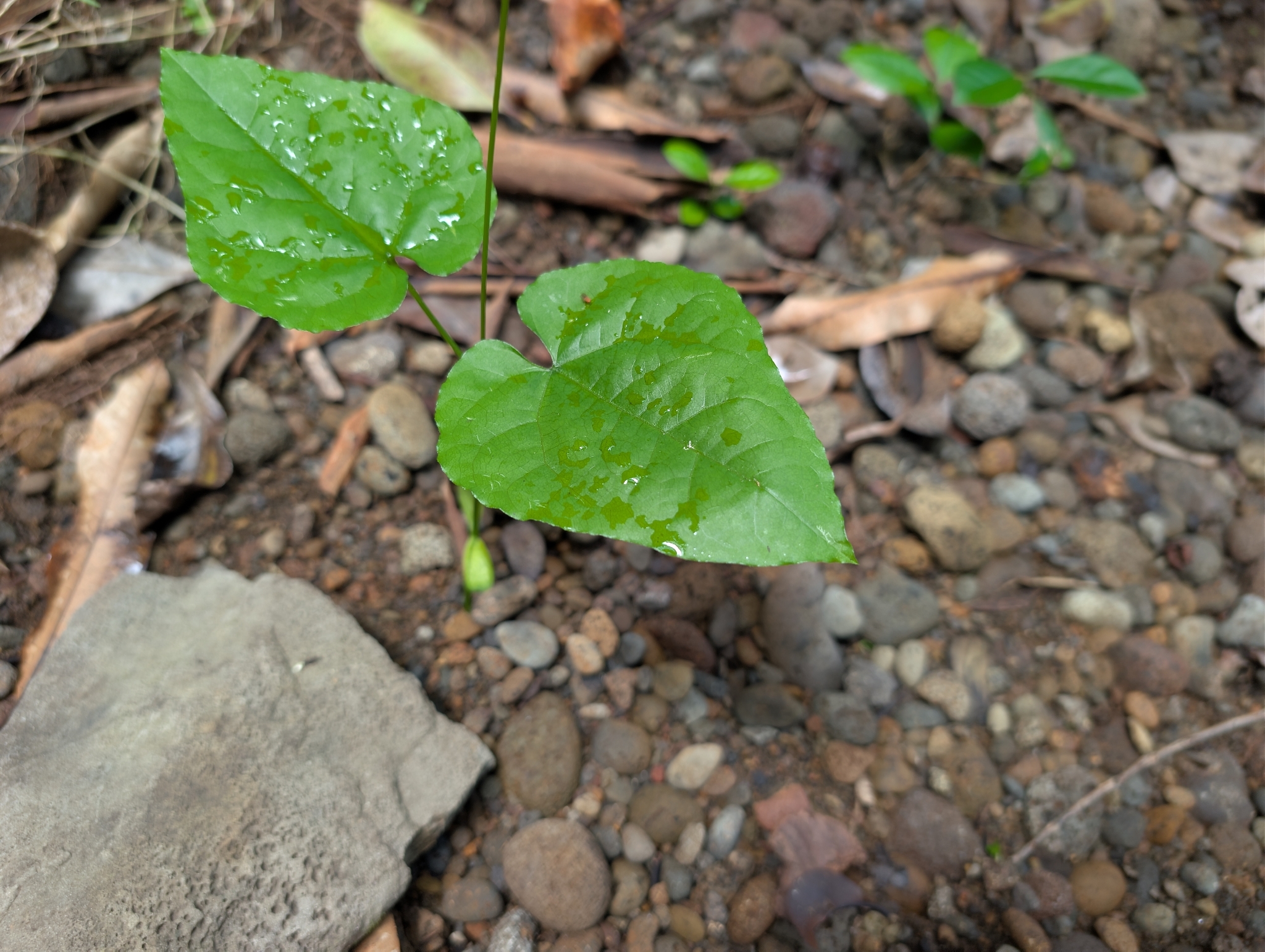
Fiveleaf Yam (Dioscorea pentaphylla) is a perennial climbing vine in the family Dioscoreaceae, native to tropical Asia, Australasia, and Pacific islands. It produces edible underground tubers and small aerial bulbils along its twining stems.
Raw tubers contain saponins and antinutrients that require boiling or leaching before eating. Vines require sturdy support to handle up to 10 m (33 ft) of annual growth.
Key Facts
- Hardiness: USDA zones 9 to 11
- Sunlight: Full sun to partial shade
- Watering: Regular moisture during active summer growth
- Harvest: Autumn to winter when vine dies back
- Vining Length: Up to 10 m (33 ft) in one season
Growing Fiveleaf Yam in the Garden
Fiveleaf Yam grows best in warm tropical and subtropical regions where temperatures remain consistently above 18 °C (65 °F) during summer. The vine suits ground plots with tall trellises or sturdy fence lines.
This species produces underground tubers that store energy through dry or cold dormant periods. Because vines reach lengths of 10 m (33 ft) in a single season, small raised beds quickly become overcrowded.
Identifying Dioscorea pentaphylla Leaves and Tubers
Fiveleaf Yam features compound leaves with 3 to 5 distinct leaflets attached to a central petiole measuring 3 to 10 cm (1.2 to 3.9 in) long. Stems twine counter-clockwise and carry small reddish hairs or soft prickles.
Underground tubers grow 15 to 40 cm (6 to 16 in) long with fibrous skin and pale yellow or white flesh. Small, rounded aerial bulbils measuring 1 to 3 cm (0.4 to 1.2 in) form in leaf axils by late summer.
Key botanical characteristics include:
- Leaf structure: Palmately compound with 3 to 5 elliptic leaflets up to 12 cm (4.7 in) long.
- Stems: Slender twining stems with reddish puberulence and sparse prickles.
- Inflorescence: Fragrant, pale yellow flowers arranged in panicles blooming in late summer.
- Bulbils: Tuberous aerial structures produced along mature vine nodes.
Soil and Sunlight Requirements
Fiveleaf Yam requires at least 6 hours of direct sunlight daily for maximum tuber growth. Vines tolerate partial shade, but shady conditions reduce tuber size and aerial bulbil yields.
Plant in loose, well-draining sandy loam enriched with compost. Heavy clay soil restricts root expansion, while soggy conditions cause underground tubers to rot.
Planting Fiveleaf Yam Tubers and Aerial Bulbils
Plant tuber pieces or mature aerial bulbils 8 to 10 cm (3 to 4 in) deep in early spring after frost risk ends. Space planting sites 1 to 1.5 m (3.3 to 5 ft) apart.
Sprouts emerge within 14 to 21 days once soil temperatures reach 20 °C (68 °F). Use tuber cuttings weighing at least 100 g (3.5 oz) with visible buds for rapid sprout establishment.
- Soil depth: Loose soil to 40 cm (16 in) allows straight tuber growth.
- Organic matter: Mix 2 kg (4.4 lb) of well-rotted manure per square metre prior to planting.
- Support setup: Position a 2.5 m (8 ft) trellis during planting to prevent root disturbance later.
Watering and Trellising Fiveleaf Yam Vines
Fiveleaf Yam vines require 2.5 cm (1 in) of water weekly during peak growth in late spring and summer. Reduce watering when foliage yellows in autumn as dormancy approaches.
Provide strong vertical supports such as timber posts or wire mesh. Compare this growth habit to air potato (Dioscorea bulbifera) or purple yam (Dioscorea alata), which also produce long vine shoots requiring sturdy trellising.
Apply a 5 cm (2 in) layer of straw mulch to maintain soil moisture and suppress weeds around the stem base.
Digging Up Fiveleaf Yam Tubers
Harvest Fiveleaf Yam tubers 7 to 9 months after planting when vines turn yellow and die back in late autumn. Gather aerial bulbils from stems in mid-autumn as they detach easily.
Dig a trench 30 cm (12 in) away from the main vine base to avoid cutting into tubers. Gently lift tubers from depth using a hand fork.
Culinary and Medicinal Uses of Dioscorea pentaphylla
Fiveleaf Yam tubers must be boiled, peeled, or roasted thoroughly before consumption to eliminate bitter saponins and antinutrients. Traditional preparation methods involved soaking sliced tubers in water or cooking them with wood ash.
In traditional medicine across Asia, tubers and crushed leaves were applied to treat swellings, skin infections, and joint inflammation. Bitter yam (Dioscorea dumetorum) shares similar historical uses in folk remedies.
Common Pests and Diseases
Fiveleaf Yam leaves are susceptible to leaf spot fungal infections when relative humidity exceeds 80 percent. Yam beetles and root nematodes can damage developing underground tubers.
Watch for these common issues:
- Yam beetles: Large feeding cavities in underground tubers; rotate crop locations annually.
- Nematodes: Stunted top growth and knotted tubers; practice soil solarization before planting.
- Leaf spot fungi: Brown leaf lesions; thin dense vine growth to improve air circulation.
How to Store Harvested Fiveleaf Yam Tubers
Store cured tubers at 12 to 15 °C (54 to 59 °F) in a ventilated, dark area with 70 to 80 percent humidity. Undamaged tubers remain viable for 4 to 6 months in cold storage.
Avoid washing tubers prior to storage, as free water promotes fungal rot. Inspect tubers monthly and discard any showing soft spots.
Frequently Asked Questions
Is Fiveleaf Yam edible?
Yes, Fiveleaf Yam tubers and bulbils are edible after thorough boiling or roasting to destroy bitter saponins. Never eat raw tubers.
What family does Dioscorea pentaphylla belong to?
Dioscorea pentaphylla belongs to the yam family, Dioscoreaceae.
How do you identify Dioscorea pentaphylla?
Identify it by its compound leaves containing 3 to 5 distinct leaflets, twining prickly stems, and aerial bulbils in the leaf axils.
What are the traditional medicinal uses of Fiveleaf Yam?
Traditionally, prepared tubers and leaves were applied externally in folk medicine to relieve swellings, sores, and joint pain.
Can you grow Fiveleaf Yam in containers?
Yes, Fiveleaf Yam can be grown in large 40 L (10 gal) containers with a minimum depth of 40 cm (16 in) and a sturdy trellis.
Information about traditional or historical uses is provided for educational interest only and is not medical advice. Do not use any plant to treat a condition without speaking to a qualified professional.
Sources & Verification
Taxonomy and distribution are checked against the databases below. Care guidance is written for cultivated species only and reviewed by our editor. How We Build Plant Profiles →
More in Dioscorea
Yellow Guinea Yam
Dioscorea cayenensis
☀️ Full Sun 💧 Moderate

Air Potato
Dioscorea bulbifera
☀️ Full Sun 💧 Moderate

Lesser Yam
Dioscorea esculenta
☀️ Full Sun 💧 Moderate
Black Bryony
Dioscorea communis
☀️ Partial Shade 💧 Moderate

Common Yam Vine
Dioscorea transversa
☀️ Bright Indirect 💧 Moderate

Elephant’s Foot
Dioscorea elephantipes
☀️ Bright Indirect 💧 Low