
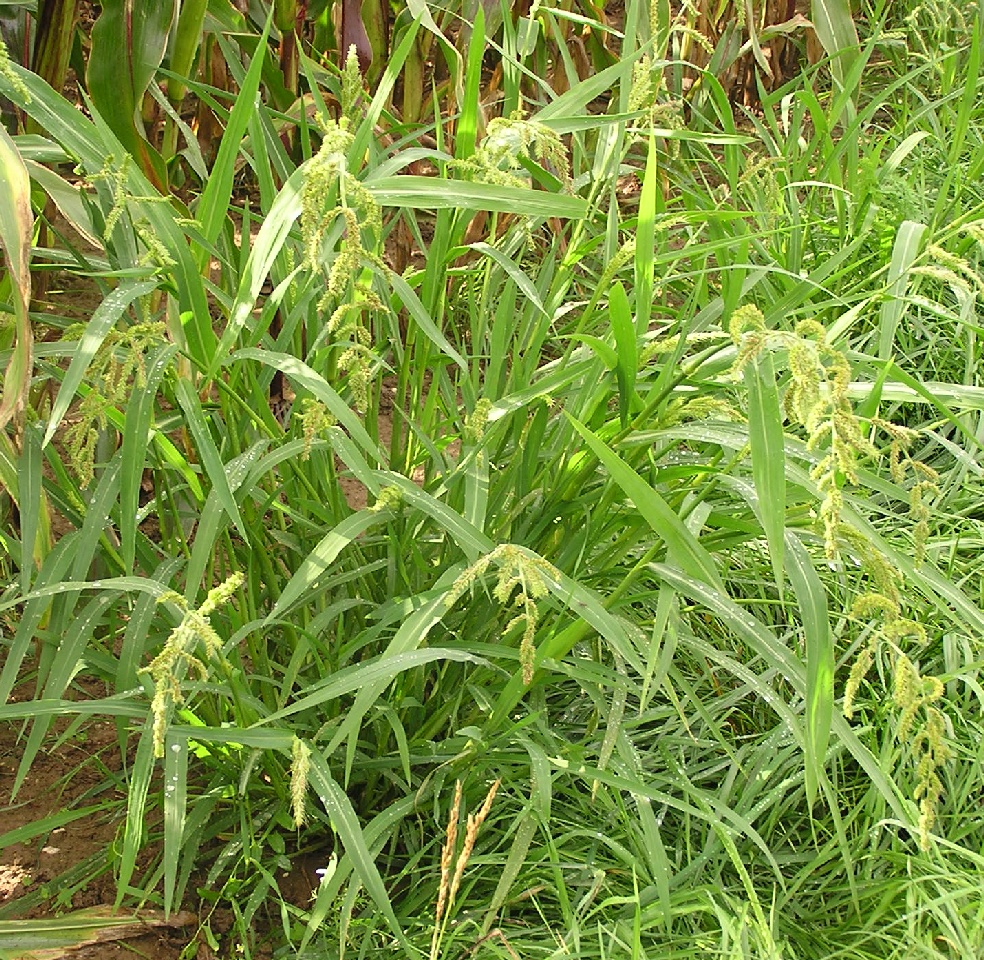
Early water grass (Echinochloa oryzoides) is an annual grass native to Eurasia that infests flooded agricultural soils. It grows as a major agricultural weed in commercial rice fields across Asia, Europe, and North America.
This species is famous for Vavilovian mimicry, closely resembling cultivated rice plants during early growth phases before producing distinct bristled seed heads. Controlling its spread requires early identification before seeds drop into paddy irrigation water.
Key Facts
- Plant Type: Annual warm-season aquatic grass
- Native Range: Eurasia and temperate Asia
- Habitat: Rice paddies, ditches, and wet fields
- Height: 80–150 cm (31–59 in) tall
- Key Trait: Mimics domestic rice seedlings
What Is Early Water Grass?
Early water grass is an aggressive annual paddy weed that competes with flooded cereal crops. In agricultural settings, early water grass establishes in flooded fields where standing water inhibits standard terrestrial weeds. It competes directly with cultivated crops for soil nitrogen, light, and root space.
Because it germinates alongside spring crops and shares similar growth requirements, farmers must actively manage infestations to avoid significant yield losses in commercial grain fields.
How to Identify Early Water Grass
Early water grass grows 80–150 cm (31–59 in) tall with smooth, hairless leaf sheaths and distinct awned spikelets. Stems are erect or bent at the lower joints, forming stout clumps in shallow water. Leaves are flat, 10–40 cm (4–16 in) long and 1–2 cm (0.4–0.8 in) wide, lacking ligules and auricles at the junction between the leaf blade and sheath.
Key botanical identification characteristics include:
- Ligule: Absent entirely, creating a smooth blade junction
- Inflorescence: Erect to nodding panicle, 10–25 cm (4–10 in) long
- Spikelets: Oval, 3.8–5.5 mm (0.15–0.22 in) long, densely clustered
- Awns: Long terminal bristles measuring 15–50 mm (0.6–2.0 in) on spikelets
- Roots: Fibrous root system anchoring in saturated mud
Native Habitat and Distribution
The native range of early water grass spans Eurasia, but the species now occurs in rice-growing regions worldwide. It thrives in wet, nutrient-rich soils, standing water up to 15 cm (6 in) deep, irrigation canals, and riverbanks. In North America and Southern Europe, it has established naturalized populations along agricultural drainage networks.
The plant requires high solar exposure and warm summer temperatures between 20–35 °C (68–95 °F) to complete its growth cycle from seedling to seed setting.
Ecological Mimicry and Growth Habits
Early water grass survives in agricultural systems by physically mimicking domestic rice (Oryza sativa) seedlings during early growth. This biological phenomenon, known as Vavilovian mimicry, evolved through generations of manual weeding in paddy fields. Farm workers historically pulled weeds that differed visually from rice, accidentally selecting for weed seedlings that closely resembled the target crop.
A single plant can produce 2,000 to 10,000 seeds per season. The heavy seeds float on water currents, allowing rapid dispersal throughout connected canal systems during irrigation cycles.
Agricultural Impact and Weed Control
Early water grass is classified as a major noxious weed in flooded grain fields across California, Asia, and the Mediterranean. Uncontrolled infestations reduce crop yields by 20% to 70% due to aggressive nitrogen absorption and canopy shading. Dense stands also complicate mechanical harvesting by clogging equipment and contaminating harvested grain.
Management strategies rely on integrated control measures:
- Crop Rotation: Rotating flooded crops with dryland field crops
- Stale Seedbeds: Irrigating to induce germination, then tilling before planting
- Herbicide Applications: Using selective post-emergence herbicides before flowering
- Clean Seed Sourcing: Using certified weed-free crop seed lots
Ecological Role and Wildlife Value
Early water grass has no commercial cultivation value, though wild waterfowl eat its abundant seeds. In wetland ecosystems, ducks and wetland birds consume mature spikelets late in the season. Grazing livestock may eat young foliage prior to flowering, but mature awned seed heads can irritate animal mouth tissues.
Unlike cultivated grains, the husks are tough and difficult to process, limiting any historical human consumption to periods of famine.
Similar Grass Species Compared
Early water grass is distinguished from look-alikes by its larger spikelets, long awns, and total lack of ligules. Differentiating grass species in saturated fields requires close inspection of the leaf collar and seed structure. Several related wild grasses occupy identical aquatic habitats.
Key comparative differences include:
- Domestic Rice (Oryza sativa): Features prominent membranous ligules and hair-like auricles at the leaf base.
- Barnyard Grass (Echinochloa crus-galli): Has smaller spikelets measuring 2.5–4 mm and shorter or variable awns.
- Jungle Rice (Echinochloa colona): Lacks awns entirely and exhibits purple band markings across leaf blades.
- Coast Cockspur Grass (Echinochloa walteri): Has distinctly hairy leaf sheaths, unlike the smooth sheaths of early water grass.
Frequently Asked Questions
What is the common name for Echinochloa oryzoides?
The primary common name for Echinochloa oryzoides is early water grass, also widely known as early barnyard grass or hairy millet.
How do you distinguish early water grass from rice?
Early water grass lacks ligules and auricles at the leaf junction, whereas domestic rice (Oryza sativa) possesses prominent membranous ligules and delicate auricles.
Why is early water grass difficult to control in fields?
Early water grass mimics the appearance of rice seedlings and thrives in standing water, making manual hand-weeding and water management ineffective on its own.
Is early water grass toxic to animals or livestock?
Early water grass is non-toxic to animals, though its stiff awns can cause physical mouth irritation to livestock if consumed when fully mature.
Is early water grass related to lawn grass watering schedules?
No, early water grass (Echinochloa oryzoides) is a specific botanical weed species found in agricultural paddies, unrelated to lawn care routines or lawn watering timing.
Sources & Verification
Taxonomy and distribution are checked against the databases below. Care guidance is written for cultivated species only and reviewed by our editor. How We Build Plant Profiles →


