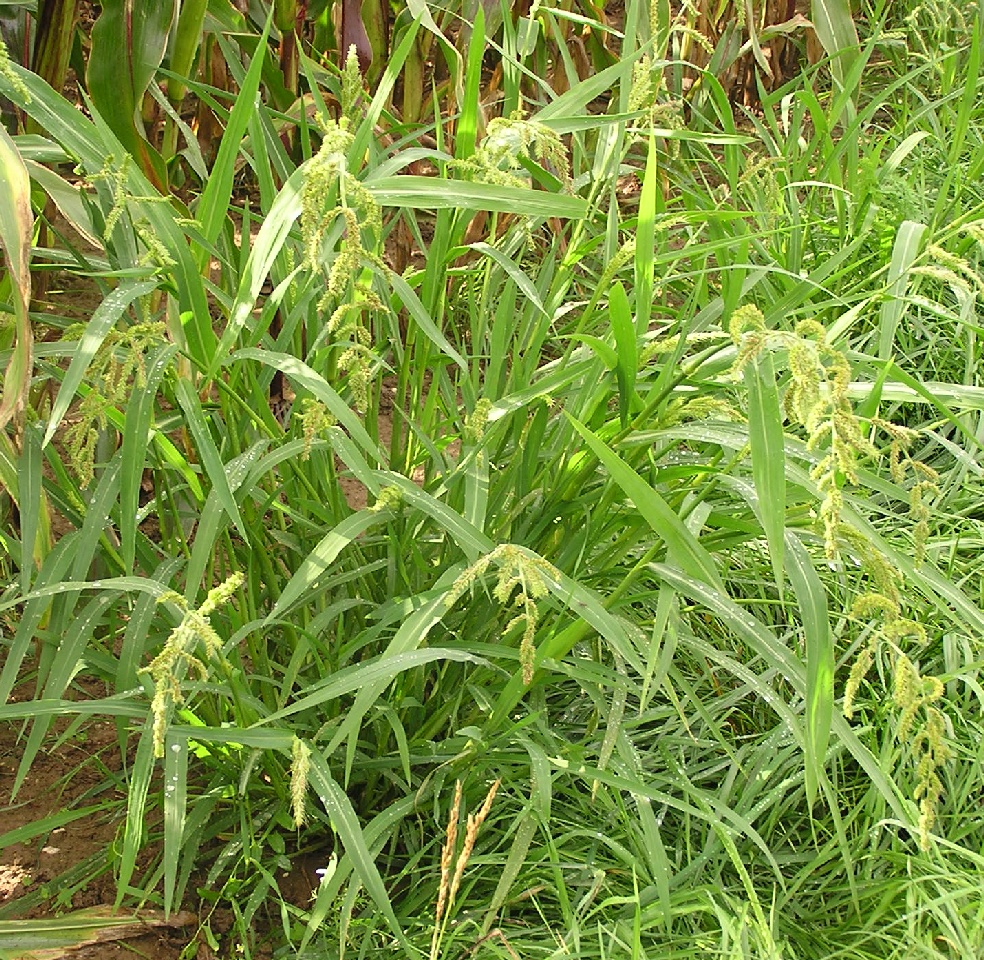
Barnyard grass (Echinochloa crus-galli) is a fast-growing annual grass native to tropical and warm temperate Asia, characterized by its reddish-purple, clustered seed heads and flattened reddish stem bases.
A single plant can produce up to 40,000 seeds per season, making it a prolific agricultural competitor in rice paddies, irrigated corn crops, and damp turf lawns across the world.
Key Facts
- Plant Type: Warm-season annual grass
- Height: 30–150 cm (1–5 ft)
- Key Identifier: Completely lacks a ligule at leaf junctions
- Seed Production: Up to 40,000 seeds per plant
- Habitat: Moist soils, ditches, flooded fields, and crop borders
- Control: Pre-emergent herbicides or hand-pulling before seed drop
What Is Barnyard Grass Like in the Field
Barnyard grass is an aggressive annual weed that germinates when soil temperatures reach 13–15 °C (55–60 °F) in late spring.
The plant forms broad, tufted bunches with upright culms that reach 30 to 150 cm (1 to 5 ft) in height. Its rapid vegetative growth allows it to outcompete emerging grain crops and turfgrasses for nitrogen and moisture within four weeks of germination.
Because it thrives in moist ground, it dominates wet depressions, irrigation channels, and cultivated fields across agricultural regions worldwide.
How to Identify Barnyard Grass
To confirm you are looking at barnyard grass, examine the leaf collar: it is the only common agricultural grass with no ligule and no auricles whatsoever.
Look for these distinct botanical characteristics across the plant:
- Leaf Collar: Smooth junction where the leaf blade meets the sheath, with zero hairs, membrane, or ligule.
- Stems: Compressed and distinctly flattened at the base, often showing a reddish-purple tint.
- Leaves: Hairless, flat blades 10–50 cm (4–20 in) long and up to 2 cm (0.8 in) wide, with a light-coloured midrib.
- Seed Head: Terminal panicle 10–25 cm (4–10 in) long, carrying dense, nodding green or dull purple spikelets with or without bristly awns up to 10 mm (0.4 in) long.
Where Does Barnyard Grass Grow
Barnyard grass occurs in full sun and saturated or wet soil, including flooded basins, road ditches, riverbanks, and agricultural row crops.
While native to Eurasia, the grass has established naturalized colonies in over 60 countries across every continent except Antarctica. It shows high tolerance to temporary waterlogging and heavy clay soils, making it a primary weed of flooded rice (Oryza sativa) production.
The species also invades over-watered turf lawns, vegetable garden beds, and edges of ponds where drainage is restricted.
How Barnyard Grass Spreads and Reproduces
Barnyard grass reproduces entirely by seed, with a single mature plant discharging between 2,000 and 40,000 seeds in late summer and autumn.
The seeds disperse through several common vectors:
- Irrigation Water: Flotation down ditches, canals, and flooded furrows into clean fields.
- Agricultural Equipment: Transfer of seed-laden mud on combine harvesters and tractor tires.
- Bird and Waterfowl Feathers: Physical transit on visiting aquatic wildlife.
- Contaminated Grain: Inclusion in poorly cleaned pasture or cover crop seed mixes.
Seeds can remain viable in moist soil for up to 3 to 5 years, though up to 90% of a cohort germinates or degrades within the first two years.
How to Control and Remove Barnyard Grass
Control of barnyard grass depends on preventing seed maturation before plants exceed 10 cm (4 in) in height.
To clear infestations in lawns, gardens, or crop rows, use these established methods:
- Hand Pulling: Uproot young tufts before the seed head emerges, ensuring the flattened stem crown is lifted from the soil.
- Mowing: Cut every 7 to 10 days; while plants can adapt by setting seed heads below normal deck height, regular cuts suppress seed volume.
- Pre-Emergent Herbicides: Apply pendimethalin or dithiopyr in spring before soil temperatures consistently exceed 13 °C (55 °F).
- Post-Emergent Herbicides: Spot-treat active young growth with quinclorac or clethodim according to label directions for specific turf and crop tolerances.
Ecological Role and Forage Value
Waterfowl consume barnyard grass seeds heavily during autumn migration, while livestock readily graze young foliage that contains 10–14% crude protein before flowering.
Ducks and geese strip the dense seed panicles in marshes and managed wetlands. Cattle and sheep accept the grass as green pasture forage when young, and farmers occasionally harvest wild stands for emergency hay.
However, forage utility drops rapidly after flowering as stems become fibrous and unpalatable, and nitrate toxicity risks spike on heavily fertilized fields.
Agricultural Impact and Weed Status
Barnyard grass ranks among the top three worst agricultural weeds in world rice farming, capable of reducing crop yields by 50% to 80% if unmanaged.
Beyond direct competition for light and nutrients, the species extracts up to 80% of available soil nitrogen early in the growing season. It also displays allelopathy, releasing phenolic compounds that suppress the germination and seedling vigour of surrounding crop species.
Extensive herbicide resistance has emerged worldwide, with populations demonstrating resistance to propanil, quinclorac, and ALS-inhibiting herbicides.
Barnyard Grass Look-Alikes and Similar Species
You can separate barnyard grass from look-alike species by its total lack of a ligule or hairs at the leaf sheath junction.
Look closely at these commonly confused species:
- Large Crabgrass (Digitaria sanguinalis): Has distinct hairy leaf sheaths and a prominent membranous ligule, unlike the completely smooth collar of barnyard grass.
- Yellow Foxtail (Setaria pumila): Features long hairs on the upper surface of the leaf blade near the base and a fringe of hairs for a ligule.
- Jungle Rice (Echinochloa colona): A close congener with distinct purple banding or zebra stripes across the leaf blades and shorter, un-awned spikelets.
- Green Foxtail (Setaria viridis): Bears a dense, brush-like cylindrical seed head rather than open, branched panicles.
Frequently Asked Questions
What is the difference between barnyard grass and crabgrass?
Barnyard grass completely lacks a ligule and hairs at the leaf junction, whereas large crabgrass (Digitaria sanguinalis) features a prominent membranous ligule and hairy sheaths. Barnyard grass also has a branched, purple-tinged panicle rather than the finger-like spikes of crabgrass.
Is barnyard grass an annual or perennial?
Barnyard grass is an annual grass that completes its entire life cycle from spring germination to autumn seed drop within a single frost-free season. The parent plant dies with winter frosts, leaving seeds to overwinter in the soil.
Is barnyard grass edible for humans?
The seeds are edible and have been gathered in traditional cultures as wild millet, ground into flour or boiled like porridge. However, seeds harvested from agricultural fields should not be eaten due to potential herbicide contamination.
Is barnyard grass good for hay?
It can be cut for hay if harvested before the flowering stage when crude protein sits between 10% and 14%. Once the coarse seed panicles emerge, palatability drops sharply and nitrate accumulation can pose a toxicity hazard to livestock.
What herbicide kills barnyard grass?
Selective herbicides such as quinclorac and clethodim control young, emerged barnyard grass, while pre-emergent products containing pendimethalin or dithiopyr stop seedlings from sprouting. Always verify product labels for turfgrass or crop compatibility.
Sources & Verification
Taxonomy and distribution are checked against the databases below. Care guidance is written for cultivated species only and reviewed by our editor. How We Build Plant Profiles →
- Kew Plants of the World OnlineTaxonomic status and native distribution
- USDA NRCS Plant GuideBiological characteristics and agricultural habits
- University of California Statewide Integrated Pest Management ProgramIdentification characteristics and chemical control
- GBIF — Global Biodiversity Information Facilitytaxonomy, synonyms, occurrence records
- Wikipediageneral reference