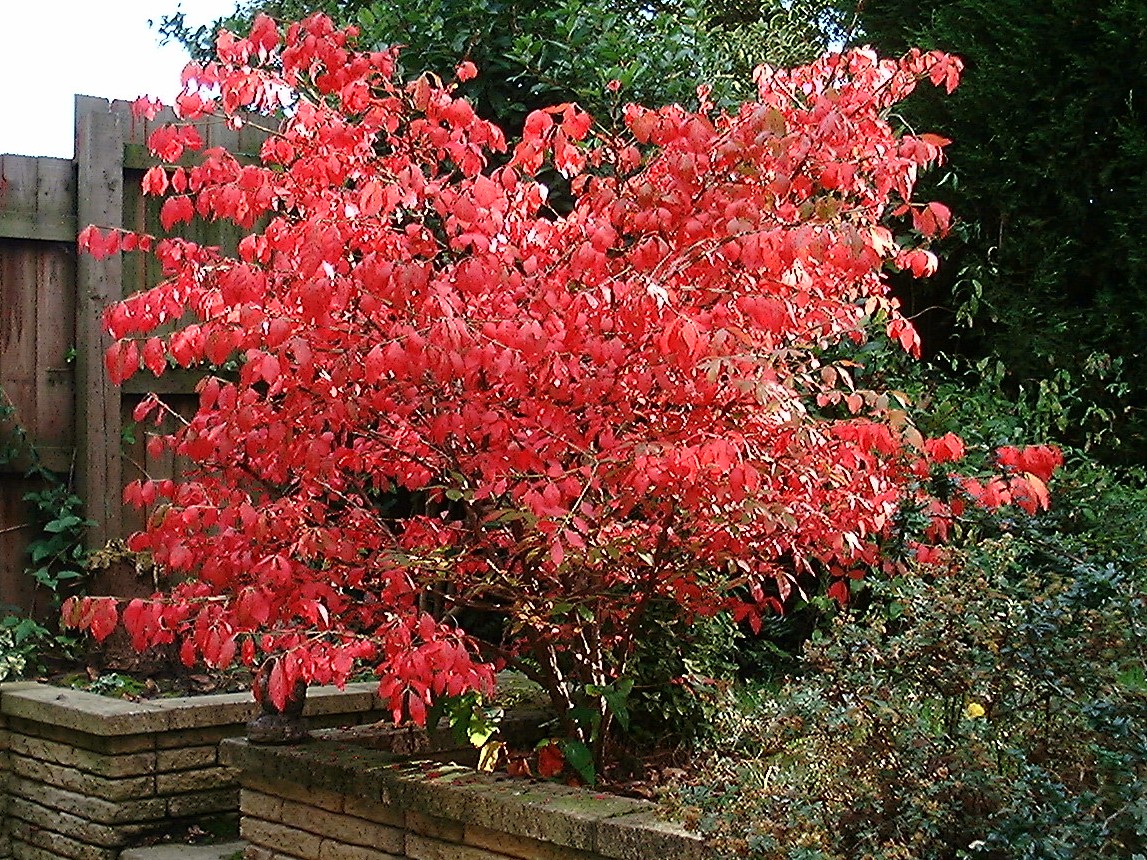
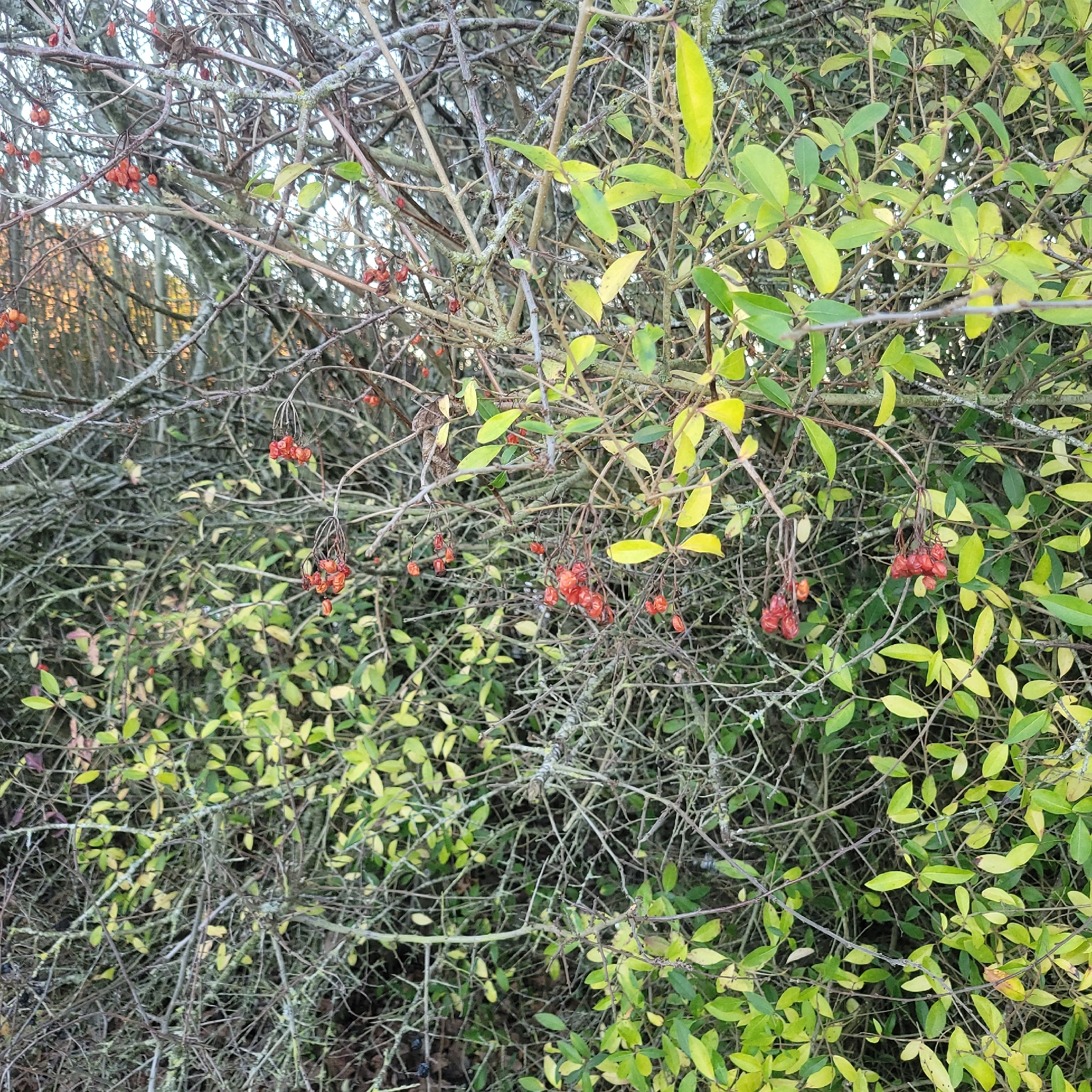
Japanese spindle (Euonymus japonicus) is an evergreen broadleaf shrub native to coastal areas of Japan, Korea, and eastern China, distinguished by leathery, oval leaves with shallowly serrate margins. It thrives in maritime salt spray and urban pollution where other formal hedging plants fail.
Its main vulnerability is foliar disease: without full air circulation, powdery mildew and scale insects rapidly defoliate the dense interior stems.
Key Facts
- Plant type: Broadleaf evergreen shrub
- Hardiness: USDA Zones 7–9 (hardy to -15 °C / 5 °F)
- Mature height: 2–4 m (6.5–13 ft) unpruned
- Growth rate: 20–30 cm (8–12 in) per year
- Soil tolerance: Clay, sand, chalk, and salt-laden ground
- Toxicity: Toxic to humans, dogs, and cats if eaten
Is Japanese Spindle Right for Your Garden?
Japanese spindle suits gardeners who need a dense, wind-resistant evergreen hedge that stays green year-round in coastal or urban environments. It withstands gale-force ocean winds and street-level exhaust that scorch boxwood (Buxus sempervirens) or cherry laurel (Prunus laurocerasus).
It is not ideal for perpetually damp, heavily shaded courtyards. High humidity combined with stagnant air creates chronic powdery mildew and scale outbreaks that require seasonal intervention.
Botanical Features and Identifying Traits
The plant is distinguished by opposite, leathery leaves measuring 3–7 cm (1.2–2.8 in) long with blunt serrations along the outer edge. The upper leaf surface is dark green and glossy, while the undersides are pale matte green on smooth, erect green twigs.
In June and July, four-petaled flowers appear in axillary cymes:
- Flower size: 5 mm (0.2 in) across
- Flower color: Pale greenish-white with four distinct stamens
- Fruit: Smooth, pinkish-white capsules that split open in autumn to reveal orange-coated seeds (arils)
- Bark: Grey-brown with fine vertical fissuring on mature trunks
Mature Size and Growth Rate
Standard forms reach a mature height of 2–4 m (6.5–13 ft) and a spread of 1.5–2.5 m (5–8 ft) if left unclipped. Annual growth averages 20–30 cm (8–12 in) under optimal garden conditions.
Dwarf varieties such as ‘Microphyllus’ stay under 1 m (3.3 ft), making them direct substitutes for dwarf box. In hedge form, shear plants twice during the growing season to maintain them at any set height between 1 m (3.3 ft) and 3 m (10 ft).
Site Selection and Sun Exposure
Japanese spindle performs best in full sun to partial shade with at least 4–6 hours of direct sunlight daily. Variegated cultivars lose their gold or silver margins and revert toward green when planted in dense shade.
The root system tolerates almost any soil type from pH 6.0 to 8.0, including heavy clay, shallow chalk, and coastal sands, provided standing water drains within 2 hours after heavy rain. Avoid depressions where cold air and winter moisture settle.
How to Plant Japanese Spindle
Plant container-grown specimens in autumn or early spring while the soil retains warmth and moisture. Dig a hole twice as wide as the root ball and equal to its depth.
Follow these spacing guidelines based on your design:
- Dense formal hedge: Space plants 40–50 cm (16–20 in) apart in a single trench
- Screening border: Space plants 75–100 cm (30–39 in) apart
- Individual specimen: Allow 1.5 m (5 ft) of clearance on all sides
- Watering after planting: Apply 10–15 L (2.6–4 gal) of water directly to the base to settle the soil
Japanese Spindle Care: Watering and Fertilizer
Established shrubs require watering only during drought periods exceeding 2–3 weeks without measurable rain. In their first two seasons, apply 15 L (4 gal) of water per plant once a week from May to September.
Apply a balanced 10-10-10 granular fertilizer at a rate of 50 g per square meter (1.5 oz per square yard) in early April. Do not feed after July, as late flushes of soft green growth will suffer winter kill during the first hard frost.
How to Prune Japanese Spindle Tree
Prune formal hedges and topiary twice per year, first in May and again in September. This schedule controls shape without removing dormant overwintering buds.
To trim and manage growth effectively:
- Formal hedges: Shear sides with a slight taper toward the top (batter) so lower foliage receives direct sunlight
- Renovation: Cut overgrown, leggy stems back by up to one-third in late March just before spring bud burst
- Sanitation: Remove all dead, crossing, or scale-encrusted branches down to the main framework
- Clean tools: Wipe shear blades with 70% isopropyl alcohol between shrubs to prevent fungal transmission
Japanese Spindle Flies, Scale, and Fungal Problems
The two primary threats are euonymus scale (Unaspis euonymi) and powdery mildew (Erysiphe euonymi). Scale appears as tiny, white, needle-like encrustations along the undersides of stems and leaves, triggering premature yellowing and dieback.
Gardeners frequently observe clusters of flies and caterpillars on foliage in early summer:
- Spindle ermine moth: Caterpillars (Yponomeuta cagnagella) weave thick silk webbing and strip foliage in May; blast them off with a hose or prune out webs
- Spindle flies: Flowers produce pungent nectar that attracts blowflies, flesh flies, and hoverflies, which act as primary pollinators
- Scale control: Spray dormant horticultural oil in late winter, followed by insecticidal soap during the nymph crawler stage in June
- Mildew control: Thin out internal branches to maximize airflow and avoid overhead evening sprinklers
Winter Hardiness and Cold Protection
Japanese spindle is reliably hardy down to -15 °C (5 °F), corresponding to USDA Zone 7. Below this threshold, drying winter winds scorch the glossy leaves, turning leaf margins brown and papery.
Potted shrubs and bonsai require root protection when temperatures drop below -5 °C (23 °F), as container roots freeze much faster than in-ground root balls. Move containers against a sheltered house wall or wrap the pots in burlap.
Landscape Uses and Bonsai Culture
Japanese spindle serves as a dense coastal windbreak, foundation hedge, or compact topiary. Its salt tolerance makes it a dominant windbreak choice along Atlantic, Pacific, and European shorelines.
It is also trained as a bonsai subject due to its small leaves, rapid budding on old wood, and tolerance of hard root pruning. For bonsai, wire flexible 1- to 2-year-old branches in late spring, and repot every 2 years using an aggregate mix containing 60% akadama and 40% pumice.
Japanese Spindle Care Through the Seasons
| Spring | Apply a balanced granular fertilizer in April. Prune back winter-damaged stems and spray horticultural oil if euonymus scale nymphs appear on new shoots. |
|---|---|
| Summer | Shear hedges in late June. Water young plantings with 15 L (4 gal) weekly during dry spells, and inspect interior branch crotches for ermine moth webbing. |
| Autumn | Complete the final hedge trim in early September. Clear fallen leaves beneath shrubs to reduce overwintering powdery mildew spores, and water deeply before the ground freezes. |
| Winter | Shake heavy, wet snow off branches to prevent splaying. Move container-grown specimens to a wind-sheltered wall to protect root systems from freezing. |
Diagnosing Common Japanese Spindle Problems
| What you see | Likely cause | What to do |
|---|---|---|
| White, crusty specks coating stems and yellowing leaves | Euonymus scale infestation | Prune severely infested branches and spray the remaining stems with horticultural mineral oil during the spring crawler stage. |
| White powdery coating across leaf surfaces | Powdery mildew fungal infection | Thin the interior canopy to improve air circulation and treat foliage with a sulfur-based fungicide or potassium bicarbonate spray. |
| Silk webbing enclosing defoliated twigs in late spring | Spindle ermine moth caterpillars | Cut out and dispose of the silk nests immediately, or spray with Bacillus thuringiensis while caterpillars are small. |
| Brown, scorched leaf margins after cold periods | Winter wind desiccation | Water deeply before winter freezes and erect a burlap windbreak on windward sides. |
Selected Japanese Spindle Cultivars
- ‘Green Spire’ – narrow, upright column growing to 2 m tall
- ‘Aureomarginatus’ – dark green leaves with bright yellow margins
- ‘Ovatus Aureus’ – broad golden-yellow borders, compact shrub form
- ‘Microphyllus’ – miniature box-like leaves reaching 1 m maximum
- ‘Silver Queen’ – deep green foliage with broad creamy-white margins
Frequently Asked Questions
Is Japanese spindle tree invasive?
Japanese spindle is listed as invasive in parts of the eastern United States, particularly from Maryland to Georgia, where escaped garden plants colonize woodland edges. It rarely invades natural habitats in northern Europe or maritime climates, but berries can be spread into wild spaces by birds.
How to propagate Japanese spindle?
Propagate by taking 10–15 cm (4–6 in) semi-ripe cuttings in July or August. Dip the cut base in rooting hormone powder, insert into a 50/50 mix of perlite and peat substitute, and keep under high humidity for 6–8 weeks until roots form.
Why does my Japanese spindle attract so many flies?
Japanese spindle flowers secrete an exposed, open pool of nectar that specifically attracts flies and hoverflies for pollination rather than bees. The insect activity lasts for 2–3 weeks in early summer while the greenish blossoms remain open.
Can you grow Japanese spindle tree as a bonsai?
Yes, Japanese spindle adapts readily to bonsai cultivation due to its ability to back-bud on old wood and withstand hard canopy reduction. Cultivars like 'Microphyllus' with small foliage are preferred for smaller tree styles.
How far apart should I plant a Japanese spindle hedge?
Space plants 40–50 cm (16–20 in) apart for a dense, continuous formal hedge. For taller, loose screening, increase spacing to 75–100 cm (30–39 in).
Sources & Verification
Taxonomy and distribution are checked against the databases below. Care guidance is written for cultivated species only and reviewed by our editor. How We Build Plant Profiles →
- Royal Horticultural SocietyCultivar profiles and pruning guidance
- North Carolina State ExtensionPlant characteristics and landscape toxicity data
- Missouri Botanical GardenGrowing requirements and pest management
- GBIF — Global Biodiversity Information Facilitytaxonomy, synonyms, occurrence records
- Plants of the World Online (Kew)accepted name, native range
- Wikipediageneral reference