
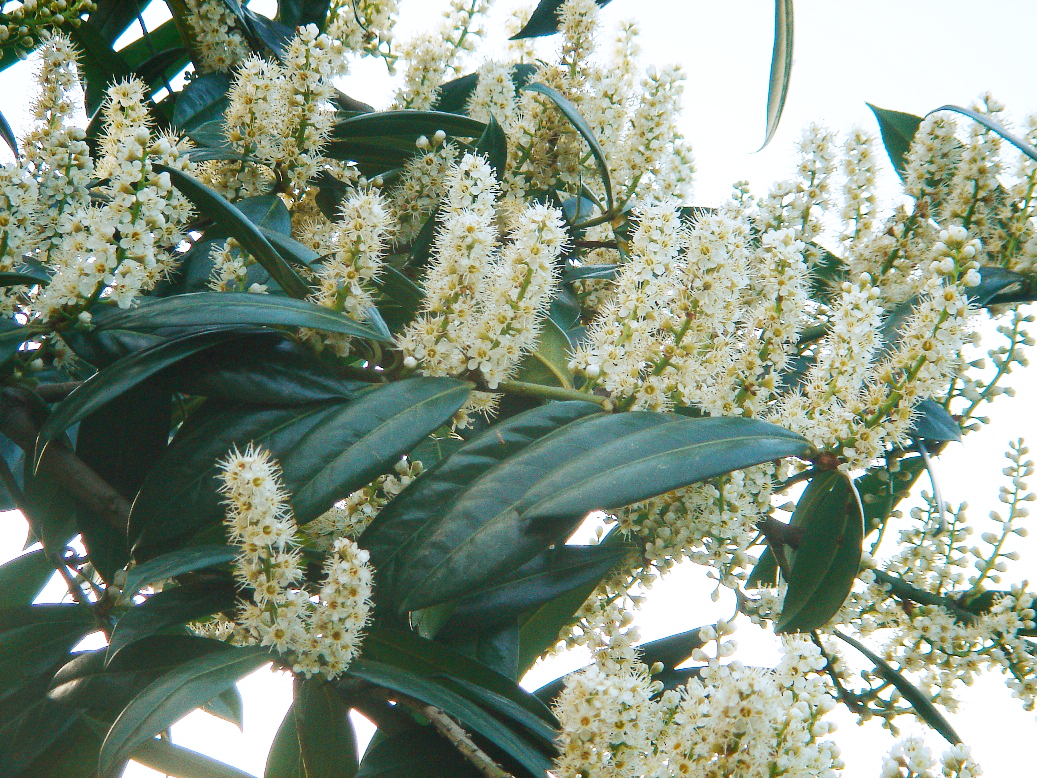
Cherry laurel (Prunus laurocerasus) is a large evergreen shrub native to southeastern Europe and southwestern Asia, recognisable by its thick, lustrous foliage and upright racemes of fragrant white flowers.
It tolerates dry shade and compacted clay where other boundary plants thin out, but its leaves and seeds release hydrogen cyanide when crushed or ingested, making it unsuitable alongside livestock paddocks.
Key Facts
- Growth rate: 30–60 cm (12–24 in) per year
- Hardiness: USDA zones 6–9 (hardy to -15 °C / 5 °F)
- Pruning window: Late spring (June) or early autumn (September)
- Hedging spacing: 60–90 cm (24–36 in) apart
- Toxicity: Foliage, stems, and berry kernels are poisonous
Is Cherry Laurel Right for Your Garden?
Cherry laurel works best when you need an impenetrable, fast-forming evergreen barrier to block traffic noise, wind, or visual intrusion. It thrives in neglected boundary strips where poor soil and tree root competition starve more delicate hedging options.
It does not suit narrow borders or small courtyard gardens without aggressive annual maintenance. Unchecked specimens quickly reach the proportions of a multi-stemmed woodland tree, shading neighbouring beds and outcompeting smaller perennials.
Cherry Laurel Botanical Appearance and Fruit
The shrub is defined by leathery, oblong-lanceolate leaves measuring 10–20 cm (4–8 in) long with glossy, dark green upper surfaces and pale, matte undersides. In April and May, upright flower spikes 8–15 cm (3–6 in) long carry dozens of creamy white, five-petalled flowers with a sweet, almond scent.
The flowers develop into conical drupes, turning from green to red before ripening into glossy, dark purple-black berries in late summer. While the related Portuguese laurel (Prunus lusitanica) displays distinct wine-red leaf stalks and smaller foliage, cherry laurel retains stout green petioles.
Cherry Laurel Growth Rate and Mature Size
An established cherry laurel puts on 30 to 60 cm (12 to 24 in) of new stem growth every year under normal conditions. In rich, moisture-retentive ground, shoots can extend by up to 90 cm (36 in) in a single season.
Left unpruned, standard types will reach a mature height of 6–8 m (20–26 ft) with an equal spread, forming a dense, domed canopy. Dwarf or spreading cultivars such as ‘Otto Luyken’ cap their growth naturally at 1–1.5 m (3.3–5 ft), reducing the need for structural cutting.
Ideal Position and Soil Conditions
This shrub tolerates almost any light condition, growing reliably in full sun, dappled woodland light, or deep shade under mature tree canopies. Sunlight encourages denser flower spikes and tighter branching, whereas specimens grown in heavy shade develop slightly larger, thinner leaves.
It succeeds in neutral, acidic, and alkaline soils ranging from pH 5.5 to 7.8, including heavy London clay, limestone brash, and sand. The only ground it cannot endure is waterlogged, swampy earth where stagnant water pools for days after rain.
How to Plant a Cherry Laurel Hedge
Space rootball or container-grown plants 60 to 90 cm (24 to 36 in) apart from centre to centre for a solid, gap-free screen. Dig individual planting holes twice as wide as the root mass and match the depth precisely so the nursery soil line sits flush with the surrounding grade.
- Strip perennial weeds and turf in a 1 m (3.3 ft) wide strip along the boundary.
- Break up the base of the trench with a garden fork to allow root penetration.
- Position plants and firm the soil around rootballs with the heel of your boot to eliminate air pockets.
- Apply a 7 cm (3 in) layer of shredded bark mulch along the base, keeping it clear of main stems.
Watering and Feeding Cherry Laurel Trees and Shrubs
Give new plantings 15 to 20 litres (4 to 5 gallons) of water once a week from April to September during their first two years in the ground. Established shrubs develop deep, fibrous root networks and survive standard summer dry spells without supplemental irrigation.
Feed young plants each spring with a balanced general granular fertiliser, such as blood, fish, and bone at 70 g per square metre (2 oz per square yard). Avoid feeding after July, as late flushes of soft juvenile growth suffer frost scorching when winter sets in.
Cherry Laurel Pruning Times and Techniques
Prune your hedge with hand-held secateurs or loppers in late spring or early September to keep the foliage clean and intact. Avoid powered hedge trimmers whenever possible, as machine blades slice through the large leaves, leaving brown, tattered edges that remain visible for months.
- Cut back wild shoots just above a dormant leaf bud or side shoot to conceal cut wounds.
- Prune in late spring (May to June) immediately after flowering to shape the framework.
- Tidy late summer growth in September before autumn frosts begin.
- Rejuvenate overgrown hedges by cutting thick limbs back to 60 cm (24 in) from the base in late winter.
Cherry Laurel Care: Yellow Leaves and Common Pests
Yellow leaves near the base of the plant usually indicate waterlogging, natural leaf shedding, or severe nitrogen hunger. Old leaves turn completely pale yellow and drop naturally in early summer as vigorous new shoots emerge above them.
Check for irregular holes with purplish margins, which signify shothole disease caused by the bacterium Pseudomonas syringae or powdery mildew fungi. Vine weevil grubs (Otiorhynchus sulcatus) also target containerised laurels, severing underground roots and causing mature plants to collapse suddenly during dry weather.
Winter Care and Cold Hardiness
Established plants withstand winter temperatures down to -15 °C (5 °F) without wood damage or branch loss. Late spring frosts can crisp soft new shoots, but the plant breaks new buds within four weeks to replace damaged leaves.
In exposed, wind-swept locations, frozen soils coupled with bright winter sunlight can induce leaf scorch and desiccation. Shield vulnerable young plants with temporary windbreak netting during their first winter, and water thoroughly before the ground freezes solid in November.
Cherry Laurel Care Through the Seasons
| Spring | Spread 70 g/m² of balanced organic fertiliser along the drip line in March. Check for early aphids on fresh growth, and prune dead or frost-scorched wood back to healthy buds in April. |
|---|---|
| Summer | Trim hedge borders in June using secateurs to remove rogue shoots. Soak the root zone of shrubs planted within the last two years with 20 litres of water weekly during dry periods. |
| Autumn | Carry out a final hedge trim in early September to neaten lines before winter. Rake up fallen leaves, top up organic mulch to a depth of 7 cm (3 in), and plant new bare-root or rootballed stock. |
| Winter | Brush heavy wet snow off top branches to prevent wood from splitting under the weight. Undertake hard structural renovation pruning on old, overgrown specimens in late winter before spring sap rises. |
Solving Common Cherry Laurel Problems
| What you see | Likely cause | What to do |
|---|---|---|
| Lower leaves turning yellow and dropping | Natural foliage turnover or poor soil drainage causing root suffocation | Check soil moisture depth; if waterlogged, aerate surrounding soil and reduce supplementary watering. |
| Small circular holes with brown margins across leaves | Shothole disease triggered by bacterial or fungal pathogens | Prune out severely infected branches and clear fallen debris to lower surface humidity. |
| White powdery coating and distorted new shoots | Powdery mildew infection during warm, humid weather | Thin dense inner branches with secateurs to increase internal airflow and sunlight penetration. |
| Notched leaf margins and sudden unprompted wilting | Adult vine weevils chewing edges and larvae eating roots below ground | Drench root zones with beneficial entomopathogenic nematodes in late spring or early autumn. |
Popular Cherry Laurel Cultivars
- ‘Rotundifolia’ – broad leaves, standard choice for dense boundary screens
- ‘Novita’ – exceptional winter cold hardiness and increased mildew resistance
- ‘Otto Luyken’ – compact dwarf habit reaching 1 m (3.3 ft)
- ‘Caucasica’ – upright, narrow framework with darker, slender foliage
- ‘Etna’ – bronze-orange young spring shoots maturing to deep glossy green
Landscape Uses and Garden Companions
Cherry laurel is primarily employed as a tall privacy hedge, acoustic screen, or evergreen backdrop for mixed ornamental borders. Its dark green canvas provides year-round contrast against lighter foliage shrubs and flowering perennials.
Effective companion shrubs that share its soil tolerance include common box (Buxus sempervirens), cherry dogwood (Cornus mas), and bay laurel (Laurus nobilis). For contrast in large shrub borders, pair it with the deciduous foliage of common elder (Sambucus nigra) or guelder rose (Viburnum opulus).
Frequently Asked Questions
How fast does a cherry laurel hedge grow?
A healthy cherry laurel hedge grows between 30 and 60 cm (12 and 24 in) per year once established. In deep, fertile ground with adequate spring moisture, leader shoots can add up to 90 cm (36 in) in a single season.
When is the best time to prune cherry laurel in the UK?
The best time to prune cherry laurel in the UK is late spring (late May to June) after the initial growth flush, or late summer (September). Use hand secateurs rather than hedge trimmers to avoid slicing the broad leaves in half, which leaves brown dead edges.
Are cherry laurel berries poisonous?
Yes, cherry laurel berries and their seed kernels are poisonous to humans, dogs, cats, and livestock. The seeds contain cyanogenic glycosides that convert into toxic hydrogen cyanide when chewed and digested.
What is the difference between cherry laurel and Carolina cherry laurel?
Cherry laurel (Prunus laurocerasus) is native to southeastern Europe and Asia with thick, broad leaves up to 20 cm (8 in) long, whereas Carolina cherry laurel (Prunus caroliniana) is a smaller-leaved North American native tree suited to warmer zones that releases a potent maraschino-cherry scent when crushed.
Can cherry laurel grow in full shade?
Yes, cherry laurel tolerates deep, dry shade under mature trees where many other hedge species fail. Its leaves grow broader and deeper green in shady positions, though flowering will be sparser than in full sun.
Sources & Verification
Taxonomy and distribution are checked against the databases below. Care guidance is written for cultivated species only and reviewed by our editor. How We Build Plant Profiles →
- Royal Horticultural SocietyCultivar profiles and pruning guidance
- Kew Plants of the World OnlineNative distribution and taxonomy
- NC State Extension Gardener Plant ToolboxIdentification, dimensions, and toxicity profile
- GBIF — Global Biodiversity Information Facilitytaxonomy, synonyms, occurrence records
- Wikipediageneral reference
More in Prunus

Chinese Bush Cherry
Prunus japonica
☀️ Full Sun 💧 Moderate

Chickasaw Plum
Prunus angustifolia
☀️ Full Sun 💧 Moderate

Hollyleaf Cherry
Prunus ilicifolia
☀️ Full Sun 💧 Low

Japanese Plum
Prunus salicina
☀️ Full Sun 💧 Moderate

Higan Cherry
Prunus itosakura
☀️ Full Sun 💧 Moderate

Blackthorn
Prunus spinosa
☀️ Full Sun 💧 Moderate