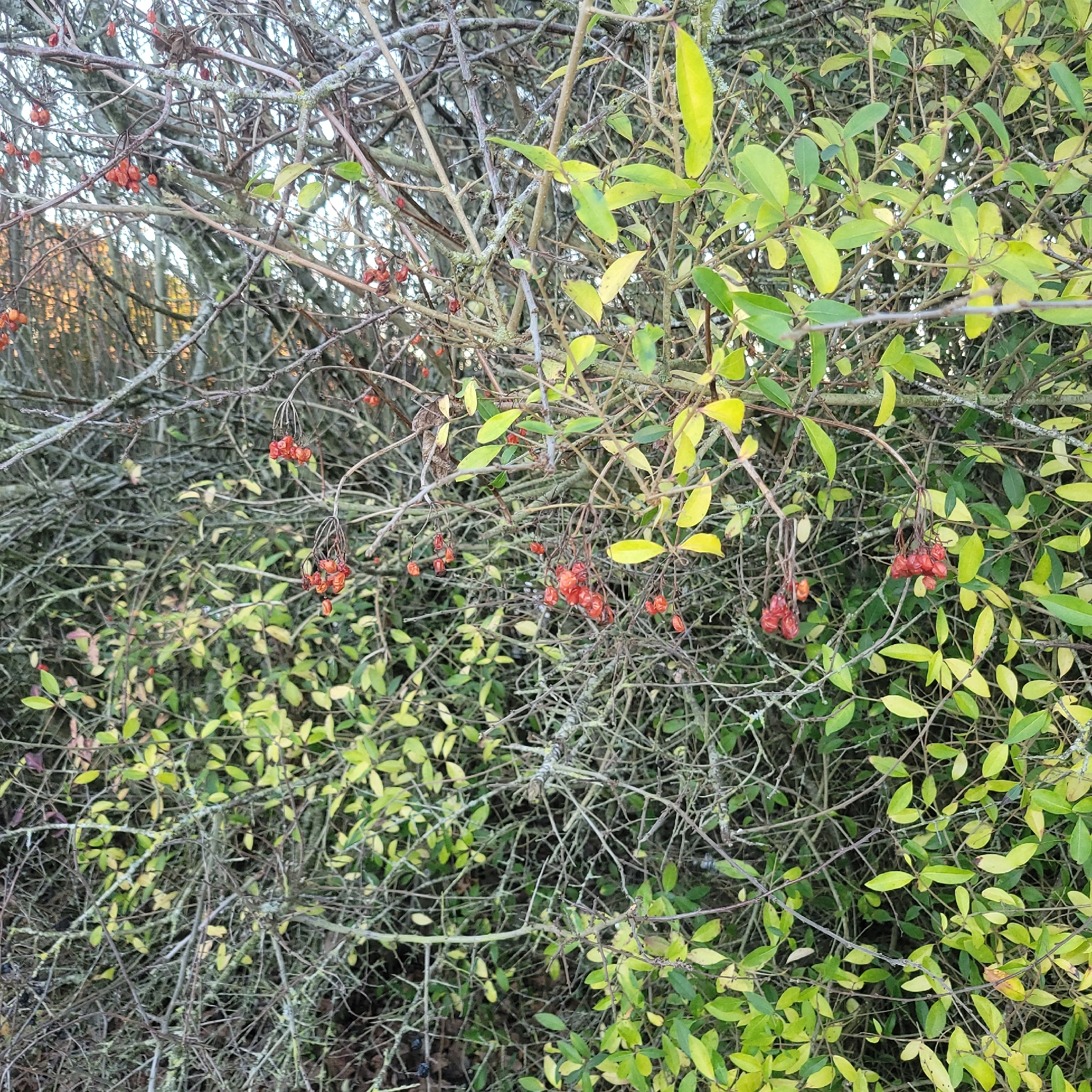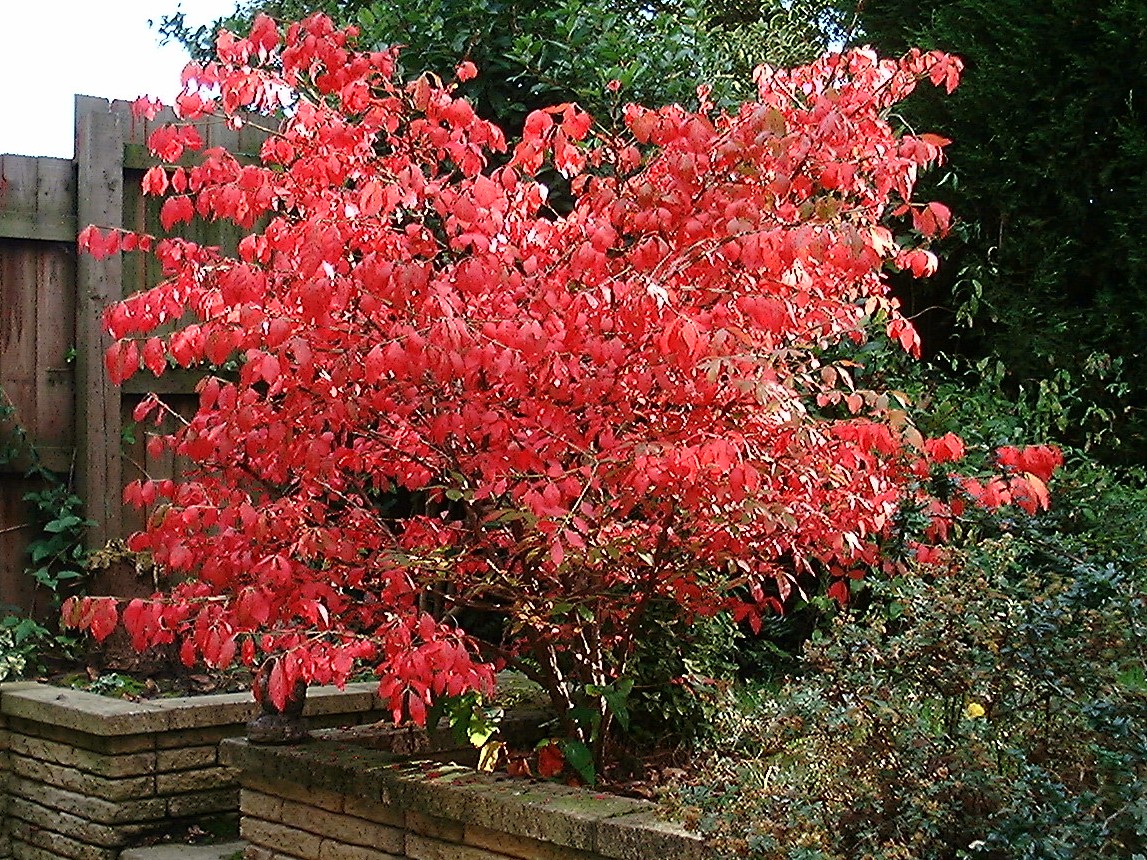
Burning bush (Euonymus alatus) is a deciduous shrub native to northern and central China, Japan, and Korea, known for its bright scarlet autumn foliage and four-angled corky stem ridges. It grows along moist woodland borders and stream banks in its native habitat.
In parts of eastern North America, burning bush spreads aggressively into native forests via bird-dispersed seeds. Check local environmental regulations before planting, or choose non-invasive cultivars like ‘Rudy Haag’.
Key Facts
- Growth habit: Deciduous multi-stemmed shrub
- Hardiness: USDA zones 4 through 8
- Light: Full sun to partial shade
- Height: 1.5 to 3 m (5 to 10 ft)
- Fall color: Crimson to scarlet foliage
- Soil pH: 6.0 to 7.5
Is Burning Bush Right for Your Yard?
Burning bush suits landscapes in USDA hardiness zones 4 through 8 where deep fall foliage color and winter branch texture are desired. It survives cold winter temperatures down to -34 °C (-30 °F) and tolerates urban clay soils.
Because birds consume the small berries and drop seeds in wild areas, Euonymus alatus is listed as invasive in several eastern US states including Massachusetts and Maine. Choose an isolated planting site or select sterile selections to prevent naturalization.
- Best placement: Border hedges, screen plantings, or specimen shrubs
- Cold limit: Fully hardy to -34 °C (-30 °F)
- Sun requirement: At least 6 hours of direct sun daily
- Maintenance: Low pruning needs once established
Burning Bush Identification and Physical Traits
You can identify burning bush by the two to four corky wings that run lengthwise along its gray-green, four-angled stems. Leaves grow in opposite pairs along the branches, measuring 3 to 7 cm (1.2 to 2.8 in) long with fine teeth along the edges.
In May, small yellowish-green four-petaled flowers bloom in clusters of three, measuring 5 mm (0.2 in) across. These mature by September into four-lobed reddish capsules that split open to display bright orange seed arils.
Foliage changes from dark green to intense pinkish-red or crimson starting in late September. Older stems lose their corky wings over time, leaving dark gray, shallowly grooved bark.
How Big Does a Burning Bush Get?
Standard burning bush shrubs mature to 1.5 to 3 m (5 to 10 ft) in height and spread, growing about 15 to 30 cm (6 to 12 in) annually. Compact selections reach smaller mature dimensions after 10 years of growth.
Unpruned shrubs develop a rounded, vase-shaped crown with multiple stems arising near the ground. Root systems remain shallow, expanding outward within the upper 30 cm (12 in) of soil to match the spread of the leaf canopy.
Where to Plant Burning Bush
Site burning bush in full sun receiving 6 or more hours of direct light to produce intense autumn pigmentation. Shaded sites cause leaves to turn pale yellow-green instead of red in October.
This shrub tolerates loamy, sandy, or heavy clay soils with a pH between 6.0 and 7.5. Avoid low-lying areas where water pools for longer than 24 hours, as saturated roots cause leaf drop.
How to Plant Burning Bush
Dig a hole two to three times wider than the root ball and equal to its depth, keeping the top of the root crown level with the soil surface. Space individual shrubs 1.5 to 2 m (5 to 6.5 ft) apart when planting a continuous hedge.
Backfill with soil, firm gently around the base, and drench the root zone with 15 L (4 gal) of water. Spread a 5 to 7 cm (2 to 3 in) layer of wood mulch around the base, keeping it 10 cm (4 in) clear of the stem bark.
- Hole dimensions: 2 to 3 times root ball width
- Hedge spacing: 1.5 to 2 m (5 to 6.5 ft) on center
- Initial water: 15 L (4 gal) at planting
- Mulch depth: 5 to 7 cm (2 to 3 in) layer
Burning Bush Care and Maintenance
Water young burning bush plants with 2.5 cm (1 in) of water per week during their first two seasons until roots establish. Established shrubs survive summer dry spells and require supplemental irrigation only after three rainless weeks.
Apply 50 g per square meter (1.6 oz per square yard) of 10-10-10 granular fertilizer in March as new buds break. Avoid feeding after July, as late nitrogen applications produce soft stem growth that suffers winter freeze damage.
Burning Bush Pruning Time and Technique
Prune burning bush in late winter or early spring while the shrub remains dormant before leaf buds open in April. Use bypass pruners and loppers to remove dead, rubbing, or damaged branches at their point of origin.
Overgrown shrubs tolerate hard renewal pruning, where you cut all stems back to 15 to 30 cm (6 to 12 in) above soil level in March. Hand-pruning with bypass shears preserves the natural winged bark texture better than mechanical hedge trimmers.
- Pruning window: February through March before bud break
- Primary tools: Hand pruners, bypass loppers, pruning saw
- Hedge shape: Keep top narrower than bottom for sunlight entry
- Hard rejuvenation: Cut down to 15–30 cm (6–12 in) from ground
Common Burning Bush Pests and Diseases
Monitor stem bark for euonymus scale (Unaspis euonymi), small white or dark gray armored insects that cause leaf yellowing and stem dieback. Spray branches with dormant horticultural oil in early spring before eggs hatch in May.
Two-spotted spider mites (Tetranychus urticae) multiply on leaf undersides during dry summer weather above 30 °C (86 °F), turning foliage yellow or brown. Spraying leaf undersides with strong water sprays or insecticidal soap reduces mite counts.
Burning Bush Winter Care
Protect stem bases from rabbits and voles during winter by installing a 60 cm (24 in) cylinder of hardware cloth around the trunk. Rodents chew the tender winged bark when snow hides ground cover, girdling low branches.
Apply a 7 cm (3 in) layer of shredded bark mulch over the root zone in late autumn after the ground freezes. Winter watering is unnecessary once the plant drops its leaves and enters winter dormancy.
Uses and Environmental Impact of Burning Bush
Landscapers use burning bush for accent planting, privacy screening, and autumn color displays. In traditional East Asian herbal practices, dried stem wings and bark were used historically under the name Gui Jian Chu.
Wild birds eat the orange seeds and scatter them into native habitats, where Euonymus alatus displaces native shrubs like eastern burning bush (Euonymus atropurpureus) and highbush blueberry (Vaccinium corymbosum). Select native alternatives where naturalization poses a local concern.
Year-Round Care for Burning Bush
| Spring | Prune dead or rubbing branches in March before leaf buds break. Apply 50 g per square meter (1.6 oz per square yard) of 10-10-10 slow-release fertilizer. |
|---|---|
| Summer | Provide 2.5 cm (1 in) of water weekly during periods with no rainfall. Spray leaf undersides with water to deter spider mites during hot spells above 30 °C (86 °F). |
| Autumn | Rake fallen leaves around the base to reduce pest overwintering sites. Check stems for scale insects after foliage drops in late October. |
| Winter | Install a 60 cm (24 in) hardware cloth guard around the base to prevent rodent gnawing. Replenish mulch layer to 7 cm (3 in) depth after the first freeze. |
Burning Bush Problems and Diagnostic Guide
| What you see | Likely cause | What to do |
|---|---|---|
| Yellowing leaves and white crust on stems | Euonymus scale insect infestation | Apply horticultural oil spray in early spring before crawler activity begins in May. |
| Dull yellow-green autumn leaf color | Insufficient direct sunlight exposure | Relocate the plant to a position receiving at least 6 hours of full sun daily. |
| Speckled gray foliage with fine web strands | Two-spotted spider mites in hot weather | Spray leaf undersides daily with water or apply insecticidal soap. |
| Stripped bark near ground level in spring | Winter feeding by rabbits or voles | Enclose lower stems in hardware cloth mesh rising 60 cm (24 in) high. |
Burning Bush Cultivars Compared
- ‘Compactus’ – dwarf selection growing 1.5–2 m (5–6.5 ft) tall with dense branching
- ‘Rudy Haag’ – slow-growing sterile form reaching 1–1.5 m (3–5 ft) with minimal seed set
- ‘Timber Creek’ (Chicago Fire) – upright form with bright crimson autumn foliage
- ‘Fire Ball’ – winter-hardy selection to zone 4 with tight globular branch structure
Frequently Asked Questions
Is burning bush invasive?
Yes, burning bush (Euonymus alatus) is listed as invasive in over twenty US states, mainly in the Northeast and Midwest. Birds spread the seeds into natural woodlands, where dense growth displaces native understory plants.
When is the best time to prune a burning bush?
Prune burning bush in late winter or early spring between February and March while the plant is dormant. Pruning before new growth begins allows you to reshape stems and remove dead branches without reducing autumn leaf display.
How fast does a burning bush grow?
Burning bush grows at a slow rate of 15 to 30 cm (6 to 12 in) per year. Shrubs take 3 to 5 years after planting to establish a full root network and reach maximum growth rates.
What does the burning bush symbolize in the Bible?
In Exodus 3:2, the burning bush represents divine presence and miraculous survival, as the bush burned without being consumed. The ornamental shrub Euonymus alatus earned its common name from its scarlet autumn leaves, not from direct botanical relation to the biblical account.
Why are my burning bush leaves not turning red?
Leaves fail to turn red if the shrub receives fewer than 6 hours of direct sunlight per day. Late summer fertilizer applications high in nitrogen also impair red pigment synthesis in autumn.
Is burning bush toxic to dogs and cats?
Yes, all parts of burning bush are toxic to dogs, cats, and horses because they contain cardiac glycosides and alkaloids. Ingestion causes vomiting, diarrhea, abdominal pain, and weakness.
Information about traditional or historical uses is provided for educational interest only and is not medical advice. Do not use any plant to treat a condition without speaking to a qualified professional.
Sources & Verification
Taxonomy and distribution are checked against the databases below. Care guidance is written for cultivated species only and reviewed by our editor. How We Build Plant Profiles →