
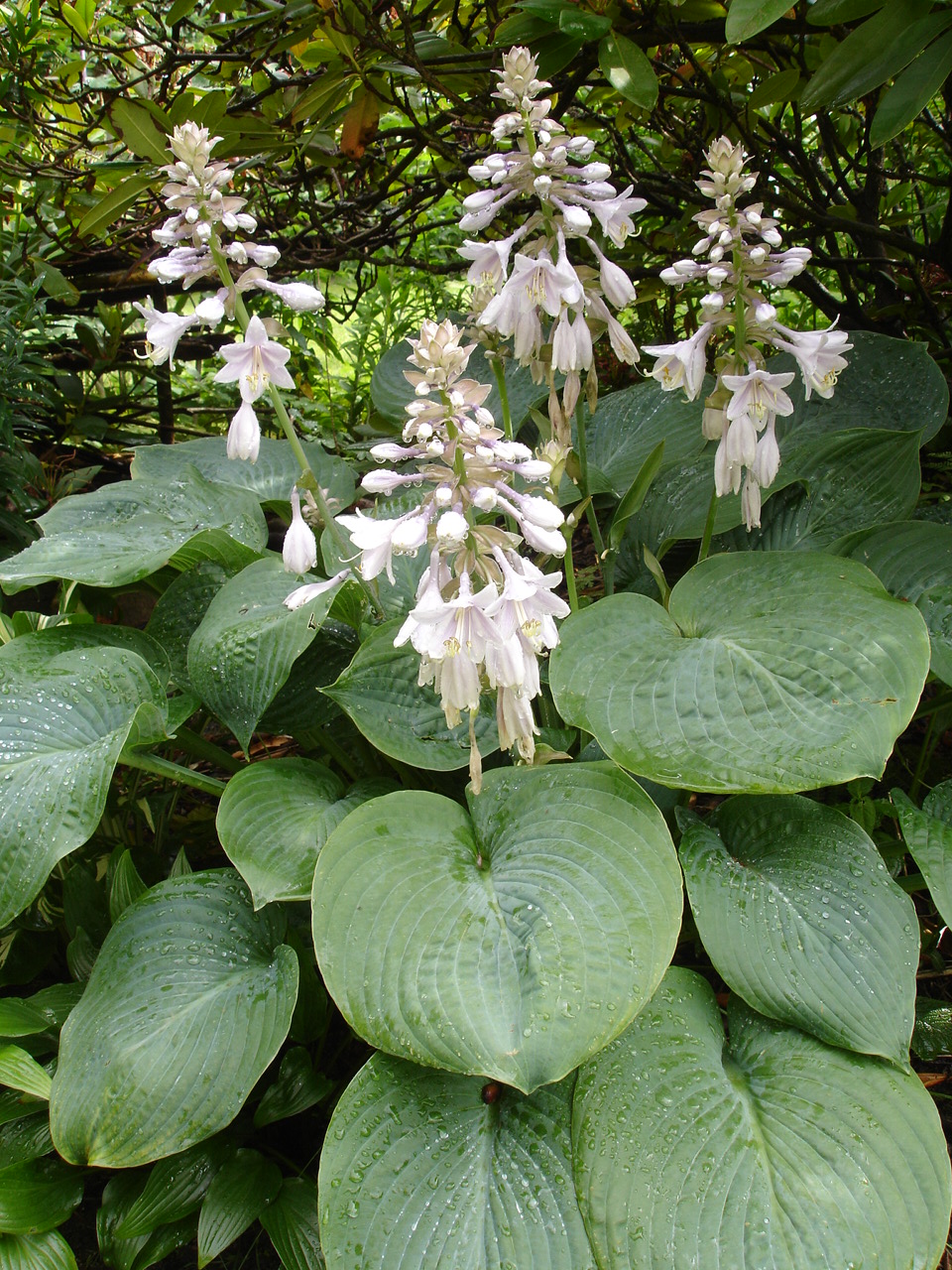
Siebold’s plantain lily (Hosta sieboldiana) is a long-lived herbaceous perennial native to Japan, recognised for its massive, heart-shaped, glaucous blue-grey leaves with deep corrugated veining. It anchors cool, moist garden borders and woodland plantings across temperate climates.
This species requires steady soil moisture and complete protection from hot midday sun, which strips the protective blue wax layer from its foliage and scorches leaf margins within hours.
Key Facts
- Light: Partial to full shade
- Water: 2.5 to 5 cm (1 to 2 in) weekly
- Soil: Moist, rich, well-drained loam (pH 6.0–7.0)
- Height: 60–90 cm (24–36 in)
- Spread: 90–150 cm (3–5 ft)
- Hardiness: USDA Zones 3–8
Is Siebold’s Plantain Lily Right for Your Garden?
Siebold’s plantain lily suits shaded, sheltered sites with rich soil and steady moisture levels. It requires a dedicated footprint in the landscape, spreading up to 150 cm (5 ft) across at maturity. Gardeners in dry, exposed, or windy settings will struggle to maintain its foliage quality.
This plant suits gardeners who want reliable, architectural ground coverage beneath mature tree canopies. It thrives in regions with cold winters, needing cold dormancy to reset growth each spring.
- Needs at least 700 hours of winter temperatures below 4 °C (40 °F)
- Foliage reaches maximum spread within 4 to 6 years of planting
- Unsuitable for thin, sandy soils that dry out rapidly
Botanical Identification and Appearance
Siebold’s plantain lily forms a dense, symmetrical mound of thick, cordate leaves measuring up to 40 cm (16 in) long and 30 cm (12 in) wide. The leaves feature heavy seersucker corrugation with 12 to 14 pairs of distinct veins arching toward the leaf tip.
A powdery, epicuticular wax covers both leaf surfaces, giving the blade an opaque chalky-blue or glaucous tint in spring. As temperatures rise and rain erodes this coating through the summer months, the foliage shifts toward dull blue-green.
In early summer, stout, unbranched flower scapes rise 70 to 100 cm (28 to 40 in) high, just above the leaf mound. Funnel-shaped, near-white to very pale lilac blooms open sequentially from the bottom to the top of each raceme over 3 to 4 weeks.
Sun or Shade: Where to Plant Siebold’s Plantain Lily
Plant Siebold’s plantain lily in dappled shade, morning sunlight, or full open shade. Exposure to direct midday or afternoon sun degrades the blue wax bloom and causes large, bleached scorch patches on leaf blades.
Dappled light filtering through tall deciduous trees provides optimal illumination for chlorophyll production without generating leaf-surface heat. If planting near buildings, position the clump along north-facing or east-facing walls.
- Morning sun (up to 2 hours) maintains leaf health if soil stays damp
- Deep, dense shade slows growth rates but preserves the blue colour longest
- Avoid hot southern or western exposures entirely
How to Plant Siebold’s Plantain Lily
Install container-grown or bareroot plants so the crown sits exactly level with or 2.5 cm (1 in) below the surrounding soil line. Planting the crown too deeply invites fungal crown rot, while shallow planting exposes emerging eyes to frost heave.
Dig a planting hole twice as wide as the root mass and roughly 30 cm (12 in) deep. Incorporate 5 to 8 cm (2 to 3 in) of well-rotted leaf mould, compost, or aged manure into the native soil to build water-holding capacity.
Space multiple specimens 100 to 120 cm (40 to 48 in) apart to give mature clumps room to expand without crowding. Apply a 5 cm (2 in) blanket of coarse wood chip or bark mulch over the root zone, keeping it 5 cm (2 in) clear of the dormant crown.
Watering and Fertilizer Schedule
Siebold’s plantain lily requires 2.5 to 5 cm (1 to 2 in) of water per week throughout the growing season from April to September. The large, broad leaves transpire moisture rapidly during warm weather.
Water deeply at ground level using a soaker hose or drip line rather than overhead sprinklers. Wetting the foliage directly washes away the wax layer that provides the blue coloration and creates ideal conditions for fungal leaf spots.
- Apply water in early morning so the soil surface dries before nightfall
- Top-dress with a balanced slow-release granular fertilizer (such as 10-10-10) in April
- Stop all fertilizer applications by late July to allow crowns to harden for autumn
How to Prune Siebold’s Plantain Lily
Prune individual flower scapes down to the base of the crown immediately after the last blossoms fade in midsummer. Removing spent scapes prevents the plant from spending energy on seed development and keeps the mound looking tidy.
Do not prune healthy green leaves during summer, as every leaf blade manufactures carbohydrates for the overwintering root system. Remove only torn, scorched, or slug-chewed outer leaves by severing the individual petiole at the plant base with clean bypass pruners.
In late autumn, after a hard freeze turns the foliage yellow and translucent, cut all collapsed stems flat to the ground. Removing this spent foliage eliminates overwintering shelters for slug eggs and foliar nematodes.
Propagating by Division or Seed
Propagate Siebold’s plantain lily by dividing established clumps in early spring just as dormant shoot buds (‘eyes’) pierce the soil. Clumps divide most cleanly every 4 to 6 years when mature.
Dig up the entire root mass using a sharpened garden spade, slicing a circle 15 cm (6 in) wider than the leaf perimeter. Wash off excess soil with a hose to expose the interconnected rhizomes and roots.
- Slice through the crown using a clean, sharp pruning knife or spade
- Ensure every division contains at least 2 to 3 growing eyes and a fibrous root cluster
- Replant divisions immediately at original depth and water thoroughly
- Seeds take 3 to 5 years to reach flowering size and show genetic variation
Pests, Diseases, and Deer Damage
Slugs, snails, and white-tailed deer represent the main threats to foliage integrity throughout spring and summer. The thick, puckered leaf texture of this species offers more natural slug tolerance than smooth-leafed hostas, but tender spring shoots remain vulnerable.
Deer browse hosta mounds down to bare petioles in single night feeding sessions. Where deer are present, apply systemic egg- or garlic-based repellents early in spring, or enclose beds within 2.4 m (8 ft) protective fencing.
- Slugs: Scatter iron phosphate bait pellets around clump bases as shoots emerge
- Hosta Virus X (HVX): Causes mottled blue tissue and twisted leaves; destroy infected plants
- Foliar nematodes: Cause brown necrotic wedges between veins in late summer
- Root rot: Caused by poor drainage or overwatering in heavy, stagnant clay
Winter Care and Dormancy Prep
Siebold’s plantain lily is fully cold-hardy down to -40 °C (-40 °F) in USDA Zone 3 and requires no artificial heating or thermal wraps. Cold winter weather is an essential biological requirement that breaks shoot dormancy.
Once freezing temperatures collapse the foliage in autumn, clear away all decaying leaves and debris from the base. Wet, rotting hosta leaves provide ideal wintering habitats for slug populations and fungal spores.
In zones 3 and 4, apply a loose 5 cm (2 in) layer of shredded leaves or evergreen boughs over the crown after the ground freezes solid. This mulch layer buffers against repeated freeze-thaw cycles that can heave crowns out of the ground in early spring.
Flowers and Seed Heads
Flowers open between June and July on stout, upright scapes that hold racemes of 15 to 30 trumpet-shaped florets. Individual flowers measure 4 to 5 cm (1.5 to 2 in) long and carry faint lilac blushing against a predominantly chalk-white ground.
Bumblebees frequently visit the nectar-rich flowers in the morning hours. Following pollination, blooms develop into three-chambered cylindrical seed pods measuring 3 to 4 cm (1.2 to 1.6 in) long.
- Flower stalks remain upright for roughly 3 to 4 weeks
- Pods turn from waxy green to dry papery brown by September
- Each pod splits along three seams to release winged, flat black seeds
Year-Round Care for Siebold’s Plantain Lily
| Spring | Spread 5 cm (2 in) of compost around the base before shoots unfurl. Apply iron phosphate slug bait around the perimeter as eyes emerge. Divide mature clumps in early spring if expansion is desired. |
|---|---|
| Summer | Deliver 2.5 to 5 cm (1 to 2 in) of moisture weekly via ground irrigation. Cut spent flower scapes to the crown in July after petals drop. Inspect leaf undersides regularly for slug feeding signs. |
| Autumn | Cease all supplemental fertilizer inputs by late August. Cut collapsed, frosted foliage down to the crown level in October or November. Clear away debris to eliminate slug egg-laying habitats. |
| Winter | In zones 3 and 4, apply 5 cm (2 in) of loose straw or shredded leaf mulch over crowns once soil freezes. Check crowns in late winter for frost heaving and gently press exposed roots back into soil. |
Troubleshooting Common Foliage Problems
| What you see | Likely cause | What to do |
|---|---|---|
| Large irregular holes and silver slime trails on leaves | Slugs and snails feeding on foliage during damp nights | Apply iron phosphate bait pellets around the crown base in early spring. |
| Bleached, dry, brown patches on leaf margins | Sunburn and heat stress from direct afternoon sun exposure | Transplant the clump to a northern or eastern exposure with dappled shade. |
| Stems cleanly severed with all leaf blades missing | Browsing by white-tailed deer | Apply regular deer repellent sprays or install physical protective netting. |
| Mottled yellow ink-bleed patterns and puckered leaf veins | Hosta Virus X (HVX) infection | Dig up and destroy the infected plant; do not compost or use contaminated tools. |
| Brown dry tissue bounded strictly between leaf veins | Foliar nematodes infesting leaf interiors | Cut and destroy affected leaves, and switch strictly to drip irrigation. |
Named Varieties and Cultivars
- ‘Elegans’ – heavily corrugated, glaucous blue-grey leaves with white flowers
- ‘Frances Williams’ – blue-green leaves bordered with wide golden-yellow margins
- ‘Blue Angel’ – huge blue leaves forming mounds over 150 cm wide
- ‘Blue Mammoth’ – broad, powder-blue leaves with thick substance and slug resistance
- ‘Olive Bailey Langdon’ – golden-bordered blue leaves resistant to spring sun scorch
Companion Plants for Siebold’s Plantain Lily
Pair Siebold’s plantain lily with shade-tolerant perennials that feature finely cut foliage and contrasting vertical silhouettes. The broad, massive leaves create a backdrop that accentuates lacy, upright shade plants.
Plant ostrich fern (Matteuccia struthiopteris) behind the clump to provide height and feather-like texture. Foreground pairings with Japanese painted fern (Athyrium niponicum) echo the silvery-blue tones of the hosta’s waxy leaves.
- Chinese astilbe (Astilbe chinensis) provides vertical, colourful flower plumes in July
- Wild bleeding heart (Dicentra eximia) offers continuous pink blooms from May to frost
- Golden Japanese forest grass (Hakonechloa macra) provides arching leaves and colour contrast
Frequently Asked Questions
Is Siebold's plantain lily a hosta?
Yes, Siebold's plantain lily is Hosta sieboldiana, a distinct wild species in the genus Hosta native to Japan. Plantain lily is simply an older traditional common name for all hostas.
Is Siebold's plantain lily deer resistant?
No, Siebold's plantain lily is not deer resistant. Deer actively seek out hosta foliage and can consume an entire mature clump down to ground level overnight.
Is Siebold's plantain lily edible?
Young rolled spring shoots, known as urui in Japan, are traditionally boiled or fried in tempura as seasonal mountain vegetables. However, mature foliage contains bitter saponins that can cause nausea.
What are the traditional medicinal uses of Siebold's plantain lily?
In traditional Japanese and Chinese folk practices, crushed fresh hosta leaves and roots were historically applied topically to soothe minor skin swellings, insect bites, and burns.
Can Siebold's plantain lily grow in full sun?
No, Siebold's plantain lily cannot tolerate full sun. Direct sunlight melts the glaucous blue wax layer, turns the leaves dull green, and quickly scorches the leaf margins.
Can you grow Siebold's plantain lily from seed?
Yes, the open-pollinated seed pods yield viable seeds that germinate readily after 4 weeks of cold stratification. However, seedlings will display natural variation and will not replicate named cultivars precisely.
Information about traditional or historical uses is provided for educational interest only and is not medical advice. Do not use any plant to treat a condition without speaking to a qualified professional.
Sources & Verification
Taxonomy and distribution are checked against the databases below. Care guidance is written for cultivated species only and reviewed by our editor. How We Build Plant Profiles →
- Kew Plants of the World OnlineTaxonomic baseline and native distribution data.
- Royal Horticultural SocietyGrowth dimensions and Award of Garden Merit cultivar data.
- Missouri Botanical GardenCultivation, hardiness zones, and site requirements.
- ASPCA Animal Poison ControlToxicity verification for cats, dogs, and horses.
- GBIF — Global Biodiversity Information Facilitytaxonomy, synonyms, occurrence records
- Wikipediageneral reference
