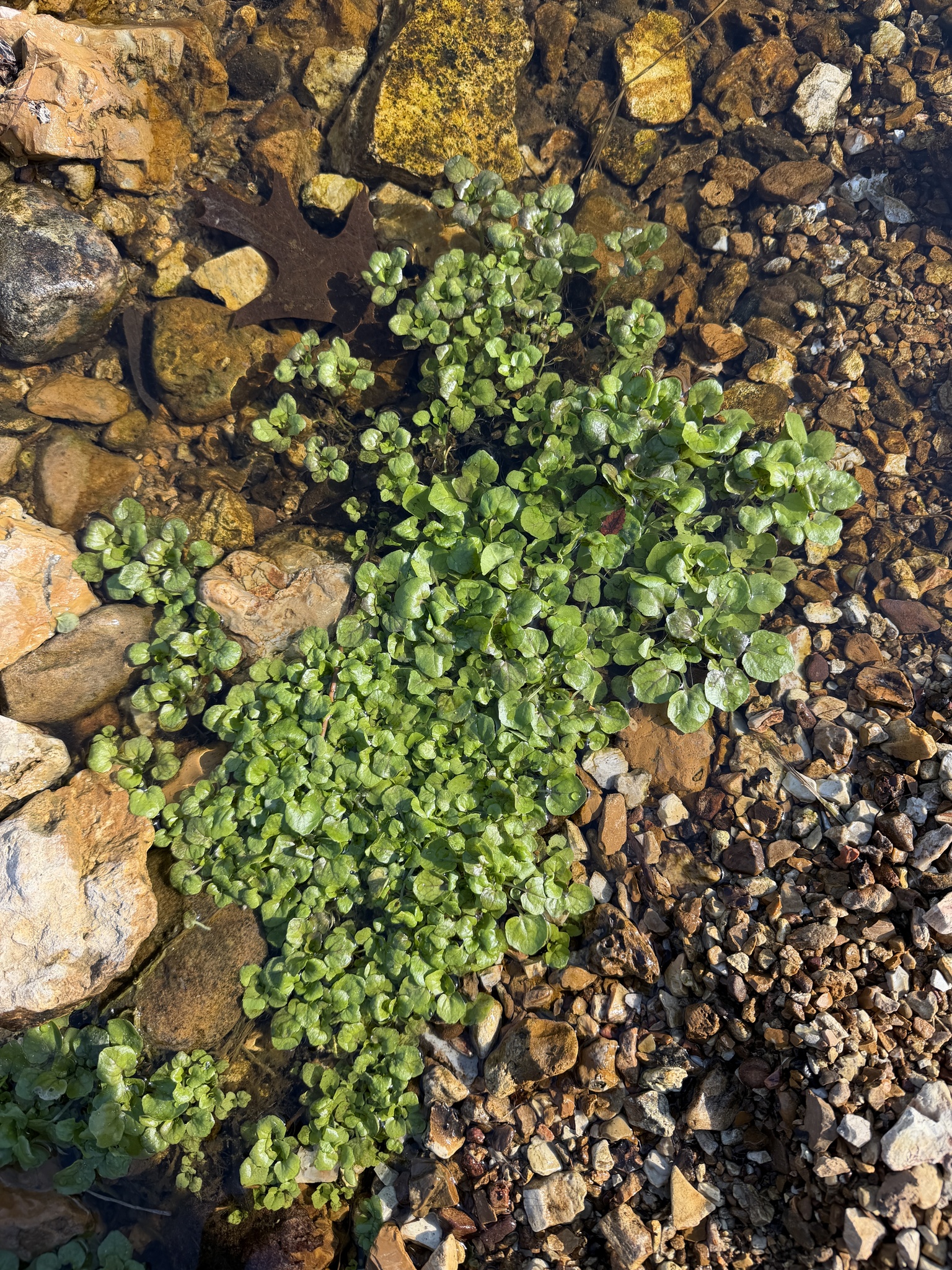
Narrow-fruited Watercress is a hardy, semi-aquatic perennial member of the mustard family, Nasturtium microphyllum, found creeping through shallow streams and ditches across the Northern Hemisphere. It is often mistaken for the common watercress, but is distinguished by its longer, narrower fruit pods and smaller leaf segments.
This species thrives in cool, moving water and can form dense floating mats that span several meters. While it provides a peppery harvest for foragers, it can become aggressive in non-native regions like North America and Australia.
Key Facts
- Flowering: white flowers appear from May to August
- Seed Pods: distinct single row of seeds in pods
- Edibility: leaves are edible but require clean water sources
- Height: stems reach 10-60 cm (4-24 in) long
- Habitat: found in springs and slow-moving streams
How Narrow-Fruited Watercress Fits into the Landscape
Finding Narrow-fruited Watercress in the wild provides a reliable indicator of cool, oxygenated freshwater. This plant is not a garden ornamental but a functional aquatic species that stabilizes muddy banks and provides cover for small aquatic invertebrates. It suits those managing natural wetlands or springs who want to maintain native biodiversity without the intervention of more aggressive pond weeds.
- Grows best in water depths of 5-15 cm (2-6 in)
- Prefers a constant flow of water to prevent stagnation
- Spreads via creeping stems that root at the nodes
- Indicates a pH range of 6.0 to 8.0 in its environment
Identifying Narrow-Fruited Watercress in the Wild
You can identify Nasturtium microphyllum by its pinnate leaves with 3-9 leaflets and its unique seed arrangement. The plant produces small white flowers with four petals, typical of the Brassicaceae family, measuring about 4-5 mm (0.15-0.2 in) across. The most definitive feature is the fruit, a silique (pod) 16-30 mm (0.6-1.2 in) long, containing seeds arranged in a single row.
- Leaflets are ovate or round, with the terminal leaflet being the largest
- Stems are hollow and succulent, often floating or reclining
- Pods are slightly curved and narrower than those of Nasturtium officinale
- Roots form easily at the leaf joints (nodes) when in contact with mud
Where Narrow-Fruited Watercress Grows Naturally
Narrow-fruited Watercress typically grows in neutral to alkaline springs, ditches, and streams at elevations below 1500 m (4920 ft). It is a common sight in Europe and Western Asia, but has naturalized extensively across North America, from New England to Michigan and through most Canadian provinces. The plant requires a consistent water source and rarely survives in soils that dry out completely during the summer.
- Found in clear, slow-moving water with gravel or silt bottoms
- Common in chalk streams and limestone-rich areas
- Occurs frequently alongside brooklime (Veronica beccabunga)
- Withstands winter temperatures down to -20 °C (-4 °F) if submerged
Ecological Role and Invasive Potential
The primary ecological role of this species is providing habitat for aquatic larvae and small fish. It grows rapidly during the spring, often covering the water surface and reducing light penetration for submerged algae. While it is native to the Palearctic, it is considered a naturalized weed in parts of the United States and Mexico, where it can outcompete local aquatic flora in nutrient-rich waters.
- Pollinated by flies and small bees attracted to the nectar
- Provides a food source for the larvae of the orange-tip butterfly (Anthocharis cardamines)
- Can absorb excess nitrates from agricultural runoff
- Spreads primarily through stem fragmentation and water-dispersed seeds
Conservation Status of Nasturtium microphyllum
Narrow-fruited Watercress is currently listed as Least Concern (LC) across most of its native European range. It is widespread and faces no major threats, often benefiting from the channelization of waterways and moderate nutrient enrichment. In North America, it is not listed as a prohibited invasive species at the federal level, though local authorities may monitor its spread in sensitive wetland habitats.
Traditional Uses and Edibility Warnings
Narrow-fruited Watercress is entirely edible and is harvested for its peppery leaves and stems. Historically, it was used as a source of Vitamin C to prevent scurvy among sailors and rural populations. However, foraging from the wild carries a significant risk of liver fluke (Fasciola hepatica) infection if the water is contaminated by livestock runoff.
- Leaves can be eaten raw in salads or cooked like spinach
- Contains high levels of glucosinolates, which give the peppery bite
- Traditionally used as a diuretic and digestive aid
- Must be washed thoroughly or boiled to ensure safety from parasites
Differences Between Nasturtium microphyllum and Watercress
The main difference between these two species is the arrangement of seeds in the fruit pod. To tell them apart, you must examine the seed pods under a magnifying glass; Nasturtium officinale has seeds in two distinct rows, while Nasturtium microphyllum has only one. A hybrid between the two, Nasturtium × sterile, also exists and produces no viable seeds.
- Common watercress (Nasturtium officinale): pods are shorter and wider
- Large bitter-cress (Cardamine amara): has violet anthers instead of yellow
- Fool’s water-cress (Apium nodiflorum): has umbel-shaped flower clusters and smells of celery
Frequently Asked Questions
Is Nasturtium microphyllum edible?
Yes, it is edible and tastes very similar to common watercress with a sharp, peppery flavor. Always harvest from clean, flowing water to avoid parasites like liver fluke.
Is Narrow-fruited Watercress invasive?
It is not federally listed as invasive in the United States, but it is naturalized and can grow aggressively in nutrient-rich wetlands. It may outcompete some native aquatic species in localized areas.
How fast does Narrow-fruited Watercress grow?
It grows very fast during the spring and summer months, capable of forming large floating mats in a single season. It spreads both by seed and by stem fragments that root in the mud.
What is the difference between N. microphyllum and N. officinale?
The primary difference is the seed arrangement; N. microphyllum has seeds in one row inside its pods, while N. officinale has two rows. Additionally, N. microphyllum generally has longer, narrower pods.
Can it grow in stagnant water?
No, it generally requires moving or flowing water to stay healthy. In stagnant ponds, the plant often succumbs to rot or becomes covered in algae.
Information about traditional or historical uses is provided for educational interest only and is not medical advice. Do not use any plant to treat a condition without speaking to a qualified professional.
Sources & Verification
Taxonomy and distribution are checked against the databases below. Care guidance is written for cultivated species only and reviewed by our editor. How We Build Plant Profiles →