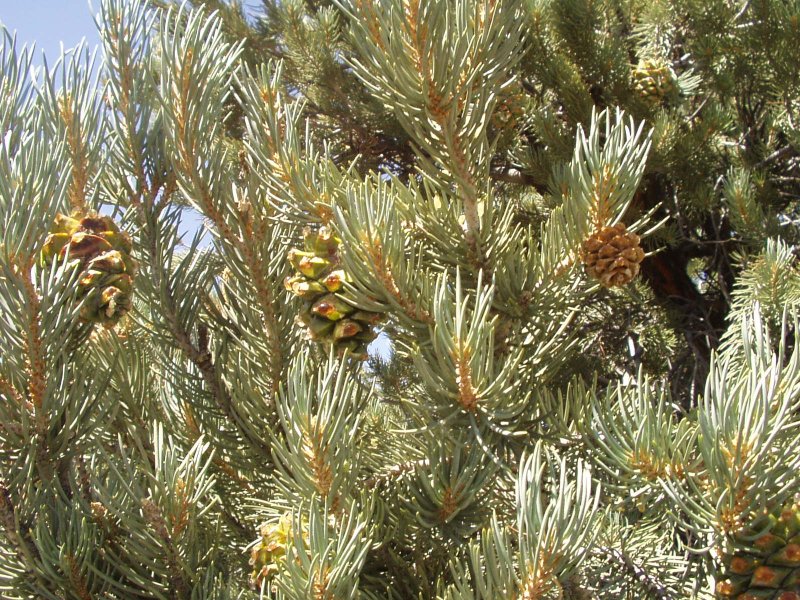
Turkish pine (Pinus brutia) is an evergreen conifer native to the eastern Mediterranean and western Asia, recognized by its open crown, red-brown fissures, and paired needles. The tree covers millions of hectares across coastal and foothill forests from Greece and Turkey to northern Iraq.
It survives dry summer droughts and thin limestone soils where maritime pine (Pinus pinaster) and stone pine (Pinus pinea) frequently fail. Its heavy resin content makes it combustible in summer wildfire regimes.
Key Facts
- Light: Full sun all day
- Water: Low; highly drought-tolerant once established
- Mature Size: 20–35 m (65–115 ft) tall
- Hardiness: USDA Zones 7 to 10
- Soil: Well-drained, tolerates alkaline limestone and thin rock
Is Turkish Pine Right for Your Garden?
Turkish pine suits spacious, sun-drenched properties in dry or semi-arid climates where root space is unconstrained. It handles fierce maritime winds, poor chalk soils, and sustained summer heat without supplemental irrigation once rooted.
You should avoid planting this tree close to foundations, paved driveways, or rooflines. The lateral root system spreads beyond the branch canopy, and fallen needles accumulate in gutters and dry landscape beds, generating a fire hazard.
Identifying Brutia Pine: Needles, Cones, and Bark
You can identify Pinus brutia by its paired needles measuring 10–18 cm (4–7 in) long and heavy, stalkless cones pointing forward along the twigs. This distinguishes it directly from Aleppo pine (Pinus halepensis), whose cones hang backward on distinct curved stalks.
The tree develops characteristic botanical features as it matures:
- Needles: Bright green to dark green, bundled in twos, rigid, and 1 to 1.5 mm thick.
- Seed Cones: Reddish-brown, 6–11 cm (2.5–4.5 in) long, sessile (lacking stalks), held horizontally or facing forward.
- Bark: Orange-red and smooth on juvenile wood, fracturing into deep, blackish-brown vertical plates on mature trunks.
- Habit: Pyramidal in youth, flattening into an open, irregular, broad-topped canopy with age.
Mature Size and Growth Rate
Turkish pine grows rapidly in its first two decades, reaching a mature height of 20 to 35 m (65 to 115 ft) and a branch spread of 8 to 15 m (26 to 50 ft). Under harsh coastal winds or steep rocky crags, trees remain stunted at 10 to 12 m (33 to 40 ft).
Saplings often add 40 to 70 cm (16 to 28 in) of height per season in warm climates when root growth is unrestricted. Crown spread widens significantly after thirty years as lower boughs self-prune and upper branches thicken.
Sun and Soil Requirements for Brutia Pine
Plant Turkish pine in unobstructed full sun with sharp drainage and a soil pH between 6.0 and 8.5. It does not tolerate shade at any stage of life and declines rapidly under the canopy of larger forest trees.
The root system accepts challenging substrates:
- Shallow limestone and chalk rendzinas.
- Coarse sands, gravel banks, and dry clay loam.
- Saline coastal air, though not waterlogged salt marshes.
- Extremely low organic matter sites where nitrogen levels are minimal.
How to Plant and Propagate from Seed
Propagate Turkish pine from seeds sown in early spring after four to six weeks of cold stratification at 2–4 °C (35–40 °F). Untreated seeds exhibit variable dormancy due to thick seed coats.
To plant nursery-grown container saplings:
- Dig a planting pit twice the width of the root ball and equal in depth.
- Keep the root flare level with or 2 cm (1 in) above the surrounding grade.
- Do not add compost or rich peat amendments to the planting hole, as this discourages lateral root search in native soil.
- Firm the native backfill soil gently and construct a low soil basin around the perimeter to catch seasonal rain.
Watering and Feeding Turkish Pine Trees
Provide newly planted saplings with deep soaking every 7 to 10 days during their first dry season, then end supplemental watering entirely once roots establish. Overwatering mature specimens causes root rot and weak, floppy trunk wood.
Established landscape trees require zero supplemental fertilizer. Excess nitrogen promotes rapid, weak shoots that snap in winter gales and increases vulnerability to conifer aphid infestations.
Pruning Turkish Pine and Bonsai Training
Prune mature trees exclusively during midwinter dormancy between December and February to minimize sap bleeding and avoid attracting bark beetles. Remove only broken, rubbing, or dead limbs, cutting just outside the branch collar.
Bonsai growers favor Pinus brutia for its rugged bark, needle response, and drought tolerance:
- Candle pinching: Break spring candles back by half in mid-spring to force back-budding.
- Needle reduction: Pluck older pairs in late autumn to balance sap flow across interior branches.
- Wiring: Apply aluminium or annealed copper wire from late autumn through winter when sap flow is low.
- Substrate: Use an inorganic bonsai mix containing 70% pumice or lava rock and 30% akadama.
Pests and Disease Problems
The primary threat across its native and cultivated range is the pine processionary caterpillar (Thaumetopoea pityocampa), which constructs silken winter nests in branch tips and defoliates the canopy. The urticating hairs of these caterpillars cause severe skin and eye irritation in humans and pets.
Watch for additional conifer disorders:
- Needle cast fungi (Lophodermium species): Yellow-brown banding on older needles during wet, humid springs.
- Bark beetles (Tomicus species): Small entrance holes leaking resin tubes along the trunk during severe drought.
- Armillaria root rot: Canopy dieback caused by planting in poorly draining, waterlogged ground.
Winter Hardiness and Wind Tolerance
Mature Turkish pines withstand winter low temperatures down to -15 °C (5 °F), making them hardy through USDA Zone 7b. Young seedlings may experience needle burn when cold drops abruptly below -10 °C (14 °F) in late autumn.
The species possesses deep anchoring taproots that handle severe Mediterranean and desert windstorms. Heavy, wet snow loads occasionally fracture long horizontal limbs because the wood is brittle compared to Scots pine (Pinus sylvestris).
Landscape Uses, Timber, and Varieties
Turkish pine provides heavy structural timber, firewood, paper pulp, and shelterbelt cover across southern Europe, the Middle East, and the American Southwest. It is also tapped in Turkey and Greece for pine resin, and is the primary host for the scale insect Marchalina hellenica, which bees feed upon to produce pine honey.
Gardeners and foresters separate several geographic forms, including the Afghan pine (Pinus brutia var. eldarica) and Pitsunda pine (Pinus brutia var. pityusa), selected for cold resistance and desert performance.
Year-Round Maintenance for Turkish Pine
| Spring | Inspect branch tips for silken caterpillar nests and prune them off before larvae emerge. Apply a 5 cm (2 in) mulch layer around saplings, keeping the mulch 10 cm (4 in) away from the trunk. |
|---|---|
| Summer | Deeply water saplings planted within the last 18 months once every two weeks during rainless periods. Rake away dry fallen needles from the base of the trunk to reduce regional wildfire hazards. |
| Autumn | Sow stratified seeds into deep native-soil nursery tubes for root development. Plant new container specimens while autumn soil is warm and seasonal rains commence. |
| Winter | Carry out structural pruning on broken or dead branches during full dormancy. Wire and needle-pluck bonsai specimens while sap pressure remains at its lowest. |
Common Turkish Pine Problems and Solutions
| What you see | Likely cause | What to do |
|---|---|---|
| Silken white web bags in branch tips with thinning foliage | Pine processionary caterpillar (Thaumetopoea pityocampa) | Prune out and destroy silken nests in late autumn or apply Bacillus thuringiensis sprays when caterpillars are small. |
| Yellow needles dropping across the interior branches in autumn | Normal seasonal needle senescence | No action needed; Turkish pine sheds needles that are two to three years old every autumn. |
| Pitch tubes and fine wood dust along trunk crevices | Pine bark beetle boring activity | Irrigate drought-stressed trees deeply at root level and remove dead wood to prevent brood development. |
| Rapid browning of entire branch tips in late spring | Diplodia tip blight (Sphaeropsis sapinea) | Prune diseased shoot tips 15 cm (6 in) below visible damage during dry weather and sanitize tools. |
Recognized Varieties of Pinus brutia
- var. eldarica – Afghan pine; darker green, highly drought and cold tolerant.
- var. pityusa – Pitsunda pine; native to the Black Sea coast with longer needles.
- var. pendulifolia – distinctly drooping foliage found in southern Turkey.
- var. koraiensis – compact regional ecotype native to Crimean cliffs.
Frequently Asked Questions
What is the difference between Pinus brutia and Pinus halepensis?
Pinus brutia holds its cones pointing forward on virtually stalkless attachments, with needles 10–18 cm (4–7 in) long. In contrast, Aleppo pine (Pinus halepensis) has shorter needles and carries cones backward on distinct, curved stalks.
What does Pinus brutia Ten. mean?
The abbreviation 'Ten.' refers to Italian botanist Michele Tenore, who scientifically described and named the species in 1811 from trees growing in Calabria.
What is the natural distribution of Pinus brutia?
The tree is primarily native to Turkey, but populations extend across Cyprus, Crete, Greece, western Syria, Lebanon, northern Iraq, the Caucasus, and Crimea.
Can Brutia pine be grown as a bonsai?
Yes, bonsai enthusiasts grow Pinus brutia because its needles reduce well with candle pinching and its rough bark develops fissured character quickly in containers.
What is Pinus brutia var. eldarica?
Also called Eldar pine or Afghan pine, this drought-hardy variety is native to Azerbaijan and Georgia and is widely planted as an urban windbreak across the arid American Southwest.
Information about traditional or historical uses is provided for educational interest only and is not medical advice. Do not use any plant to treat a condition without speaking to a qualified professional.
Sources & Verification
Taxonomy and distribution are checked against the databases below. Care guidance is written for cultivated species only and reviewed by our editor. How We Build Plant Profiles →