
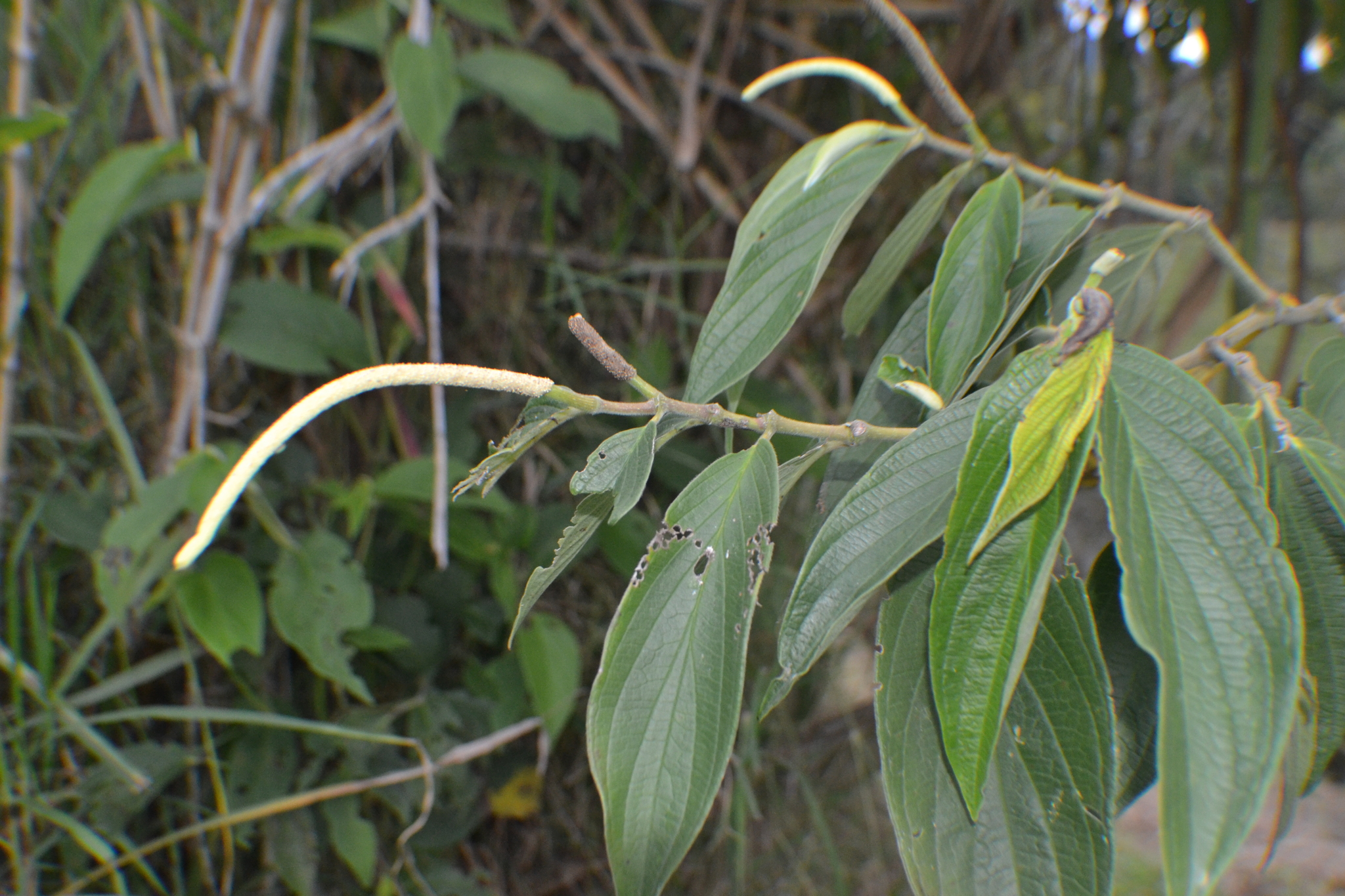
Bamboo Piper is a fast-growing tropical shrub native to Central and South America, easily recognized by its distinctive jointed stems and curved flower spikes. Known scientifically as Piper aduncum, it belongs to the pepper family and emits a sharp, spicy aroma when its foliage or fruits are crushed.
While often used in traditional medicine, this species is a vigorous pioneer plant that can become invasive in tropical climates outside its native range. It reaches maturity quickly, producing thousands of seeds that are primarily dispersed by fruit bats and birds.
Key Facts
- Light: Full sun to partial shade
- Height: 3 to 7 m (10 to 23 ft)
- Water: High; prefers consistently moist soil
- Hardiness: USDA zones 10-12
- Growth Rate: Fast
Is Bamboo Piper Right for Your Garden?
Growing Bamboo Piper requires warmth and significant space because this shrub can expand several meters in a single growing season. It suits large tropical gardens where a quick privacy screen or windbreak is needed, provided you have the time to manage its aggressive spread. Because it is a pioneer species, it excels at colonizing bare soil but can quickly overwhelm smaller ornamental plants if left unchecked.
You should avoid planting this species if you live near sensitive tropical wetlands or forest edges where it might escape cultivation. In regions like the Philippines and Hawaii, it is monitored for its ability to form dense monocultures that shade out native flora. It is best for experienced gardeners who understand the maintenance needs of high-biomass tropical shrubs.
Identifying Bamboo Piper by Its Look
The most striking feature of the Bamboo Piper is its jointed, zig-zagging stems that closely resemble the culms of bamboo. These stems are brittle, grayish-green, and marked by prominent nodes where the branches and leaves emerge. The leaves are lance-shaped, measuring 12-20 cm (5-8 in) in length, with a rough, sandpaper-like upper surface and a finely hairy underside.
The flowers appear as solitary, curved spikes (spadices) that stand opposite the leaves, measuring 8-15 cm (3-6 in) long. These spikes start out white or pale green and eventually turn yellow-brown as the tiny, one-seeded fruits ripen. When crushed, every part of the plant releases a potent peppery scent, which is a key diagnostic feature for the Piper genus.
Ideal Site and Soil Conditions
Bamboo Piper thrives in full sun to partial shade and requires a humid environment with high annual rainfall to reach its full potential. While it can tolerate a variety of soil types, it performs best in deep, well-draining loamy soils that are rich in organic matter. In its native habitat, it is frequently found along riverbanks and forest clearings where moisture is abundant.
The plant is sensitive to salt spray, so it should be protected or moved inland in coastal gardens. It grows at elevations from sea level up to 3,000 m (9,800 ft), showing a wide tolerance for different atmospheric pressures but zero tolerance for frost. Ensure the site has enough vertical clearance, as the arching branches can easily reach 7 m (23 ft) in height.
Planting and Initial Establishment
Plant Bamboo Piper during the start of the rainy season to ensure the root system establishes before any dry periods occur. Dig a hole twice the width of the root ball and mix in a generous amount of aged compost to provide the nutrients required for its rapid initial growth. If you are planting multiple shrubs for a screen, space them at least 3 m (10 ft) apart to allow for their wide, arching habit.
Young plants need protection from strong winds, which can snap the brittle, succulent stems before they have hardened. Provide a temporary stake for specimens over 1 m (3 ft) tall until the trunk thickens. Water the new plant deeply twice a week for the first month to prevent the large leaves from wilting.
Watering and Feeding Requirements
You must maintain consistently moist soil for Bamboo Piper, as it lacks the drought-tolerance of many other tropical shrubs. During dry spells, the leaves will droop significantly, signaling that the plant needs immediate irrigation. Applying a 5-10 cm (2-4 in) layer of organic mulch around the base will help retain soil moisture and keep the roots cool.
Feed the plant with a balanced, slow-release fertilizer twice a year, once in early spring and again in mid-summer. Because it is a fast grower, it can occasionally suffer from nitrogen deficiency, which manifests as pale or yellowing leaves. In high-rainfall areas, you may need to supplement with liquid seaweed or fish emulsion to replace leached nutrients.
Pruning for Shape and Control
Prune Bamboo Piper hard after the main flowering flush to maintain a manageable size and prevent it from becoming too leggy. This species handles heavy pruning well and can be cut back by up to half its height to encourage a bushier, more compact form. Regular thinning of the oldest stems at ground level helps rejuvenate the plant and improves airflow through the center of the shrub.
If you want to prevent the plant from spreading via seed, you must remove the flower spikes before they turn brown and dry. Use sharp, sterilized loppers for thicker stems, as the wood is soft but can tear easily. Always wear gloves when pruning, as the sap and peppery oils can be irritating to sensitive skin.
Managing Pests and Invasive Growth
The most common problem with Bamboo Piper is its tendency to self-seed aggressively in warm, wet climates. You should monitor the surrounding garden for volunteer seedlings and pull them early before they develop deep taproots. In some jurisdictions, this plant is classified as a noxious weed, so check local regulations before planting it in the ground.
- Mealybugs: Look for white, cottony masses in the leaf axils and treat with neem oil.
- Root Rot: Ensure drainage is excellent, as standing water will kill the root system.
- Stem Borers: Watch for small holes and sawdust-like frass on the jointed stems.
- Fungal Leaf Spot: Avoid overhead watering to reduce moisture on the foliage.
Winter Protection and Temperature Limits
Bamboo Piper will suffer severe tissue damage if temperatures drop below 10 °C (50 °F). It is strictly a tropical species and cannot survive any degree of frost or freezing temperatures. If you live in a marginal climate, you must grow the plant in a large container and move it into a heated greenhouse or conservatory for the winter months.
During the winter, the plant’s growth will slow down significantly, and you should reduce watering frequency to prevent root rot. Maintain high humidity indoors by using a humidifier or misting the leaves regularly, as dry indoor air can lead to spider mite infestations. Avoid placing the plant near cold drafts or heating vents, which can cause sudden leaf drop.
Traditional and Modern Uses
Bamboo Piper was traditionally used as a natural antiseptic and wound dressing by indigenous groups in the Amazon basin. The leaves were often crushed and applied directly to cuts or boiled into a tea to treat digestive upsets. While these uses are well-documented in ethnobotanical studies, the plant is now primarily studied for its essential oils.
- Insecticide: The compound dillapiole found in the leaves acts as a potent bio-pesticide.
- Culinary: The dried spikes are occasionally used as a substitute for long pepper (Piper longum).
- Construction: In rural areas, the straight stems are used for light fencing and tool handles.
- Ecology: The plant provides a critical year-round food source for various species of fruit bats.
Year-Round Care for Bamboo Piper
| Spring | Apply a balanced slow-release fertilizer and increase watering frequency as new growth appears. Prune back any winter-damaged tips. |
|---|---|
| Summer | Monitor for mealybugs and spider mites. Ensure the soil remains consistently moist and provide extra water during heatwaves. |
| Autumn | Remove spent flower spikes to prevent unwanted seed dispersal. Reduce fertilizer application as the growth rate begins to slow. |
| Winter | Protect from temperatures below 10 °C (50 °F). Reduce watering and move container-grown plants indoors to a bright, humid spot. |
Why Is My Bamboo Piper Struggling?
| What you see | Likely cause | What to do |
|---|---|---|
| Yellowing lower leaves | Nitrogen deficiency or overwatering | Apply a nitrogen-rich fertilizer and check that the soil is not waterlogged. |
| Wilting during the day | Insufficient soil moisture | Increase watering frequency and apply a thick layer of mulch to the root zone. |
| Sticky residue on leaves | Scale insects or aphids | Wipe the leaves with a soap and water solution or apply neem oil. |
| Brittle, snapping branches | Wind damage or old age | Thin out old stems and provide a windbreak for younger plants. |
Frequently Asked Questions
What is the difference between Bamboo Piper and Kava?
Bamboo Piper (Piper aduncum) has lance-shaped leaves and jointed stems, whereas Kava (Piper methysticum) has large, heart-shaped leaves and contains psychoactive compounds not found in the Bamboo Piper.
Is Bamboo Piper invasive?
Yes, it is considered a highly invasive species in the Pacific Islands, Southeast Asia, and parts of Australia due to its rapid growth and high seed production.
Can I eat the fruit of the Bamboo Piper?
The fruit spikes are edible and have a mild peppery taste, but they are generally used as a spice or traditional medicine rather than a primary food source.
Why is it called Bamboo Piper?
The name comes from the plant's distinctive stems, which feature swollen nodes and a straight growth habit that closely resembles small bamboo canes.
Is the 'Piper' bamboo pendant related to this plant?
No, 'Piper' and 'Bamboo' in fashion or home decor often refer to brand names or styles and are not related to the botanical species Piper aduncum.
Information about traditional or historical uses is provided for educational interest only and is not medical advice. Do not use any plant to treat a condition without speaking to a qualified professional.
Sources & Verification
Taxonomy and distribution are checked against the databases below. Care guidance is written for cultivated species only and reviewed by our editor. How We Build Plant Profiles →


