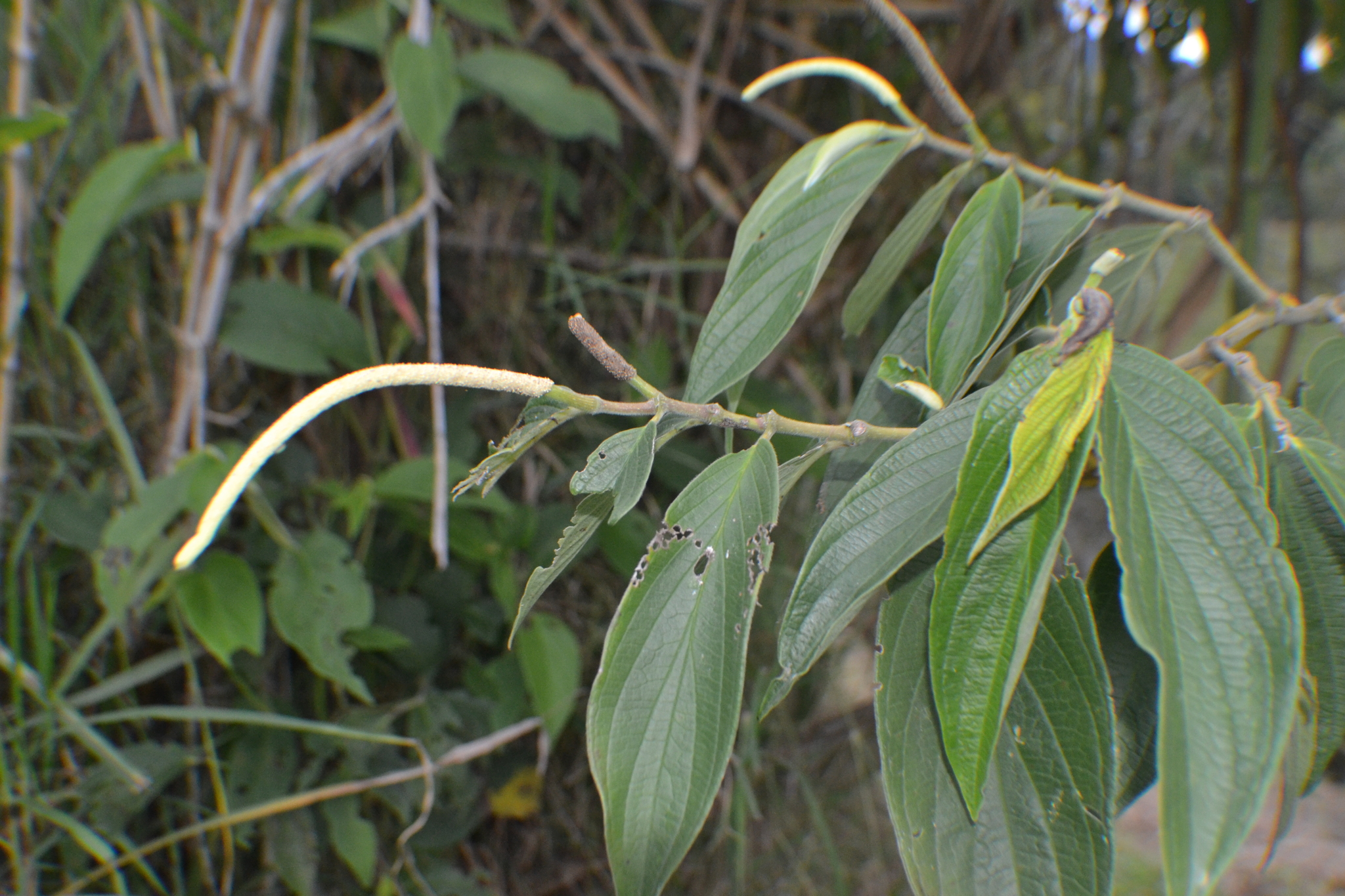
Betel leaf (Piper betle) is an evergreen perennial climber native to Southeast Asia, cultivated throughout the tropics for its pungent, heart-shaped leaves. It belongs to the pepper family and produces smooth, aromatic foliage from creeping nodal stems.
This vine fails completely once temperatures fall below 10 °C (50 °F). If you live outside the tropics, container cultivation in rich potting soil with a sturdy moss pole is required to keep it alive through cold seasons.
Key Facts
- Light: Dappled shade or morning sun; avoid harsh midday glare
- Water: Keep soil consistently damp, never saturated
- Minimum Temperature: 10 °C (50 °F)
- Soil: Rich, loamy, free-draining mix at pH 5.5–7.0
- Harvest: Pick mature lower leaves individually year-round
Growing Betel Leaf in Containers and Indoors
Betel leaf performs best in a 25–35 cm (10–14 in) pot equipped with drainage holes and a climbing support. A coir totem or wood trellis gives the adventitious nodal roots a textured surface to grip as the vine ascends.
Indoor plants require high humidity and consistent warmth. Place containers near an east-facing window where they receive gentle early light, or set up artificial grow lamps providing 12 hours of diffuse light daily.
- Select an unglazed terracotta pot to avoid waterlogging the roots.
- Install a central climbing post at the time of planting to prevent root disturbance later.
- Maintain indoor humidity above 60% using a small room humidifier or pebble tray.
Identifying Piper betle Foliage and Growth
You can identify Piper betle by its smooth, cordate leaves measuring 8–18 cm (3–7 in) long with an asymmetric base and prominent palmate venation. Crushing a mature leaf produces a distinct clove-like, spicy scent that distinguishes it from ornamental relatives.
Stems are woody at the base and semi-succulent at the growing tips, producing adventitious roots at every node. Dioecious flowers emerge in cylindrical catkins measuring 3–8 cm (1.2–3.1 in) in length, though flowering rarely happens in container specimens.
The plant is frequently confused with wild betel (Piper sarmentosum), but wild betel stays low as a 60 cm (24 in) groundcover with rounded leaf bases, whereas true betel climbs up to 4 m (13 ft) and carries distinctly elongated, glossy leaf tips.
Ideal Light, Temperature, and Humidity Conditions
The vine thrives under partial shade with 3–4 hours of filtered sunlight each day. Direct summer sun bleaches the foliage and scorches leaf margins within hours.
Keep ambient temperatures between 22 °C and 32 °C (72–90 °F) for active vegetative growth. Growth halts when temperatures drop below 15 °C (59 °F), and leaves drop when prolonged exposure to 10 °C (50 °F) occurs.
- Summer placement: Position pots under 50% shade netting or beneath open tree canopies.
- Winter threshold: Bring containers indoors before nighttime lows reach 12 °C (54 °F).
- Humidity target: Maintain relative humidity between 65% and 85% to prevent leaf edge crisping.
Propagating Betel Leaf from Stem Cuttings
The most reliable method of propagation is taking stem cuttings with at least 3 nodes from semi-mature vines during warm spring or early summer weather. Commercial farming operations propagate almost entirely through terminal vine cuttings rather than seed.
Strip leaves from the lower two nodes, leaving one or two leaves at the top. Cuttings root quickly in water or directly in a mixture of equal parts perlite and peat.
- Cut a healthy vine 1 cm (0.4 in) below a node using sterilised pruners.
- Submerge the bottom nodes in clean water, replacing the liquid every two days.
- Transfer rooted stems into soil once new water roots reach 3–5 cm (1–2 in) in length.
- Keep the potting mix moist and shaded for the first 14 days after transplanting.
Watering Routine and Soil Care
Water betel leaf when the top 2.5 cm (1 in) of soil feels dry to the touch. The vine demands constant moisture around its root zone but will rot rapidly if kept in sitting water.
Use a growing medium containing two parts potting loam, one part coarse sand or perlite, and one part well-rotted compost. The organic matter mimics the leaf mould of tropical forest floors while perlite ensures rapid excess drainage.
- Apply liquid seaweed or balanced organic fish emulsion at half-strength every 21 days from spring to early autumn.
- Top-dress pots with 2 cm (0.8 in) of decomposed worm castings every spring.
- Cut back watering in winter by half, checking moisture depth with a finger before every application.
How and When to Harvest Betel Leaves
Begin harvesting once the vine produces at least 15 to 20 mature leaves and has anchored securely to its support. Always harvest from the bottom third of the vine to encourage vigorous vertical shoots.
Snip mature, deep green leaves with their petioles attached using sharp snips early in the morning. Leaving 1–2 cm (0.4–0.8 in) of the leaf stem protects the vine node from fungal infection.
Commercial farming plots yield continuous harvests every 15 to 30 days during warm months. Never strip more than one-third of the total foliage mass in a single session, or vine vigor will decline sharply.
Traditional Uses, Quids, and Health Context
Betel leaf has been traditionally chewed across South and Southeast Asia for centuries as a breath freshener and digestive stimulant. In traditional Ayurvedic practice, warm leaves coated with castor oil were applied over the chest to soothe coughs and congestion.
The leaf itself contains essential oils rich in chavibetol and eugenol, but it is frequently consumed as part of a preparation called ‘paan’. This parcel wraps the leaf around sliced areca nut (Areca catechu), slaked lime (calcium hydroxide), and spices.
- Public health authorities document that chewing betel leaves combined with areca nut and tobacco is strongly carcinogenic, causing elevated rates of oral cancer.
- Traditional infusions of the leaf were historically applied topically for skin irritation and minor scalp flaking.
- In Southeast Asian cooking, fresh leaves are used raw to wrap spiced fillings or sliced thinly into vegetable salads.
Controlling Betel Leaf Pests and Fungal Disease
The primary threat to container-grown plants is bacterial leaf spot and root rot caused by wet, compacted soil. If brown spots with yellow halos spread across leaf surfaces, reduce watering immediately and improve airflow.
Indoor plants also attract sap-sucking pests during dry winter periods. Check the undersides of leaves and leaf axils weekly.
- Spider mites: Indicated by faint yellow stippling and fine webbing; treat by washing foliage with tepid water and applying insecticidal soap.
- Mealybugs: White, cottony clusters near stem nodes; remove manually with a cotton swab dipped in 70% isopropyl alcohol.
- Fungal blight (Colletotrichum): Black sunken lesions on older foliage; remove diseased leaves and avoid overhead wetting.
Storing Harvested Betel Leaves
Store fresh leaves by wrapping them in a damp cotton cloth inside a perforated container at 12–15 °C (54–59 °F). Standard home refrigerators set to 4 °C (39 °F) are too cold and will turn the leaves black within 24 hours.
In traditional households, vendors use a dedicated wooden or brass box (often referred to as a betel leaf box or paan daan) lined with moist cloth. This keeps the leaves crisp for up to a week.
- Do not wash leaves until right before you intend to use them.
- Sort through stored leaves daily and remove any showing yellowing or damp decay.
- Trim 2 mm off the petiole base every three days to refresh water uptake if holding them with stems submerged.
Year-Round Care for Betel Vines
| Spring | Repot rootbound vines into fresh loamy mix with 20% compost. Resume half-strength liquid fertilizer every three weeks and take nodal cuttings once new shoots appear. |
|---|---|
| Summer | Shield plants from harsh midday sun using 50% shade fabric. Water thoroughly whenever the surface soil dries, mist foliage on hot days, and harvest mature leaves regularly. |
| Autumn | Reduce fertilizer applications to zero by mid-autumn. Transition outdoor pots indoors before temperatures sink below 12 °C (54 °F), placing them in bright, indirect light. |
| Winter | Cut watering in half and keep soil barely moist to avoid root rot. Maintain ambient humidity near 60% with a pebble tray and shield the foliage from dry radiator heat. |
Diagnosing Common Betel Leaf Plant Problems
| What you see | Likely cause | What to do |
|---|---|---|
| Yellowing lower leaves dropping prematurely | Overwatering or compacted soil starving roots of oxygen | Allow top 3 cm of soil to dry out between waterings and verify pot drainage holes are clear. |
| Brown, crispy margins on young leaves | Low air humidity or exposure to dry heating vents | Move the pot away from airflow drafts and run an indoor humidifier to maintain at least 60% humidity. |
| Bleached, papery patches on foliage | Sunburn from harsh direct midday sunlight | Relocate the plant to filtered morning light or place behind a sheer curtain. |
| Black spots with yellow halos across leaves | Bacterial leaf blight aggravated by overhead watering | Prune infected leaves, water the soil directly without wetting leaves, and increase ventilation. |
| Stunted shoot extension and pale foliage | Nitrogen depletion in older potting soil | Top-dress the container with worm castings and apply liquid seaweed feed. |
Regional Betel Leaf Cultivars
- ‘Magahi’ – tender, aromatic leaves without sharp pungency
- ‘Calcutta’ – dark green, large pungent leaves
- ‘Banarasi’ – thin, pale green leaves with mild flavour
- ‘Meetha’ – sweet-toned leaves popular in eastern India
- ‘Venmony’ – vigorous climber from Kerala with thick foliage
Frequently Asked Questions
What is the scientific name of betel leaf?
The scientific name of betel leaf is Piper betle, a member of the pepper family (Piperaceae).
Can you grow a betel leaf plant indoors?
Yes, betel leaf grows indoors if placed near an east-facing window or under grow lights with humidity above 60%. Provide a moss totem or trellis so the climbing nodes can attach.
How do you care for a betel leaf plant in winter?
Move the pot indoors before night temperatures drop below 12 °C (54 °F), cut watering frequency in half, and stop all fertilizer applications until spring. Keep the plant away from cold window glass and warm radiator drafts.
How was betel leaf traditionally used for cold and cough?
In traditional Ayurvedic remedies, whole betel leaves were gently warmed, coated with a thin layer of oil such as mustard or castor, and placed on the chest as a warm compress to ease congestion.
Is betel leaf the same as wild betel?
No, betel leaf (Piper betle) is a climbing vine with large, pointed heart-shaped leaves, while wild betel (Piper sarmentosum) is a low-growing bush under 60 cm (24 in) tall with rounder, thinner leaves.
Why are my betel leaves turning yellow?
Yellow leaves are most commonly caused by overwatering or poor drainage in the container. Let the top 2.5 cm (1 in) of soil dry out between waterings and ensure excess water drains freely from the pot.
Information about traditional or historical uses is provided for educational interest only and is not medical advice. Do not use any plant to treat a condition without speaking to a qualified professional.
Sources & Verification
Taxonomy and distribution are checked against the databases below. Care guidance is written for cultivated species only and reviewed by our editor. How We Build Plant Profiles →