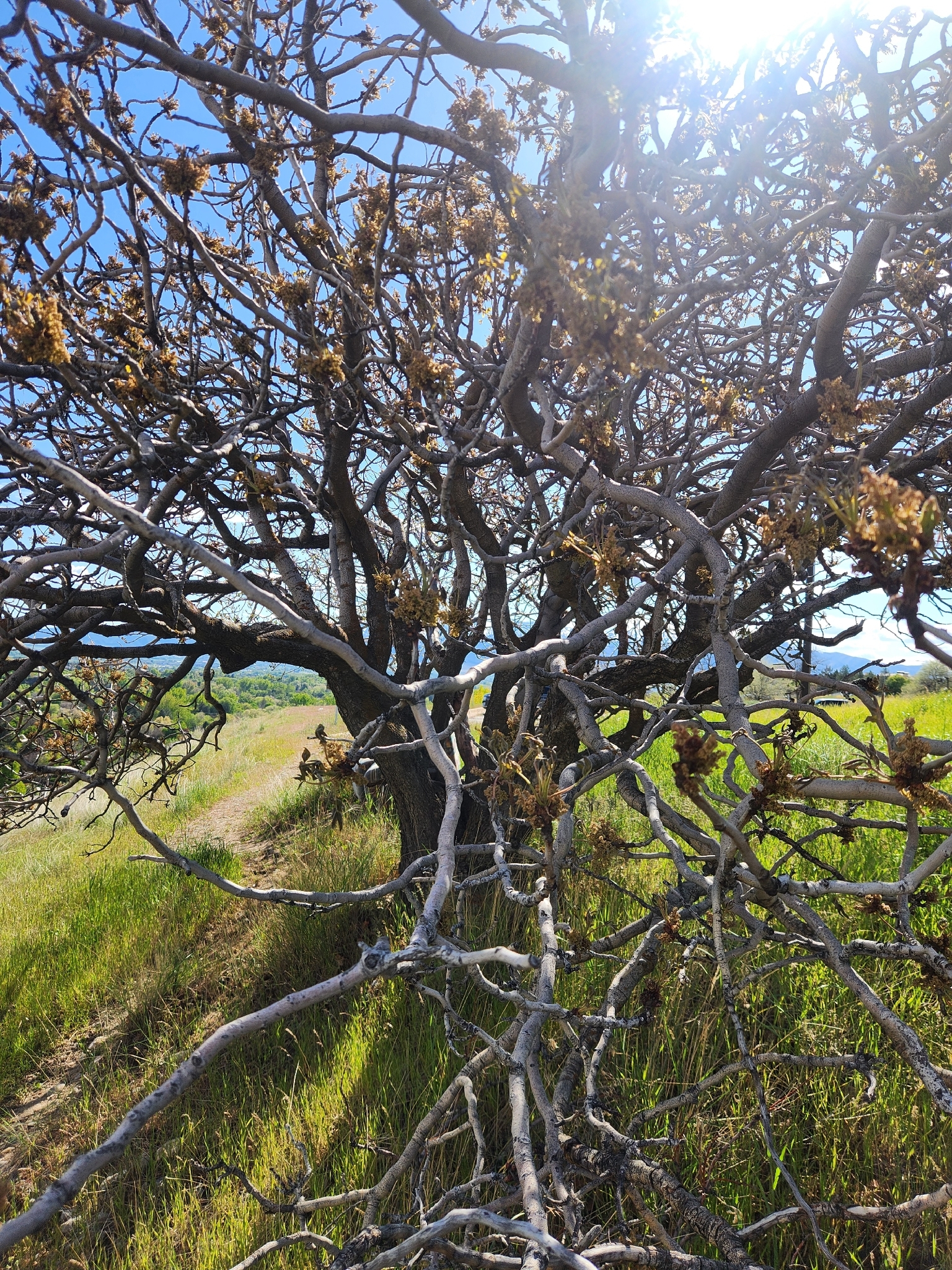
Mt. Atlas mastic tree (Pistacia atlantica) is a long-lived, drought-deciduous tree native to North Africa, the Canary Islands, the Mediterranean basin, and Southwest Asia. It features dense, pinnate foliage and produces small, oily drupes that shift from red to blue-black upon ripening.
The tree survives in arid environments receiving under 200 mm (8 in) of annual rain, making it an effective shade canopy for dry climates. It also serves as a cold-tolerant rootstock for commercial pistachio orchards.
Key Facts
- Plant Type: Deciduous tree
- Mature Height: 5-12 m (16-39 ft)
- Lifespan: 500-1,000 years
- Hardiness: USDA zones 8-11
- Soil pH: 6.0-8.5 (alkaline tolerant)
- Toxicity: Non-toxic to humans and pets
Is Mt. Atlas Mastic Tree Suitable for Your Landscape?
Atlantic pistachio requires full sun exposure, deep well-draining soil, and a climate with warm summers and mild winters in USDA zones 8 through 11. It performs best in arid or Mediterranean gardens where rainfall ranges between 150 and 600 mm (6 and 24 in) annually.
This species develops a deep taproot that penetrates rocky ground, making it effective for soil stabilization on dry slopes. Because of its broad canopy, provide ample room away from foundations and utility lines.
- Light: Minimum 6 hours direct sunlight
- Hardiness: Down to -12 °C (10 °F)
- Soil Type: Poor, rocky, sandy, or clay soils
- Space: Plant 6 to 8 m (20 to 26 ft) from structures
Identifying Mt. Atlas Mastic Tree Leaves, Flowers, and Fruit
Atlantic pistachio, botanically named Pistacia atlantica Desf., is identified by odd-pinnate foliage containing 7 to 11 leathery, dark green leaflets attached to a narrowly winged main stem. Leaflets measure 2 to 5 cm (0.8 to 2.0 in) long with smooth margins and an aromatic resinous odor when crushed.
This dioecious tree produces separate male and female flowers on different specimens during early spring. Flowers are small, greenish-red, and lack petals, borne in dense clusters along previous year branches. Female trees yield round drupes measuring 6 to 8 mm (0.24 to 0.31 in) wide that turn from bright red to dark blue-black upon maturity in autumn.
- Leaf Structure: Odd-pinnate with 7-11 lanceolate leaflets
- Bark: Dark gray with deep vertical fissures
- Fruit Size: 6-8 mm (0.24-0.31 in) globose drupes
- Flower Timing: March to April before full leaf out
Atlantic Pistachio Tree Size, Age, and Lifespan
A mature Atlantic pistachio tree reaches a height of 5 to 12 m (16 to 39 ft) with a canopy spread of 4 to 10 m (13 to 33 ft). Trees grow at a slow rate of 15 to 30 cm (6 to 12 in) per year, focusing energy on taproot expansion during early development.
The average Atlantic pistachio tree lifespan ranges from 500 to 1,000 years when growing in undisturbed wild habitats. Ancient specimens in North Africa and the Middle East feature swollen trunk bases exceeding 1.5 m (5 ft) in diameter.
- Height Range: 5-12 m (16-39 ft)
- Spread Range: 4-10 m (13-33 ft)
- Growth Rate: 15-30 cm (6-12 in) per year
- Maximum Lifespan: Over 1,000 years
Best Sun and Soil Conditions
Select a planting site in full sun with deep, porous soil and a pH level between 6.0 and 8.5. The tree tolerates highly alkaline ground, limestone outcroppings, and saline soils where other hardwood species fail.
Avoid low-lying garden zones subject to standing water or frequent spring frosts. Good air drainage prevents foliar fungal infections during humid spells.
- Sunlight: 6-10 hours full direct sun
- Soil pH: 6.0 to 8.5 (alkaline tolerant)
- Drainage: Excellent drainage required
- Salt Tolerance: Moderate to high soil salinity tolerance
Planting Atlantic Pistachio Seeds and Saplings
Sow Atlantic pistachio seeds in autumn after cold stratifying them at 4 °C (39 °F) for 30 to 60 days to break embryo dormancy. Nick or soak seeds in warm water for 24 hours prior to sowing to improve germination rates.
Plant container-grown saplings in late autumn or early spring into a hole twice as wide as the root container. Because the taproot is sensitive to disturbance, plant young trees into their permanent field position early.
- Stratification: 30-60 days at 4 °C (39 °F)
- Sowing Depth: 2 to 3 cm (0.8 to 1.2 in) deep
- Container Choice: Deep taproot pots (30+ cm depth)
- Planting Distance: 6 to 8 m (20 to 26 ft) apart
Watering and Feeding Atlantic Pistachio Trees
Water young trees every 7 to 10 days during their first two growing seasons, applying 15 to 20 liters (4 to 5 gal) per watering session. Established trees require no supplemental irrigation in areas with at least 200 mm (8 in) of annual precipitation.
Apply a balanced granular fertilizer (10-10-10) at a rate of 100 g (3.5 oz) per year of tree age in early spring. Avoid heavy nitrogen applications, which cause excessive soft shoot growth susceptible to frost.
- Young Tree Water: 15-20 L (4-5 gal) every 7-10 days
- Mature Tree Water: Monthly during severe drought only
- Fertilization: Once yearly in early spring
- Mulch: Apply a 5-8 cm (2-3 in) bark layer around dripline
How to Prune Atlantic Pistachio Trees
Prune Atlantic pistachio trees during winter dormancy between December and February to structure a single main trunk and balanced scaffold branches. Remove dead, crossing, or low-hanging limbs to maintain clearance under the canopy.
Keep pruning cuts clean and flush with the branch collar to allow quick callusing. Minimize heavy structural cuts on old wood, as large wounds exude excess sap and attract wood-boring insects.
- Timing: Late winter (December to February)
- Scaffold Height: Clear lower limbs up to 1.5 m (5 ft)
- Pruning Goal: Remove suckers, deadwood, and crossing branches
- Tool Care: Sanitize shears with 70% isopropyl alcohol
Atlantic Pistachio Pests and Diseases
The primary pests affecting Atlantic pistachio are gall-forming aphids, while verticillium wilt and phytophthora root rot represent the main fungal diseases. Monitoring foliage in late spring helps detect early pest activity before severe defoliation occurs.
Maintain clean ground under the canopy to reduce fungal spore carryover between seasons. Ensure soil drainage remains free-flowing around the root crown.
- Aphid Leaf Galls: Caused by Pemphigus species; prune infested shoots
- Verticillium Wilt: Fungal wilt (Verticillium dahliae); remove affected branches
- Root Rot: Triggered by overwatering; improve surface drainage
- Scale Insects: Treat heavy infestations with horticultural oil in winter
Winter Hardiness and Cold Tolerance
Mature Mt. Atlas mastic trees survive winter temperatures down to -12 °C (10 °F) without significant stem dieback. Trees require 400 to 800 accumulated winter chill hours under 7 °C (45 °F) to break bud dormancy properly in spring.
Protect young saplings under two years old with frost cloth when temperatures drop below -4 °C (25 °F). Mound organic mulch around the root zone before winter to guard against ground freezes.
- Hardiness Zone: USDA zones 8a through 11b
- Minimum Temp: Tolerates brief dips to -12 °C (10 °F)
- Chill Requirement: 400-800 hours below 7 °C (45 °F)
- Young Protection: Cover saplings during hard freezes
Uses for Resin, Gum, Oil, and Pistachio Rootstock
Atlantic pistachio yields commercial oleoresin, aromatic chewing gum, lipid-rich seed oil, and durable rootstocks for commercial edible pistachio (Pistacia vera). Tapping the trunk during midsummer yields a clear, viscous resin known traditionally as saghez or mastic resin.
The seeds contain up to 60% vegetable oil used locally for culinary and cosmetic purposes. In commercial agriculture, saplings serve as hardy rootstocks grafted with Pistacia vera cultivars due to their tolerance of soil salinity and drought. Other related resin-bearing species include mastic tree (Pistacia lentiscus) and terebinth (Pistacia terebinthus). Subspecies Pistacia atlantica subsp. kurdica (now often treated as Pistacia eurycarpa) is particularly valued for resin extraction in the Zagros mountain region.
- Resin Harvest: Trunk tapping in July and August
- Rootstock Value: Grafting stock for Pistacia vera
- Seed Oil Content: Up to 60% fatty acids
- Traditional Uses: Chewing gum and timber
Year-Round Atlantic Pistachio Care Calendar
| Spring | Apply 100 g (3.5 oz) of balanced granular fertilizer around the dripline. Check new foliage for red aphid galls. |
|---|---|
| Summer | Water young saplings every 7 to 10 days during dry spells. Avoid overwatering established mature trees. |
| Autumn | Collect ripe dark blue drupes for seed propagation. Stratify seeds in moist sand at 4 °C (39 °F). |
| Winter | Prune deadwood and suckers between December and February. Apply protective frost wrap to young trunks. |
Common Atlantic Pistachio Tree Problems
| What you see | Likely cause | What to do |
|---|---|---|
| Blister-like red swollen galls on leaves | Aphid feeding (Pemphigus species) | Prune infested twigs in spring or apply horticultural oil before budbreak. |
| Sudden wilting and browning of canopy branches | Verticillium wilt fungal infection | Prune dead branches, avoid excess nitrogen, and keep soil free of standing water. |
| Yellowing foliage and trunk collar rot | Phytophthora root rot from overwatering | Stop supplemental irrigation immediately and clear soil away from the root flare. |
| Failure of female tree to produce berries | Lack of male pollinator tree nearby | Plant at least one male Atlantic pistachio tree within 15 m (50 ft) of female trees. |
Recognized Subspecies of Atlantic Pistachio
- Subsp. atlantica – native to North Africa and Canary Islands
- Subsp. cabulica – native to Afghanistan and Pakistan
- Subsp. mutica – native to Turkey and Caucasus region
- Subsp. kurdica – native to Zagros region, source of saghez resin
Frequently Asked Questions
What is the common name of Pistacia atlantica?
The primary English common name is Mt. Atlas mastic tree or Atlantic pistachio. Other names include turpentine tree, wild pistachio, and Persian turpentine tree.
Are Atlantic pistachio fruits edible like regular pistachios?
The fruits of Atlantic pistachio are edible but small, oily, and highly resinous. Commercial eating pistachios come from a related species, Pistacia vera, though Atlantic pistachio is often used as a rootstock.
How long does an Atlantic pistachio tree live?
An Atlantic pistachio tree can live for 500 to 1,000 years in arid environments. Ancient specimens in the Middle East and North Africa have trunk diameters exceeding 1.5 m (5 ft).
What is Pistacia atlantica gum used for?
The resin exuded from the trunk, traditionally called saghez or mastic gum, is chewed as natural gum and used in traditional remedies. It is collected by tapping the bark of mature trees during summer.
What is the difference between Pistacia atlantica subsp. kurdica and other subspecies?
Subspecies kurdica features wider, blunter leaflets and is native to the Zagros region. Recent phylogenetic studies reclassify this subspecies as a distinct species, Pistacia eurycarpa.
Are pistachios from Atlantic Superstore the same as Pistacia atlantica?
No, pistachios sold at grocery chains like Atlantic Superstore are harvested from Pistacia vera. Atlantic pistachio (Pistacia atlantica) produces small, hard-shelled fruits mainly harvested locally in wild regions.
Information about traditional or historical uses is provided for educational interest only and is not medical advice. Do not use any plant to treat a condition without speaking to a qualified professional.
Sources & Verification
Taxonomy and distribution are checked against the databases below. Care guidance is written for cultivated species only and reviewed by our editor. How We Build Plant Profiles →