
Aleppo oak (Quercus infectoria) is a small semi-evergreen tree native to Greece, Turkey, Cyprus, and the Levant. It belongs to the beech family, Fagaceae, and grows as a scrubby tree or dense shrub reaching 2 to 6 m (6.5 to 20 ft) in height.
The tree is best known for gall nuts formed on its twigs after gall wasp stings, which accumulate high concentrations of gallotannic acid. These galls supplied iron gall ink and leather tanning materials across Asia and Europe for thousands of years.
Key Facts
- Family: Fagaceae (beech family)
- Height: 2–6 m (6.5–20 ft) tall
- Native Range: Southeastern Europe, Turkey, Levant, Iraq, Iran
- Primary Feature: Tannin-dense spherical insect galls
- Plant Type: Small semi-evergreen tree or shrub
What to Know About Quercus infectoria
Quercus infectoria operates as a wild scrub oak rather than a standard garden specimen. Its growth habit remains gnarled and low-branching, making it an ecological anchor in dry Mediterranean maquis communities rather than a timber tree.
Botanist Guillaume-Antoine Olivier first published the modern classification of this species under the name Quercus infectoria G.Olivier in 1801. Recognizing the plant relies on spotting its rigid, leathery leaves and the characteristic round woody galls attached to young shoots.
How to Identify Aleppo Oak
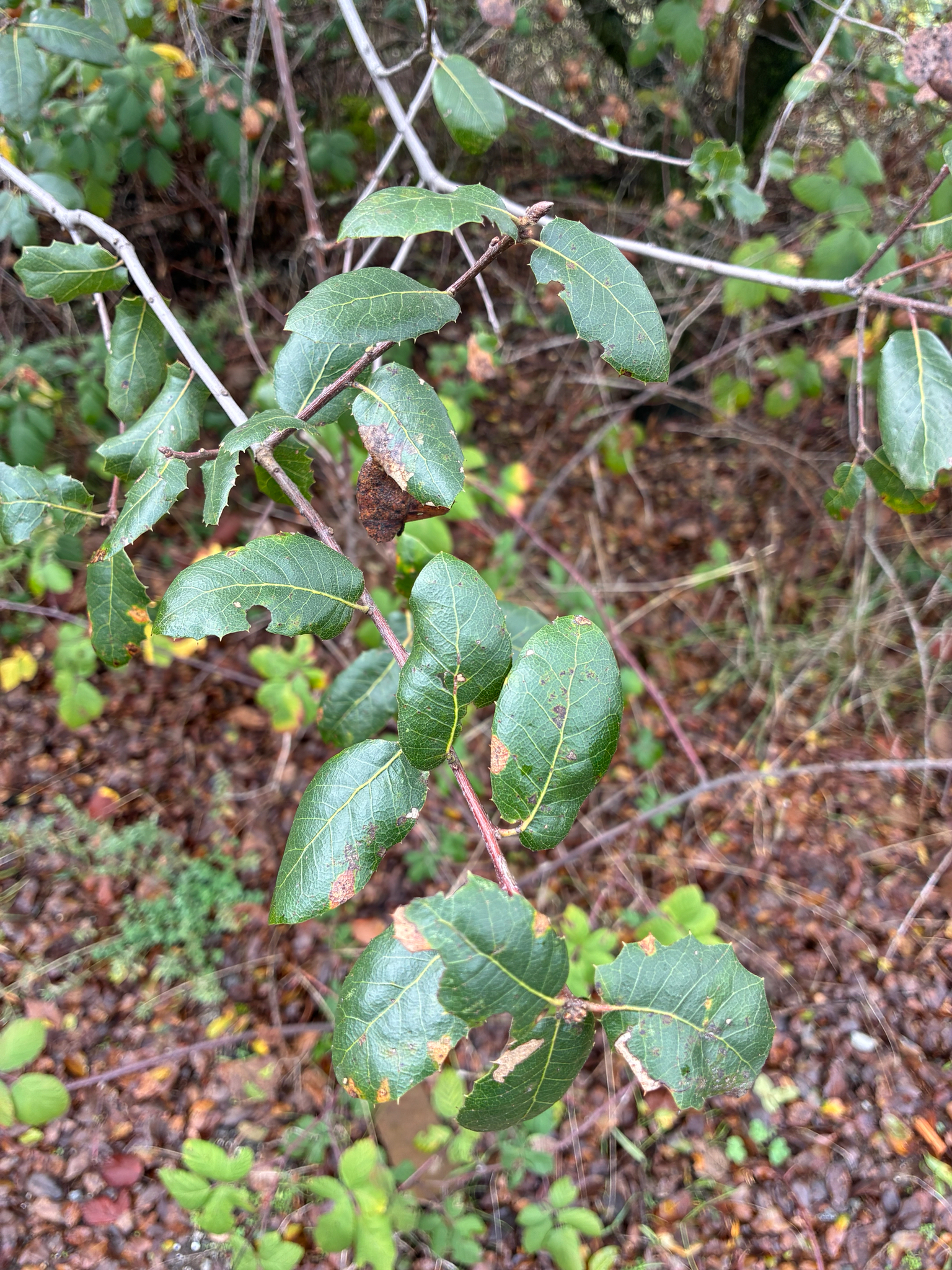
Aleppo oak leaves measure 4 to 9 cm (1.6 to 3.5 in) long with 4 to 9 pairs of shallow, rounded teeth along the margins. The upper leaf surface shows a glossy dark green hue, while the underside ranges from pale green to slightly puberulent.
The botanical characteristics include:
- Habit: Small multi-stemmed tree or spreading shrub standing 2 to 6 m (6.5 to 20 ft) high.
- Bark: Dark gray, deeply fissured and thick on older trunks.
- Flowers: Wind-pollinated catkins appearing in spring; male catkins hang down in yellow-green threads 3 to 5 cm (1.2 to 2.0 in) long.
- Acorns: Egg-shaped nuts measuring 2 to 3.5 cm (0.8 to 1.4 in) long, held in shallow scaly cups.
- Galls: Hard spherical growths 1 to 2.5 cm (0.4 to 1.0 in) in diameter, studded with short tuberosities.
Native Habitat and Distribution
Aleppo oak thrives on rocky limestone hillsides and dry maquis scrub across Greece, Cyprus, Turkey, Syria, Lebanon, Israel, Jordan, Iraq, and western Iran. It grows at elevations ranging from sea level up to 1,800 m (5,900 ft) above sea level.
The species survives prolonged summer droughts and summer temperatures exceeding 40 °C (104 °F). It prefers alkaline, calcareous soils with low organic content and excellent drainage, often co-existing with drought-adapted pines and Mediterranean brush.
Ecology and Oak Gall Formation
The signature galls on Quercus infectoria form when gall wasps lay eggs into developing leaf buds. Cynipid wasps such as Cynips gallae tinctoriae inject chemicals during oviposition, triggering the tree to build dense tissue around the larva.
Key ecological relationships include:
- Tannin concentration: The gall tissues contain 50% to 70% tannic acid, protecting the larva from herbivores.
- Wildlife habitat: Birds and small mammals forage on acorns, while fallen leaf litter enriches thin mountain soils.
- Wasp emergence: Adult wasps chew tiny exit holes through the hard gall shell in late summer to escape.
Conservation Status and Ecosystem Threats
The IUCN Red List classifies Quercus infectoria as Least Concern (LC). Populations remain widespread across the eastern Mediterranean basin and Middle East, though localized declines occur near urban areas.
Primary pressures include wild land conversion for agriculture, intense goat grazing on young shoots, and altered wildfire frequencies in dry scrub habitats. Deep root crowns allow damaged trees to resprout vigorously after fire events.
Historical Uses of Aleppo Oak Galls
Aleppo oak galls provided the main source of tannic acid for iron gall ink from the Roman era through the 19th century. Mixing gall extracts with iron sulfate produced permanent black ink used in historic manuscripts across Europe and Asia.
Traditionally, dried galls known in commercial trade as Majuphal or Manjakani were harvested before the wasp emerged. Historically, these gallnuts were used in textile dyeing, leather tanning, and traditional Asian herbal medicine to treat intestinal and oral inflammation due to their astringent properties.
Similar Oak Species
Several Mediterranean scrub oaks share overlapping ranges with Aleppo oak. Distinguishing between species depends on leaf margin shape, leaf texture, and acorn cup structure.
Look-alike species include:
- Kermes oak (Quercus coccifera): Features spiny, holly-like leaf margins and persistent stiff evergreen foliage.
- Holm oak (Quercus ilex): Forms a much taller evergreen tree up to 20 m (65 ft) with dark, smooth leaves.
- Downy oak (Quercus pubescens): Leaves have soft velvet hairs on the underside and deeper lobing.
- Turkey oak (Quercus cerris): Has mossy, bristly acorn cups and deeply lobed leaves.
Frequently Asked Questions
What is the common name of Quercus infectoria?
The primary common name of Quercus infectoria is Aleppo oak or Aleppine oak. It is also frequently called Cyprus oak or gall oak due to its historical production of tannin-rich oak galls.
What family does Quercus infectoria belong to?
Quercus infectoria belongs to the Fagaceae family, commonly known as the beech or oak family. This plant family includes all true oaks, chestnuts, and beeches.
What is a Quercus infectoria gall?
A Quercus infectoria gall is a spherical, woody growth induced on young branches when parasitic gall wasps lay eggs in leaf buds. The tree builds tannic tissue around the larva, creating a gall containing up to 70% tannic acid.
What is Quercus infectoria fructus?
Quercus infectoria fructus refers to the dried oak galls used in traditional Asian herbal medicine, often traded under names like Majuphal or Manjakani. Although termed 'fructus' in pharmaceutical texts, these structures are insect-induced galls rather than true botanical fruits.
What are the traditional benefits and uses of Quercus infectoria?
Historically, Quercus infectoria galls were used for tanning leather, making black iron gall ink, and dyeing textiles. In traditional medicine systems, extracts were applied as natural astringents for skin and mouth rinses due to their high tannin concentration.
Information about traditional or historical uses is provided for educational interest only and is not medical advice. Do not use any plant to treat a condition without speaking to a qualified professional.
Sources & Verification
Taxonomy and distribution are checked against the databases below. Care guidance is written for cultivated species only and reviewed by our editor. How We Build Plant Profiles →
More in Quercus
Interior Live Oak
Quercus wislizeni
☀️ Full Sun 💧 Low

California Live Oak
Quercus agrifolia
☀️ Full Sun 💧 Low
California Black Oak
Quercus kelloggii
☀️ Full Sun 💧 Low
Northern Red Oak
Quercus rubra
☀️ Full Sun 💧 Moderate

Channel Island Oak
Quercus tomentella
☀️ Full Sun 💧 Moderate

Lebanon Oak
Quercus libani
☀️ Full Sun 💧 Low