

Holm oak (Quercus ilex) is a massive evergreen oak native to the Mediterranean basin, known for its dense canopy and rounded habit. It bears thick, leathery leaves with silvery undersides and small annual acorns.
Unlike broadleaf oaks, this species holds foliage year-round and survives salt-laden coastal gales, but it requires sharp soil drainage and ample open space to mature.
Key Facts
- Growth rate: 20–40 cm (8–16 in) per year
- Hardiness: USDA zones 7 to 10
- Light: Full sun to partial shade
- Soil: Chalk, sand, or well-drained loam
- Toxicity: Mildly toxic to horses and livestock
What Holm Oak Is Like to Grow
Holm oak is a large evergreen shade tree that thrives in warm, windy coastal locations with minimal maintenance once settled. It forms a dense, dome-shaped crown that provides complete year-round privacy and wind protection.
You can expect a long-lived specimen that requires minimal pruning unless trained as a hedge. Its deep root structure secures heavy soils on sloped ground.
- Lifespan: 200 to 400 years
- Foliage density: Very heavy year-round shade
- Wind resistance: Excellent coastal windbreaker
- Maintenance level: Low after root establishment
Identifying Holm Oak Leaves and Bark
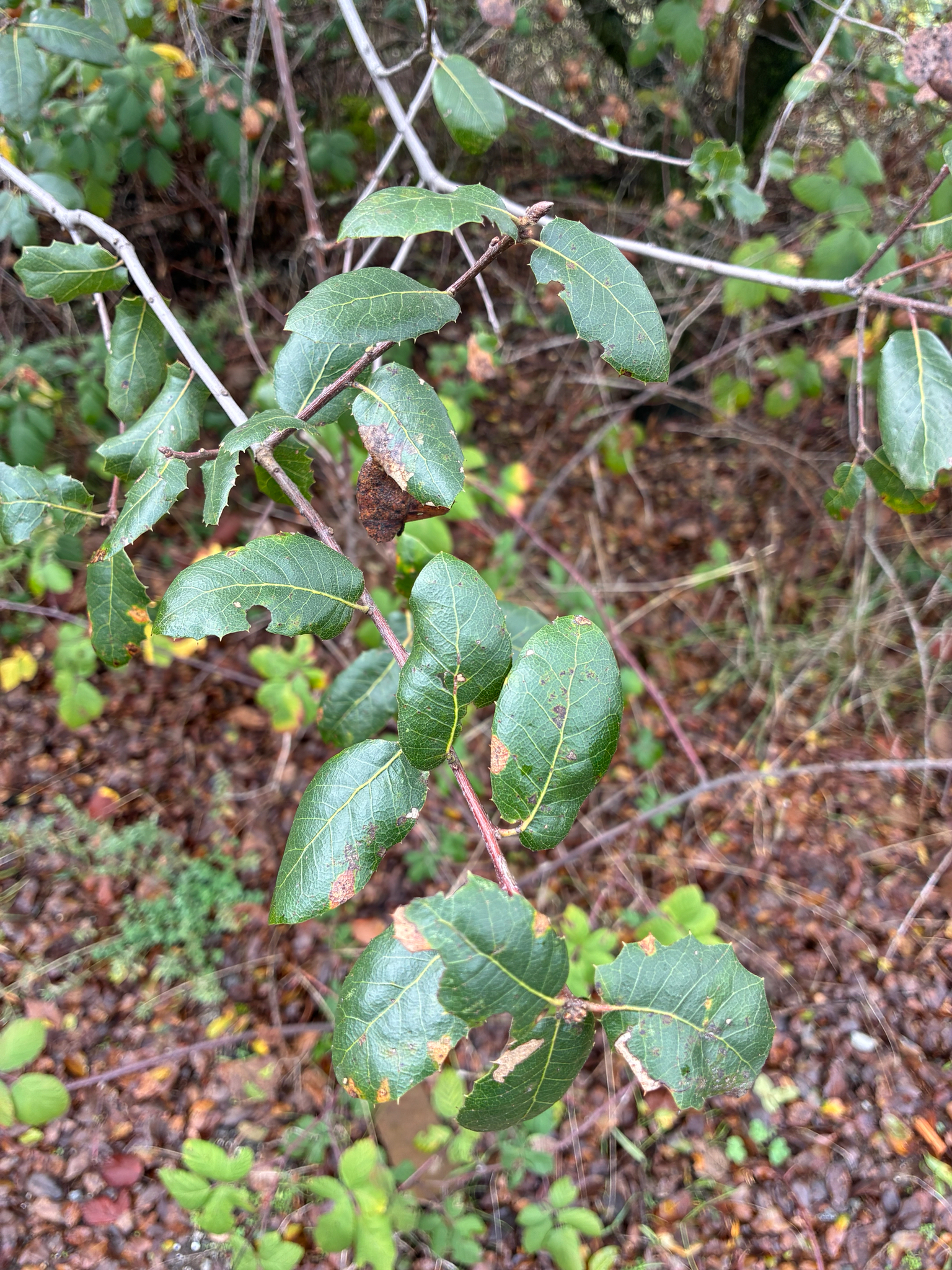
Holm oak foliage features glossy dark green leaves above with silvery white felt beneath, measuring 3-8 cm (1.2-3.1 in) long. Leaves on young shoots display spiny margins resembling European holly (Ilex aquifolium), while adult foliage on upper branches is smooth-edged and oval.
The dark gray to black bark cracks into tiny square plates on mature trunks. In May, yellowish male catkins hang in clusters 4-7 cm (1.6-2.8 in) long, followed by small 1.5-2 cm (0.6-0.8 in) pointed acorns that ripen in autumn.
- Upper leaf surface: Dark green, thick, and leathery
- Lower leaf surface: Dense silvery-gray down
- Bark texture: Finely fissured into small square scales
- Acorn size: 1.5-2 cm long in short cups
Holm Oak Growth Rate and Height
Holm oak grows at a slow to moderate rate of 20-40 cm (8-16 in) per year, eventually reaching 15-25 m (50-80 ft) tall. Its spread frequently matches its height, creating a wide rounded canopy up to 20 m (65 ft) across.
In early years, vertical growth dominates while taproots anchor into subsoil. Growth accelerates slightly in hot summers with steady moisture before tapering off as the canopy broadens.
Choosing the Best Site for Holm Oak
Plant holm oak in full sun and well-draining soil with a pH between 6.0 and 8.0. It tolerates maritime spray, salt winds, and thin chalk soils where native broadleaf trees fail.
Avoid hollows where cold air settles, as severe frost can brown young foliage. Ensure the location allows ample room, staying at least 8 m (26 ft) away from buildings to accommodate root spread, similar to planting cork oak (Quercus suber).
- Sun exposure: Full sun to light overhead shade
- Soil types: Chalk, sand, limestone, or loamy soil
- Drainage requirement: Free-draining; standing water rots roots
- Coastal tolerance: High salt and gale tolerance
How to Plant Holm Oak
Plant young holm oak trees during autumn or early spring when the soil is cool and moist. Saplings do not move easily due to early taproot development, so select a permanent location.
Dig a hole three times wider than the root ball but equal in depth. Firm the surrounding soil back into place without burying the root collar, then apply water deeply.
- Hole width: 3x root container diameter
- Planting depth: Level with surrounding soil grade
- Mulch depth: 5-7 cm (2-3 in) away from bark
- Staking: Low single stake for the first 2 years
Holm Oak Water and Fertilizer Needs
Provide young holm oaks with 10-15 litres of water per week during their first two summers, after which established trees require no supplementary watering. Mature specimens withstand severe summer droughts without leaf drop.
Fertilizer is generally unnecessary in standard soils. Top-dressing the root zone with well-rotted leaf mould in spring provides sufficient nitrogen and organic matter for annual shoot growth.
How to Prune Holm Oak
Prune holm oak between late spring and early summer to shape hedges or remove lower branches. Clipping during active growth allows wounds to heal quickly before winter cold sets in.
When maintaining formal evergreen screens, clip twice a year in May and late July. Remove dead, crossing, or damaged branches back to the branch collar using sharp pruning saws.
- Best time: May to July
- Hedge frequency: 1 to 2 clips per growing season
- Lower crown lifting: Remove lower branches gradually in early summer
- Avoid: Pruning in deep winter or late autumn
Common Holm Oak Pests and Problems
Holm oak rarely suffers major disease, but it can develop powdery mildew on tender new growth during humid summers. Good air circulation prevents most fungal leaf spots.
Monitor saplings for sap-sucking insects or gall wasps that alter leaf appearance. Siting trees in heavy wet clay leads to root rot, which causes canopy thinning and branch dieback.
- Powdery mildew: White powdery patches on fresh summer leaves
- Root rot: Caused by poor drainage or overwatering
- Oak leaf galls: Small harmless growths raised by micro-wasps
- Chlorosis: Leaf yellowing in waterlogged high-pH clay
Winter Hardiness and Protection
Holm oak withstands winter low temperatures down to -12 °C (10 °F) without damage to foliage. It is hardy across USDA zones 7 through 10 and holds green leaves throughout freezing weather.
Sub-zero winds can cause localized leaf scorch on young shoots, which drop cleanly when fresh growth emerges in May. Mulch around the root perimeter of young saplings before heavy winter freezes arrive.
Holm Oak Uses for Timber, Firewood, and Landscaping
Holm oak wood is extremely dense and heavy, making it outstanding firewood that burns hot and clean with long-lasting embers. Historically, woodworkers used the timber for wagon wheels, wine casks, and tool handles.
In Mediterranean agriculture, holm oak woodlands provide the root host for black truffle (Tuber melanosporum) cultivation and supply acorns for livestock feed. In urban landscapes, it functions as a windbreak hedge or broad shade tree alongside English oak (Quercus robur).
Frequently Asked Questions
Is holm oak fast growing?
No, holm oak grows slowly to moderately at 20–40 cm (8–16 in) per year. Its growth rate slows further once the tree reaches mature height.
Is holm oak native to the UK?
No, holm oak (Quercus ilex) is native to the Mediterranean region and was introduced to Britain in the 1500s. It grows well across southern and coastal Britain today.
Is holm oak good for burning as firewood?
Yes, holm oak is exceptional firewood because its dense wood burns slowly and generates high heat output. It requires seasoned drying for 18-24 months before burning.
How do you pronounce holm oak?
It is pronounced "home oak", with a silent "l". The name comes from "holm", an old English word for holly, referencing its spiny leaves.
How do you grow holm oak from seed?
Collect ripe brown acorns in autumn, soak them in water for 24 hours, and discard floating seeds. Plant sinking acorns 2 cm (0.8 in) deep in pots of free-draining compost placed outdoors.
What is the Holm Oak Vineyard?
Holm Oak Vineyard is a prominent winery located in Tasmania, Australia, named after the holm oak trees (Quercus ilex) planted on the estate.
Information about traditional or historical uses is provided for educational interest only and is not medical advice. Do not use any plant to treat a condition without speaking to a qualified professional.
Sources & Verification
Taxonomy and distribution are checked against the databases below. Care guidance is written for cultivated species only and reviewed by our editor. How We Build Plant Profiles →
More in Quercus

California Live Oak
Quercus agrifolia
☀️ Full Sun 💧 Low
Chinese Cork Oak
Quercus variabilis
☀️ Full Sun 💧 Moderate

Garry Oak
Quercus garryana
☀️ Full Sun 💧 Low
Interior Live Oak
Quercus wislizeni
☀️ Full Sun 💧 Low

White Oak
Quercus alba
☀️ Full Sun 💧 Moderate

Brant’s Oak
Quercus brantii
☀️ Full Sun 💧 Low