
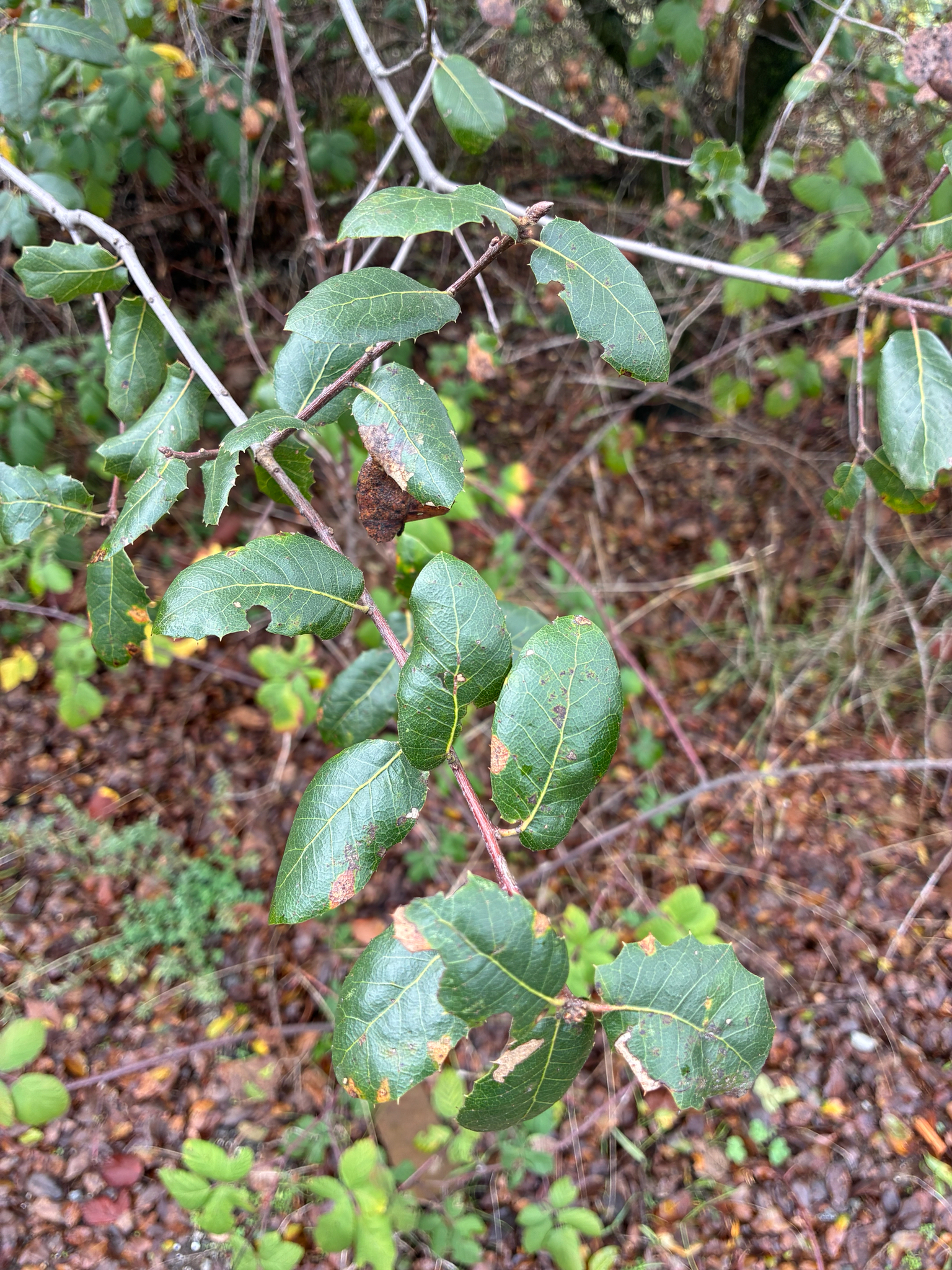
Interior live oak (Quercus wislizeni) is an evergreen tree or large shrub native to the foothills and valleys of California in western North America. You will recognize it by its glossy, dark green leaves and dense canopy that stays green through every season.
This species tolerates severe summer drought and poor soils across its native range. It forms an essential structural component of California oak woodlands and chaparral ecosystems.
Key Facts
- Native Range: Western North America, primarily California
- Plant Type: Evergreen tree or shrub
- Leaf Type: Simple, alternate, often spiny-toothed
- Growth Habit: Upright tree or multi-stemmed chaparral shrub
- Acorn Maturity: Takes two seasons to mature
Growing Habit and Landscape Fit
Interior live oak suits large native gardens, restoration projects, and wildland margins where summer irrigation is minimal. This plant adapts its form based on local conditions, growing as a spreading tree up to 22 m (72 ft) tall in deep valley soils, or remaining a dense, multi-stemmed shrub known as var. frutescens in harsh chaparral habitats.
You should plant it only where it has ample space to expand its root system and canopy without interference from structures. It dislikes wet garden soils and heavy summer watering once established. The dense evergreen foliage provides year-round privacy screens and wildlife shelter.
How to Identify Interior Live Oak Leaves and Bark
You can identify interior live oak by its flat, stiff, leathery leaves measuring 2.5 to 7 cm (1 to 2.8 in) long, which are dark green and glossy above with pale yellow-green undersides. Leaf margins on lower, shaded branches are often sharply toothed and holly-like, while leaves on upper, sun-exposed branches tend to be smoother and entire.
- Bark: Smooth and grey on young stems, turning dark greyish-brown with deep furrowed ridges on mature trunks.
- Acorns: Pointed acorns measure 2 to 3 cm (0.8 to 1.2 in) long, enclosed in a deep, warty cup that covers up to half the nut.
- Development: Acorns take two growing seasons to mature, dropping in autumn of their second year.
Natural Habitat and Distribution
Interior live oak grows natively across California, extending slightly into southwestern Oregon and Baja California. You will find it most commonly in foothill woodlands, valley borders, and interior chaparral communities below 1,500 m (4,900 ft) elevation.
It thrives on dry slopes, canyon bottoms, and in association with valley oak (Quercus lobata) and blue oak (Quercus douglasii). Calflora records show it distributed widely across most California counties away from the immediate outer coast.
Ecology and Wildlife Value
Interior live oak supports dozens of native bird and mammal species through its dense branching structure and annual acorn crop. More than 100 species of birds and mammals feed on the acorns or use the canopy for nesting and cover.
- Insects: Supports numerous native caterpillars and gall wasps that feed songbird nestlings in spring.
- Mammals: Mule deer browse the foliage, while scrub jays and squirrels cache the acorns, aiding natural seed dispersal.
- Fungi: Forms essential mycorrhizal associations in undisturbed soil that cycle nutrients through the woodland floor.
Conservation Status and Native Protection
Interior live oak maintains a secure global population and is listed as Least Concern by conservation assessments. Urban expansion and agricultural clearing continue to remove local woodland stands in parts of its range.
Many California municipalities enforce local tree protection ordinances that restrict the removal of native oaks over a specific trunk diameter. Preserving existing canopy cover protects local watershed stability and wildlife corridors.
Traditional Uses and Acorn Processing
Indigenous peoples of California traditionally used interior live oak acorns as a dietary staple after leaching the bitter tannins. The harvested nuts were shelled, dried, ground into fine meal, and flushed with warm water in sand basins to remove water-soluble compounds.
The resulting flour was cooked into a nutritious mush or baked into flatbreads. The dense hardwood was also utilized historically for firewood and heavy tool construction.
Similar Oak Species to Know
Interior live oak shares its habitat with several other evergreen oaks that require careful observation to distinguish. Coast live oak (Quercus agrifolia) features cupped leaves with bristly teeth and occurs primarily in coastal fog belts rather than interior valleys.
- Canyon live oak: (Quercus chrysolepis) features distinctive golden-yellow fuzz on the undersides of its mature leaves and acorn cups.
- Oracle oak: (Quercus × moreha) is a natural hybrid between interior live oak and California black oak (Quercus kelloggii), showing intermediate leaf characteristics.
Frequently Asked Questions
How fast does Quercus wislizeni grow?
Quercus wislizeni exhibits a moderate growth rate, typically adding 30 to 60 cm (1 to 2 ft) of height per year under favorable soil and moisture conditions.
What is the difference between Quercus wislizeni and Quercus agrifolia?
Quercus wislizeni (interior live oak) has flatter, shinier leaves and thrives in inland climates, whereas Quercus agrifolia (coast live oak) features heavily cupped, convex leaves and prefers coastal fog zones.
Are Quercus wislizeni acorns edible?
Quercus wislizeni acorns are edible only after extensive processing to leach out bitter tannins, a traditional method practiced by indigenous Californian tribes.
What does Quercus wislizeni var. frutescens mean?
Quercus wislizeni var. frutescens is a botanical designation for the shrubby, multi-stemmed growth form of the interior live oak found in harsh chaparral soils.
Sources & Verification
Taxonomy and distribution are checked against the databases below. Care guidance is written for cultivated species only and reviewed by our editor. How We Build Plant Profiles →


