
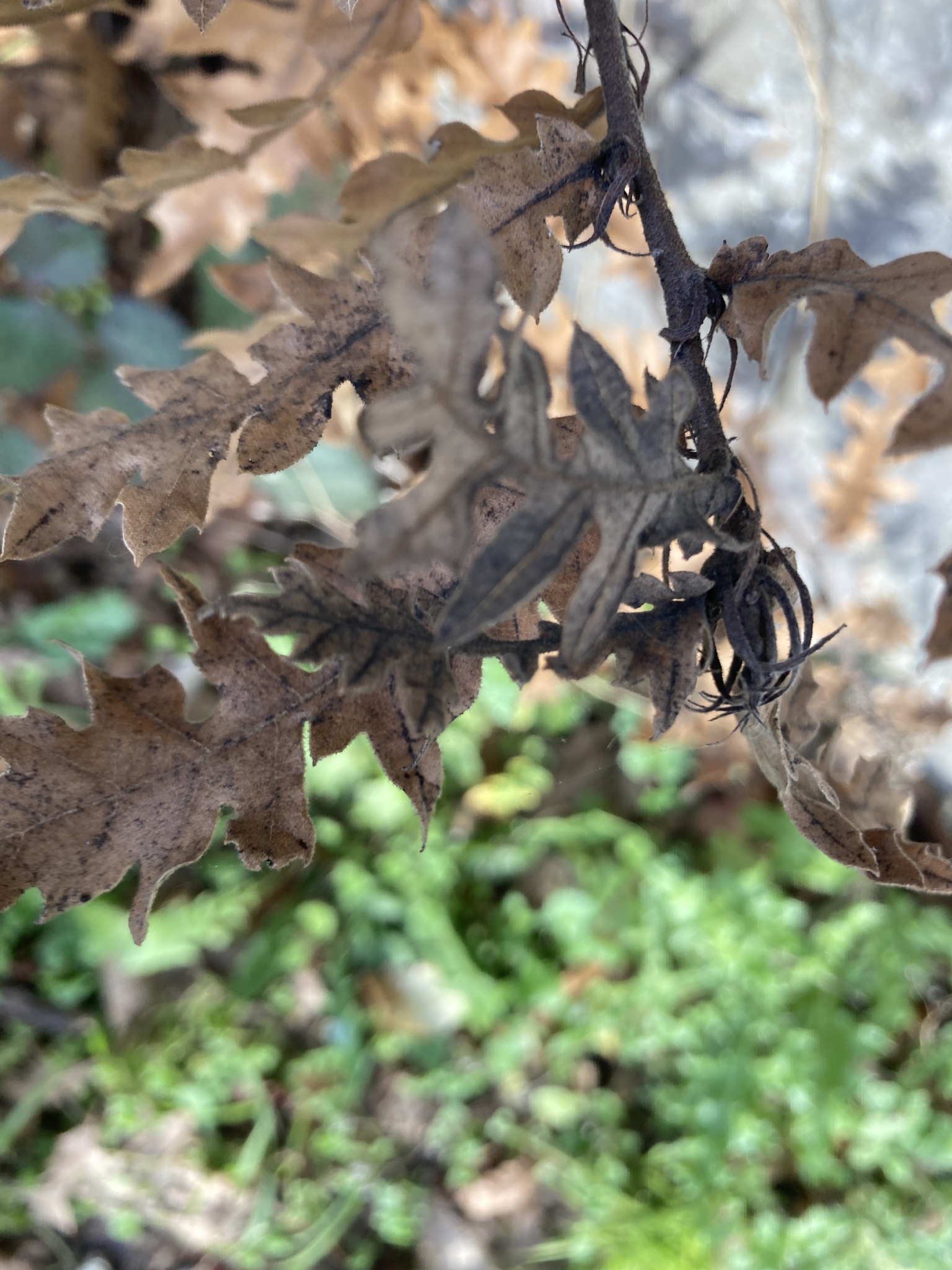
European Turkey oak (Quercus cerris) is a large deciduous tree native to southern Europe, Asia Minor, and the Levant. It features deeply lobed, bristle-tipped leaves and acorns enclosed in distinctive mossy cups.
It grows faster than native Western European oaks but produces timber prone to splitting. Landscapers plant it primarily as a windbreak, avenue tree, or large parkland specimen.
Key Facts
- Plant Type: Large deciduous tree
- Height: 25–40 m (82–131 ft)
- Growth Rate: 60–90 cm (24–35 in) per year
- Acorn Maturation: 18 months (two seasons)
- Hardiness: USDA Zones 6–9
- Soil Preference: Well-drained, acidic to alkaline
Landscape Suitability for European Turkey Oak
European Turkey oak requires expansive open space such as parks, estates, or wide road avenues to accommodate its wide crown. Its tolerance of air pollution and alkaline chalk soils makes it suitable for urban screen plantings and shelterbelts.
You should avoid planting this species near foundations, paved paths, or underground utility pipes. The extensive lateral root system spreads beyond the drip line of the canopy and can heave paving or draw moisture from reactive clay soils.
- Requires a planting area at least 15–25 m (50–80 ft) wide.
- Tolerates strong winds and coastal exposure.
- Acts as a host for the knopper gall wasp (Andricus quercuscalicis).
- Drought-tolerant once established after 3–4 years.
Identifying Quercus cerris Leaves, Acorns, and Bark
You can identify European Turkey oak by the mossy, hair-like bristles covering its acorn cups and winter buds. The leaves and stem details distinguish it from native European oaks throughout the year.
The leaves measure 7–14 cm (2.8–5.5 in) long and 3–5 cm (1.2–2.0 in) wide, featuring 6 to 12 deep triangular lobes per side with pointed, bristle-tipped teeth. The upper leaf surface is dark green and rough to the touch, while the underside carries greyish downy hairs. Winter buds are surrounded by persistent, thread-like stipules measuring 1 cm (0.4 in) long.
The acorn fruit takes 18 months to mature, ripening in the autumn of its second year. The acorns measure 2.5–3 cm (1.0–1.2 in) long, set deep within a cup covered in long, soft, reflexed scales that give it a mossy appearance. The bark is grey and shallowly fissured when young, developing thick, dark grey ridges separated by deep orange-brown furrows as the tree matures.
- Leaves: 7–14 cm (2.8–5.5 in) long, variable lobes with sharp bristle tips.
- Acorns: 2.5–3 cm (1.0–1.2 in) long in mossy, hair-covered cups.
- Bark: Dark grey with orange-red fissures in deep cracks.
- Buds: Surrounded by hair-like grey stipules through winter.
Quercus cerris Growth Rate and Mature Height
European Turkey oak grows at a fast rate of 60–90 cm (24–35 in) per year under favourable growing conditions. Young saplings establish rapidly compared to English oak (Quercus robur).
At maturity, the tree reaches a height of 25–40 m (82–131 ft) with a broad, dome-shaped canopy spanning 15–25 m (50–82 ft). The trunk diameter can exceed 1.5–2 m (4.9–6.6 ft) on mature specimens over 100 years old.
- Height at 10 years: 6–8 m (20–26 ft).
- Height at maturity: 25–40 m (82–131 ft).
- Spread at maturity: 15–25 m (50–82 ft).
- Lifespan: 150–200 years.
Site Requirements and Soil Conditions
Plant European Turkey oak in full sunlight on well-drained soil. It tolerates full exposure and performs well in open rural positions or exposed urban parks.
The tree adapts to a broad pH range from acidic soil at pH 5.0 to heavy alkaline chalk at pH 8.0. Soil textures ranging from dry sand to heavy clay are suitable, provided water does not pool around the roots for extended winter periods.
- Light: Full sun (minimum 6 hours of direct sun daily).
- Soil pH: 5.0 to 8.0.
- Soil Type: Clay, loam, sand, or chalk.
- Hardiness: USDA Zones 6 through 9 (-23 °C / -10 °F minimum).
How to Plant European Turkey Oak
Plant container-grown or root-balled Turkey oak trees between late autumn and early spring while the plant is dormant. Early winter planting allows roots to establish before summer heat.
Dig a hole twice as wide as the root ball and equal in depth. Set the root collar flush with the surrounding soil level, as planting too deep causes stem rot. Backfill with native soil, firm gently to eliminate air pockets, and water with 20–30 L (5–8 gal) of water immediately.
- Drive a single low stake into the windward side at a 45-degree angle.
- Apply a 5–8 cm (2–3 in) layer of bark mulch, keeping it 10 cm (4 in) away from the trunk.
- Water deeply twice a week during the first dry summer season.
- Remove the tree stake after two full growing seasons.
Watering and Ongoing Maintenance
Provide 30–40 L (8–10 gal) of water per week during dry periods for the first three years. Established trees rely on deep root systems and rarely require supplemental irrigation.
Fertilizer is generally unnecessary in outdoor landscape settings. If planting in nutrient-deficient sandy soils, apply a balanced slow-release fertilizer with an N-P-K ratio of 10-10-10 around the drip line in early spring at a rate of 50 g per square metre (1.6 oz per square yard).
- Maintain a weed-free zone of 1 m (3.3 ft) around the base for 3 years.
- Replenish organic mulch every autumn to retain soil moisture.
- Monitor foliage for gall activity in early summer.
Pruning Schedule and Formative Training
Prune European Turkey oak in mid-winter during complete dormancy to limit sap bleeding and reduce exposure to fungal spores. Avoid pruning between early spring and mid-summer when sap flow is high.
Establish a single dominant leader during the first 5 to 10 years by removing competing vertical shoots. Clear lower branches gradually over several years to clear a stem height of 2.5 m (8 ft) if clearance is needed below the canopy.
- Cut back crossed or rubbing branches to outward-facing buds.
- Never remove more than 20% of the live canopy in a single season.
- Always cut just outside the branch collar without leaving long stubs.
Pests, Diseases, and Gall Wasps
The host relationship with the knopper gall wasp (Andricus quercuscalicis) is the main biological concern for European Turkey oak. The wasp requires both European Turkey oak and native English oak (Quercus robur) to complete its lifecycle.
The wasp lays eggs in the female catkins of English oak, causing distorted, ridged galls that prevent normal acorn development and reduce seed viability in English oak stands. Other potential issues include oak powdery mildew (Erysiphe alphitoides) on young foliage during dry summers and honey fungus (Armillaria mellea) at the root crown.
- Knopper Gall Wasp: Distorts English oak acorns; causes minor, harmless leaf galls on Turkey oak.
- Oak Powdery Mildew: White powdery coating on young leaves; rarely fatal to mature trees.
- Honey Fungus: Causes root decay; maintain good soil drainage to reduce risk.
Turkey Oak vs European Oak: How to Tell Them Apart
European Turkey oak grows faster and has hair-like stipules around its winter buds, whereas English oak (Quercus robur) has smooth buds and stalked acorns. Distinguishing these species helps when selecting trees for timber or habitat management.
Leaf shape differs markedly: European Turkey oak leaves feature sharp, bristle-tipped lobes and rough surfaces, while English oak leaves have rounded lobes with small ear-like lobes (auricles) at the base of the leaf stem. Acorn cups on European Turkey oak are covered in soft, mossy scales, whereas English oak cups are smooth with scale-like plates.
- Acorn Cup: Turkey oak has mossy/hairy scales; English oak has smooth scales.
- Acorn Stalk: Turkey oak acorns sit directly on twigs (sessile); English oak acorns grow on long stalks (peduncles).
- Leaf Base: Turkey oak tapers without ears; English oak has ear-like basal lobes (auricles).
- Buds: Turkey oak has long hairy threads surrounding buds; English oak has smooth buds.
Frequently Asked Questions
What is European Turkey oak?
European Turkey oak (Quercus cerris) is a large deciduous tree native to southern Europe and Asia Minor. It is characterized by fast growth, deeply lobed bristle-tipped leaves, and mossy acorn cups.
What is the difference between Turkey oak and European oak?
Turkey oak (Quercus cerris) has bristle-tipped leaf lobes, mossy acorn cups, and hairy winter buds. European oak, such as English oak (Quercus robur), features rounded leaf lobes, smooth acorn cups on long stalks, and smooth buds.
What is the difference between Asian Turkey oak and European Turkey oak?
European Turkey oak refers to Quercus cerris, native to southern Europe and Asia Minor. In North America, Turkey oak refers to American turkey oak (Quercus laevis), a smaller shrubby tree native to the southeastern United States with three-lobed leaves.
How fast does Quercus cerris grow?
Quercus cerris grows rapidly at a rate of 60 to 90 cm (24 to 35 inches) per year when young. It matures into a full specimen reaching 25 to 40 m (82 to 131 ft) tall within 50 years.
Is European Turkey oak timber suitable for woodworking?
European Turkey oak timber is prone to warping, splitting, and cracking during drying due to high internal tension. It is less durable than English oak (Quercus robur) wood and is primarily used for firewood, fencing, or pulp.
Are Quercus cerris acorns toxic to dogs and livestock?
Acorns and leaves of Quercus cerris contain gallotannins, which cause gastrointestinal distress and kidney damage in horses, cattle, and dogs if eaten in large quantities.
Sources & Verification
Taxonomy and distribution are checked against the databases below. Care guidance is written for cultivated species only and reviewed by our editor. How We Build Plant Profiles →


