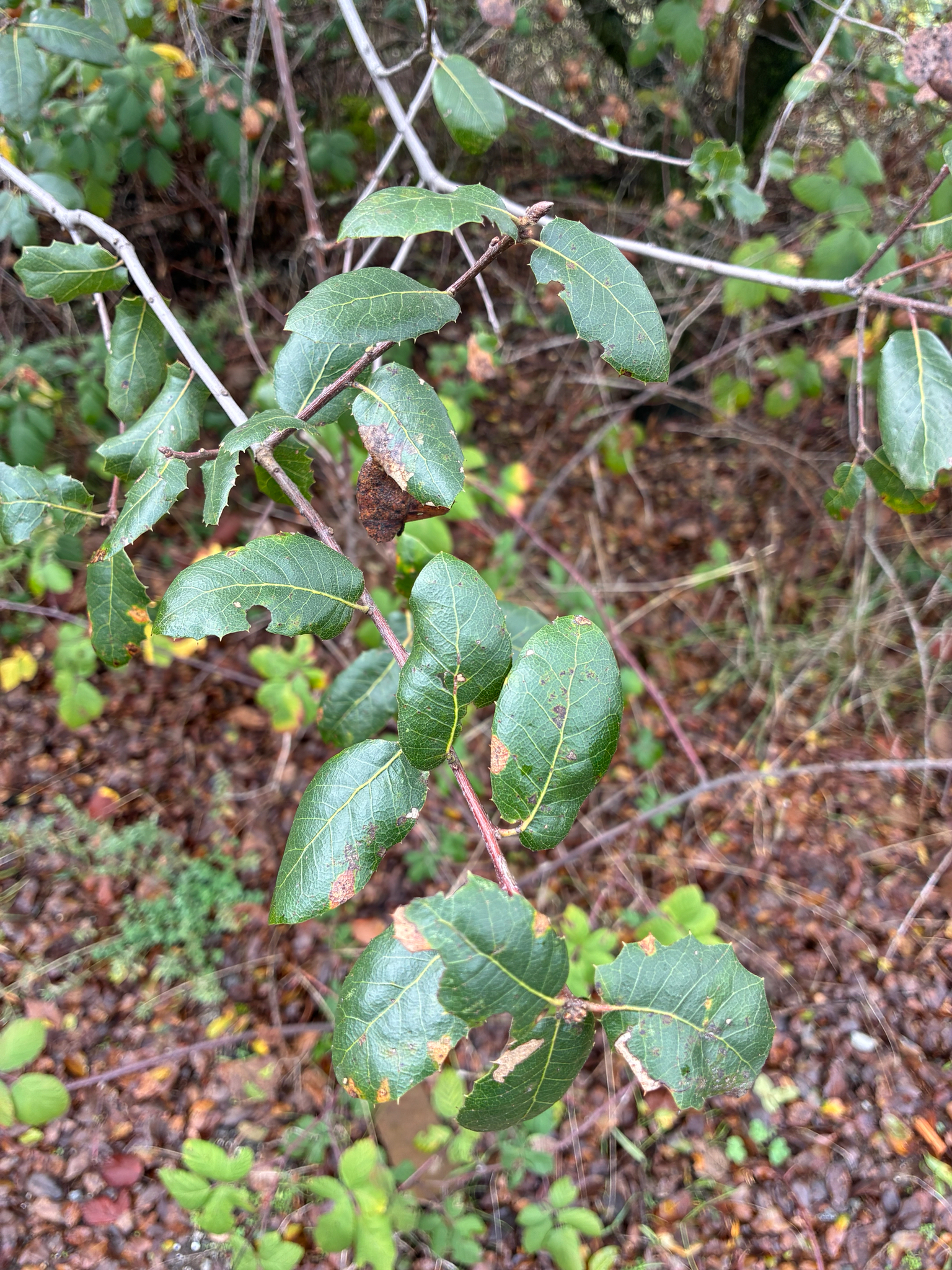
Swamp chestnut oak (Quercus michauxii) is a native hardwood tree indigenous to bottomlands and river valleys across the eastern and central United States. It is recognized for its flaky ash-gray bark, velvety silvery leaf undersides, and exceptionally large, sweet acorns.
A member of the white oak group, this long-lived shade tree produces sweet acorns that feed native wildlife while supplying dense timber historically split into thin strips for weaving durable cotton baskets.
Key Facts
- Type: Deciduous shade tree
- Height: 20–30 m (65–100 ft)
- Hardiness: USDA Zones 5 to 9
- Growth Rate: Moderate, 30–60 cm (1–2 ft) per year
- Light: Full sun
- Soil: Deep, moist, acidic bottomland soils
Landscape Fit and Yard Conditions
Swamp chestnut oak requires ample growing space and deep, moist soil to develop its wide canopy. It suits suburban parks, expansive residential lawns, and damp acreage where its broad shade can unfold without crowd barriers. While it adapts well to moist upland soils in cultivation, planting it near low spots, stream banks, or retention basins mimics its natural flood-plain habitat.
Swamp Chestnut Oak Leaf, Bark, and Acorn Identification
Swamp chestnut oak leaves measure 10 to 23 cm (4 to 9 in) long with 10 to 14 rounded teeth along each edge. The upper leaf surface displays a dark glossy green color, while the underside features dense, silvery pubescence that feels soft to the touch. In autumn, foliage turns a deep bronze to crimson-red. The bark is light ash-gray, peeling into thin scaly plates similar to white oak (Quercus alba). Acorns are unusually large, measuring 2.5 to 3.8 cm (1 to 1.5 in) long, set in a thick, bowl-shaped cup covering one-third of the nut.
Swamp Chestnut Oak Tree Size and Growth Rate
A mature swamp chestnut oak grows 20 to 30 m (65 to 100 ft) tall with a spread of 12 to 20 m (40 to 65 ft). Young trees display a moderate growth rate of 30 to 60 cm (1 to 2 ft) annually when grown in full sun and rich soil. Open-grown specimens form a single stout trunk up to 1.5 m (5 ft) in diameter supporting a rounded, spreading crown.
Swamp Chestnut Oak Native Range and Site Selection
The native range of swamp chestnut oak spans bottomlands from New Jersey south to Florida and west to East Texas and Oklahoma. Inland populations follow the Mississippi and Ohio River valleys north into Missouri, Illinois, and Indiana. For strong growth in cultivation, adhere to these site parameters:
- Select a location receiving at least 6 hours of direct sunlight daily.
- Plant in deep, rich, moist soils with a pH between 5.0 and 6.8.
- Avoid alkaline soils above pH 7.2, which trigger foliage chlorosis.
- Space the tree at least 10 m (33 ft) away from structures and utility lines.
How to Plant Swamp Chestnut Oak Trees and Acorns
Plant young container trees in autumn or early spring, or sow fresh acorns immediately after collection in late autumn. Because swamp chestnut oak belongs to the white oak group, its acorns sprout shortly after falling without needing cold stratification. Follow these steps for successful planting:
- Acorns: Sow sound acorns 2.5 cm (1 in) deep in a outdoor nursery bed or deep root-trainer pot.
- Container trees: Dig a hole twice as wide as the root ball and equal in depth.
- Settling: Water deeply immediately after backfilling to remove air pockets.
- Mulching: Apply a 7 to 10 cm (3 to 4 in) layer of woodchips around the base, keeping mulch off the trunk bark.
Tree Care, Firewood Quality, and Timber
Young swamp chestnut oak trees need 2.5 cm (1 in) of water per week for their first two growing seasons. Established trees tolerate brief dry periods but maintain fuller foliage in moist soils. Is swamp chestnut oak good firewood? Yes, its heavy, dense wood burns long with high heat output comparable to white oak, though green logs can be difficult to split by hand. Historically, woodworkers split its straight-grained sapwood into flexible strips to weave heavy cotton baskets.
When and How to Prune Swamp Chestnut Oak
Prune swamp chestnut oak exclusively during dormant winter months from December through February. Pruning in spring or summer leaves open cuts that attract bark beetles carrying oak wilt disease (Bretziella fagacearum). Keep pruning balanced:
- Establish a single central trunk by trimming back competing upper leaders.
- Remove lower side branches over several seasons to raise canopy clearance to 2.4 m (8 ft).
- Cut dead, crossing, or damaged branches cleanly at the branch collar.
- Avoid removing more than 20 percent of the foliage in a single season.
Common Swamp Chestnut Oak Problems
Oak wilt and oak leaf blister are the main fungal issues affecting swamp chestnut oak. White oaks show better resistance to oak wilt than red oaks, but stressed trees remain susceptible. Watch for these common symptoms:
- Oak wilt: Rapid wilting and browning of leaf margins in midsummer; avoid spring pruning to prevent infection.
- Oak leaf blister: Raised yellow spots on spring leaves caused by wet weather; rarely causes lasting damage.
- Twig galls: Small woody swellings on branches caused by tiny wasps; usually cosmetic and best left alone.
- Acorn weevils: Small holes in fallen nuts caused by beetle larvae; discard floating acorns before planting.
Winter Care and Hardiness
Swamp chestnut oak is cold hardy across USDA Zones 5 through 9 and requires no artificial winter protection. Autumn rainfall usually provides adequate moisture through winter, but young trees benefit from late-autumn mulching to safeguard root systems during prolonged freeze cycles. Male deer often rub antlers against young stems in late autumn, so enclose saplings in rigid mesh guards 1.5 m (5 ft) tall.
Uses for Wildlife, Timber, and Edible Acorns
Swamp chestnut oak acorns are among the sweet and palatable nuts produced by native oaks, containing low tannin levels. Are swamp chestnut oak acorns edible? Yes, after shelling and boiling or leaching out residual tannins, the nuts can be roasted or ground into flour. In ecosystems, these large acorns serve as a food source for wild turkeys, ducks, deer, and black bears. The lumber is processed into hardwood flooring, cabinetry, fence posts, and heavy construction timbers.
Swamp Chestnut Oak vs Similar Oak Species
Swamp chestnut oak is easily confused with chestnut oak, swamp white oak, chinquapin oak, and sawtooth oak. Field traits differentiate these species clearly:
- Vs Chestnut Oak (Quercus montana): Chestnut oak grows on dry upland ridges, has dark furrowed bark and hairless leaf undersides, whereas swamp chestnut oak grows in bottomlands and has silvery, hairy leaf undersides.
- Vs Swamp White Oak (Quercus bicolor): Swamp white oak leaves have fewer, shallow lobes (5 to 8 pairs) and long-stalked acorns, while swamp chestnut oak leaves have 10 to 14 tooth pairs and stalkless acorns.
- Vs Chinquapin Oak (Quercus muehlenbergii): Chinquapin oak has sharp, gland-tipped leaf teeth and smaller acorns under 2 cm (0.75 in) long.
- Vs Sawtooth Oak (Quercus acutissima): Sawtooth oak features sharp, bristle-tipped teeth and fringed acorn caps.
Frequently Asked Questions
Is swamp chestnut oak a red or white oak?
Swamp chestnut oak belongs to the white oak group (Quercus section Quercus). It features rounded leaf teeth, light ash-gray bark, and acorns that mature in a single season.
How fast does swamp chestnut oak grow?
Swamp chestnut oak grows at a moderate rate of 30 to 60 cm (1 to 2 ft) per year under full sun and moist soil conditions. Growth slows down as the canopy reaches maturity.
Are swamp chestnut oak acorns edible for humans?
Yes, swamp chestnut oak acorns are edible and contain lower tannin levels than red oak acorns. They can be eaten roasted or ground into flour once remaining tannins are leached in water.
Is swamp chestnut oak good firewood?
Swamp chestnut oak makes dense, high-quality firewood that generates long-lasting heat. Like other white oaks, it requires 12 months of seasoning after being split.
What is the difference between swamp chestnut oak and swamp white oak?
Swamp chestnut oak (Quercus michauxii) has 10 to 14 pairs of leaf teeth and stalkless acorns, whereas swamp white oak (Quercus bicolor) has 5 to 8 pairs of leaf lobes and acorns borne on long stems.
Sources & Verification
Taxonomy and distribution are checked against the databases below. Care guidance is written for cultivated species only and reviewed by our editor. How We Build Plant Profiles →