

Meadow buttercup (Ranunculus acris) is a tall perennial wildflower native to Eurasia that produces glossy, deep yellow blooms on upright branching stems. The species colonizes damp grasslands and pastures, where its bitter, blistering sap protects it from most grazing animals.
While traditional hayfields support this wildflower, dairy farmers and horse owners treat it as an unpalatable weed that can blister mouths and taint milk. It spreads by seed rather than surface runners, distinguishing its growth habit from creeping pasture weeds.
Key Facts
- Plant type: herbaceous perennial wildflower
- Mature height: 30–100 cm (12–39 in) tall
- Bloom period: May to September
- Toxicity: toxic to horses, cattle, and humans if ingested fresh
- Native distribution: Europe and temperate Asia
- Root system: short fibrous rhizome without creeping runners
The Meadow Buttercup in Pastures and Wildlands
Meadow buttercup functions as a persistent, unpalatable perennial that thrives in damp, undisturbed soils across temperate climates. In natural meadow habitats, it provides consistent nectar flows for native insects throughout summer. In working livestock pastures, however, its presence reduces usable forage acreage because grazing herds selectively avoid its acrid foliage.
Understanding this species requires acknowledging its dual nature:
- Valuable structural component of traditional European hay meadows
- Problematic pasture competitor in dairy and equestrian grazing land
- Strictly taprooted habit that does not produce above-ground stolons
- Colonizer of poorly drained, compacted ground where heavy livestock tread
Meadow Buttercup Identification and Botanical Features
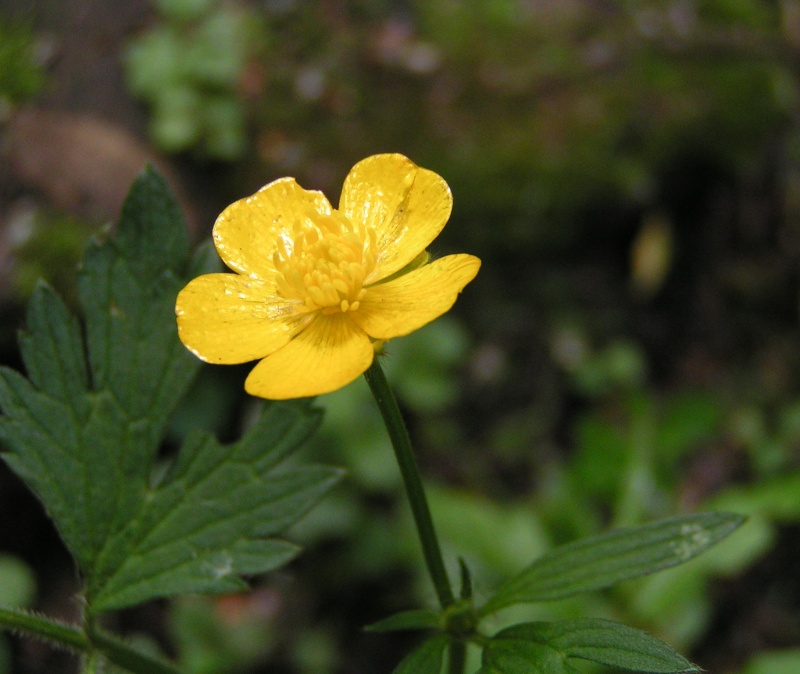
You can identify meadow buttercup by its round, hairy flowering stems and deeply palmately divided leaves that reach up to 100 cm (39 in) in height. The foliage forms a basal rosette before sending up tall, multi-branched floral stems in late spring.
Key diagnostic features include:
- Basal leaves: stalked and deeply divided into 3 to 7 narrow, sharply toothed lobes
- Stem leaves: smaller, sessile (stalkless), divided into linear segments toward the top
- Flowers: five glossy golden-yellow petals measuring 15–25 mm (0.6–1.0 in) across
- Sepals: hairy, yellowish-green, and pressed closely against the undersides of the petals
- Stems: upright, hollow, covered with fine, soft hairs, lacking rooting runners
- Fruit: a rounded cluster of smooth achenes, each bearing a short, curved beak
Native Range and Growing Habitat
Meadow buttercup is native to damp grasslands across Europe and temperate Asia, thriving from sea level up to subalpine altitudes. The plant colonizes neutral to slightly acidic soils that retain moisture through the warmest summer months.
Typical wild habitats include:
- Lowland flood meadows and damp riverbanks
- Unimproved, traditionally managed hay meadows
- Roadside ditches and damp woodland clearings
- Permanent pastures with heavy loam or clay substrates
Ecological Role and Wildlife Interactions
Meadow buttercup offers an accessible open pollen source for hundreds of generalist insect species due to its exposed floral nectaries. The glossy yellow petals use a specialized layer of starch beneath the surface cells to reflect sunlight, acting as a bright visual beacon for flying pollinators.
Key ecological relationships include:
- Pollen and nectar for hoverflies (Syrphidae) and solitary bees (Andrena species)
- Forage for beetles, including pollen-feeding blister beetles and soldier beetles
- Larval food plant for specialized moths such as the buttercup pug (Eupithecia trisignaria)
- Seed consumption in late autumn by small farmland birds, including the common finch (Fringilla coelebs)
Invasiveness and Conservation Status
Meadow buttercup is designated as a noxious weed and invasive species across parts of North America, New Zealand, and Australia. In areas like Ontario, Quebec, and the American Pacific Northwest, it aggressively displaces native flora in damp pastures and river valleys.
Controlling dense infestations requires persistence:
- Mowing before seed heads mature in early June to exhaust the root reserves
- Targeted spot-spraying of broadleaf pasture herbicides during active spring rosette growth
- Improving soil drainage through aeration to reduce the damp conditions it favors
- Avoiding overgrazing, which creates bare soil patches where dropped seeds readily sprout
Is Meadow Buttercup Poisonous to Livestock and Horses?
Fresh meadow buttercup foliage is highly toxic to cattle and horses because bruised plant tissues release the blistering compound protoanemonin. Animals usually refuse to eat the growing weed due to its intensely sharp, burning taste, but poisoning occurs when pastures are overstocked and forage is depleted.
Signs of poisoning and key safety facts include:
- Excessive salivation, oral ulceration, and swelling of the lips and tongue
- Severe colic, diarrhea, and dark, bloody urine in large grazing animals
- Skin blistering on pale or unpigmented livestock muzzles that contact sap
- Safe in dried hay: protoanemonin dimerizes into non-toxic anemonin as cut grass dries, rendering fully cured hay safe to feed
Historical Uses and Herbal Lore
Herbalists traditionally used meadow buttercup as an external counter-irritant and blistering agent to relieve rheumatism and gout. The blistering sap was historically applied to unbroken skin to draw out deep-seated inflammation, though this practice regularly caused severe, painful ulcerations.
The plant has no safe internal culinary application. All parts contain the glycoside ranunculin, meaning consumption of fresh stems or roots causes intense irritation of the digestive tract. Modern botanical and medical standards completely reject internal consumption of this species.
Meadow Buttercup vs Creeping Buttercup and Look-Alikes
You can distinguish meadow buttercup from creeping buttercup (Ranunculus repens) by its upright growth habit and absence of runners. While creeping buttercup sends horizontal stolons across the soil to form dense low mats, meadow buttercup stays rooted in a single clump and rises much higher.
Compare these common pasture species:
- Meadow buttercup (Ranunculus acris): upright to 100 cm (39 in); sepals held flat against petals; middle leaf lobe attached directly without a stalk.
- Creeping buttercup (Ranunculus repens): low-growing; long creeping runners that root at nodes; middle leaf lobe carried on a distinct stalk.
- Bulbous buttercup (Ranunculus bulbosus): base swollen into a solid corm; flower sepals reflex downwards toward the stem.
- Lesser celandine (Ficaria verna): blooms early in March; heart-shaped unlobed leaves; 8 to 12 narrow petals rather than five.
- Marsh marigold (Caltha palustris): large hollow stems; fleshy rounded leaves; flowers lack true petals and feature 5 to 8 bright yellow sepals.
Frequently Asked Questions
What is the flower meaning or symbolism of meadow buttercup?
In traditional Victorian floriography, buttercups symbolize childishness, humility, and radiant charm. The brilliant gloss of the petals has long been associated with cheerfulness and simple rural pastures.
Is meadow buttercup a perennial or an annual?
Meadow buttercup is a true herbaceous perennial. It survives the winter through a short, thick rhizome beneath the soil surface and regenerates fresh leafy rosettes each spring.
Is meadow buttercup invasive in Ontario?
Yes, meadow buttercup is considered an aggressive naturalized weed and noxious pasture plant in Ontario and across eastern Canada. It establishes rapidly in damp dairy pastures and hayfields, crowding out native grasses and clover.
Is meadow buttercup edible for humans?
No, meadow buttercup is entirely inedible and unsafe to eat. Ingestion causes intense burning of the mouth, throat swelling, vomiting, and severe abdominal cramping due to the presence of protoanemonin.
How to get rid of meadow buttercup in pasture?
Eradicate pasture buttercups by mowing fields right as flowering begins to deplete root energy and prevent seed set, alongside improving soil drainage. For dense infestations, apply targeted broadleaf herbicides such as MCPA or 2,4-D in early spring while the basal rosettes are small.
Information about traditional or historical uses is provided for educational interest only and is not medical advice. Do not use any plant to treat a condition without speaking to a qualified professional.
Sources & Verification
Taxonomy and distribution are checked against the databases below. Care guidance is written for cultivated species only and reviewed by our editor. How We Build Plant Profiles →
- Kew Plants of the World OnlineTaxonomic baseline, native range and distribution data.
- NC State Extension Gardener Plant ToolboxMorphological description, weed characteristics, and toxicity profiles.
- GBIF — Global Biodiversity Information Facilitytaxonomy, synonyms, occurrence records
- Wikipediageneral reference
More in Ranunculus

Glacier Buttercup
Ranunculus glacialis

Hairy Buttercup
Ranunculus sardous
Creeping Buttercup
Ranunculus repens
☀️ Partial Sun 💧 High
Bulbous Buttercup
Ranunculus bulbosus
☀️ Full Sun 💧 Low

Persian Buttercup
Ranunculus asiaticus
☀️ Full Sun 💧 Moderate

Celery-Leaved Buttercup
Ranunculus sceleratus
☀️ Full Sun 💧 High