

Hairy Buttercup (Ranunculus sardous) is an annual or biennial wild herb native to Europe, Northern Africa, and Western Asia, recognised by its distinctly hairy stems and reflexed green sepals beneath pale yellow flowers. It colonizes moist pastures, ditch edges, and lawn margins across temperate regions as an introduced weed.
This wild species rapidly establishes in clay-heavy soils that remain damp during early spring growth. Fresh tissues contain blistering compounds that deter livestock, making land management essential in grazing pastures.
Key Facts
- Family: Ranunculaceae (buttercup family)
- Life Cycle: Annual or biennial herb
- Height: 10–50 cm (4–20 in) tall
- Flowers: 5 pale yellow petals with reflexed sepals
- Toxicity: Toxic to humans and animals when fresh
- Toxicity Warning: Causes severe oral irritation and mouth blistering
Where Hairy Buttercup Fits in the Wild Landscape
Hairy Buttercup functions as a fast-colonizing annual pioneer plant in disturbed, damp environments across temperate climates. It fills open ground in spring before taller meadow grasses canopy over, completing its reproductive cycle before summer droughts begin.
You will encounter this plant as a persistent volunteer in damp lawns, roadside ditches, arable margins, and heavily trodden pastures. It thrives where livestock compaction or tilling removes competing perennial foliage, allowing dormant seed reserves to germinate rapidly in wet soil conditions.
- Prefers damp, disturbed ground with minimal plant competition
- Thrives in wet agricultural pastures and compacted clay soils
- Spreads aggressively through prolific annual seed production
How to Identify Ranunculus sardous
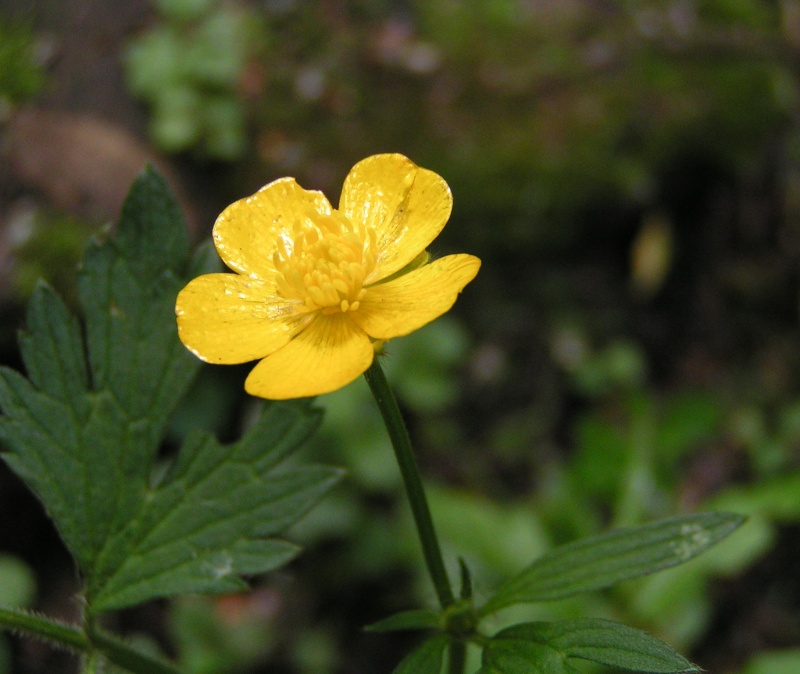
To identify Ranunculus sardous, look for distinctly turned-down sepals bending backward toward the hairy stalk directly underneath five glossy yellow petals. Stems grow 10–50 cm (4–20 in) tall and feature stiff, spreading hairs along their entire length.
Leaves are arranged alternately along the stem, borne on hairy petioles measuring 2–8 cm (0.8–3.1 in) long. The basal foliage is deeply divided into three distinct leaflets with lobed edges. Flowers measure 12–25 mm (0.5–1.0 in) wide, producing spherical fruiting heads composed of up to 35 flattened achenes topped with short, curved beaks.
- Height: 10–50 cm (4–20 in) tall erect or ascending stems
- Hairs: Stiff, spreading white hairs coat stems and foliage
- Sepals: 5 sepals fully reflexed against the floral pedicel
- Petals: 5 pale yellow, shiny petals up to 10 mm (0.4 in) long
- Fruit Cluster: Spherical head of 25–35 flat, pimpled achenes
Where Hairy Buttercup Grows Native and Wild
Hairy Buttercup is native to southern and central Europe, Northern Africa, and Western Asia, where it inhabits natural floodplain meadows and damp coastal soils. As an introduced weed, it now spans North America, Australia, and New Zealand.
The species prefers low-altitude habitats below 800 m (2,600 ft) elevation. It frequents seasonal wetlands, muddy riverbanks, field margins, and irrigated pastures where surface moisture collects during late winter and early spring.
- Native across the Mediterranean basin and temperate Europe
- Introduced widely across North America, including coastal US states
- Found in disturbed agricultural soil, ditches, and damp lawns
Ecology and Seed Production of Hairy Buttercup
A single hairy buttercup plant produces up to 1,500 seeds per season contained within clustered achenes that disperse via water runoff and sticky mud attached to machinery or grazing animals. Germination occurs mainly in autumn and early spring when soil moisture is highest.
Flowers attract early-season solitary bees, hoverflies, and small beetles seeking pollen and nectar. Birds occasionally consume mature seeds, while mammalian herbivores avoid eating mature living plants due to burning chemical compounds inside the leaves.
- Seeds remain viable in wet soil seedbanks for over 5 years
- Flowers open in full sunlight from May through August
- Insect-pollinated by wild flies, hoverflies, and small wild bees
Conservation and Agricultural Impact of Ranunculus sardous Crantz
The full scientific authority name Ranunculus sardous Crantz carries a conservation status of Least Concern (LC) due to its dense, expanding global population. Far from endangered, it is managed as an agricultural weed in pastured land and cereal fields.
When abundant in hay meadows, it degrades forage quality because livestock reject fresh plants. Dense stands lower grass yield in damp pastures, though winter mowing and improved soil drainage effectively limit seed establishment without requiring chemical herbicides.
- Status: Least Concern globally with high wild adaptability
- Reduces pasture grazing quality due to plant unpalatability
- Controlled via soil aeration, drainage improvement, and early mowing
Is Ranunculus sardous Edible or Medicinal?
Hairy buttercup is not edible and is toxic to ingest raw due to concentrations of ranunculin, an unstable glycoside that breaks down into toxic protoanemonin when the leaves are crushed or chewed. Ingesting raw plant material causes severe mouth blistering, salivation, stomach ache, and digestive distress.
Historically, extracts were traditionally used in European folk practices as topical counter-irritants to blister skin or treat rheumatic pain, though modern herbal medicine discards these practices due to high risks of chemical burns and tissue damage. Drying or boiling plant matter neutralizes protoanemonin, making dry hay safe for livestock, but fresh plants remain hazardous.
- Toxicity: Highly acrid sap causes contact dermatitis and blisters
- Edibility: Completely unsafe to consume fresh or raw
- Historical Use: Traditionally applied externally as a vesicant (blistering agent)
Distinguishing Hairy Buttercup from Similar Buttercups
You can tell hairy buttercup apart from creeping buttercup (Ranunculus repens) by checking for creeping surface runners, which hairy buttercup entirely lacks. Additionally, meadow buttercup (Ranunculus acris) features upright or spreading sepals, whereas hairy buttercup sepals bend sharply backward down the stem.
Bulbous buttercup (Ranunculus bulbosus) also displays reflexed sepals, but features a swollen, corm-like swollen bulb base below the soil, unlike the fibrous root system of Ranunculus sardous. Botanical databases such as Acta Plantarum document these micro-structures for accurate wild species confirmation.
- Ranunculus repens: Has stolons (creeping runners); R. sardous does not
- Ranunculus acris: Sepals stay flat against petals; R. sardous sepals bend backward
- Ranunculus bulbosus: Swollen corm at soil level; R. sardous has fibrous roots
Frequently Asked Questions
Is Ranunculus sardous edible?
No, Ranunculus sardous is toxic and unsafe to eat raw. Fresh plant material contains ranunculin, which causes severe irritation, blistering of the mouth, and gastrointestinal distress if swallowed.
What family does Ranunculus sardous belong to?
Hairy buttercup belongs to the buttercup family, Ranunculaceae. This family contains over 2,000 species known for shiny petals and acrid protective compounds.
What are the medicinal uses of Ranunculus sardous?
Historically, Ranunculus sardous was traditionally used in European folk medicine as a skin blisterer to relieve joint aches. Modern medical authorities advise against using this plant internally or externally because its raw sap causes severe chemical burns and blisters.
How does Ranunculus sardous reproduce through seeds?
Hairy buttercup reproduces exclusively by seeds contained within flattened achenes, producing up to 1,500 seeds per plant every summer. Seeds drop into wet mud or spread via machinery, remaining dormant in moist soil for years.
What does Ranunculus sardous Crantz mean?
Ranunculus sardous Crantz is the full scientific name of hairy buttercup, where 'Crantz' attributes the botanical classification to the 18th-century Austrian physician and botanist Heinrich Johann Nepomuk von Crantz.
Where can I find botanical records like Acta Plantarum for hairy buttercup?
European wild flora databases such as Acta Plantarum, GBIF, and Kew Plants of the World Online provide detailed distribution maps and taxonomic keys for identifying Ranunculus sardous in the wild.
Information about traditional or historical uses is provided for educational interest only and is not medical advice. Do not use any plant to treat a condition without speaking to a qualified professional.
Sources & Verification
Taxonomy and distribution are checked against the databases below. Care guidance is written for cultivated species only and reviewed by our editor. How We Build Plant Profiles →
More in Ranunculus
Bulbous Buttercup
Ranunculus bulbosus
☀️ Full Sun 💧 Low

Celery-Leaved Buttercup
Ranunculus sceleratus
☀️ Full Sun 💧 High
Lesser Spearwort
Ranunculus flammula
Common Water-Crowfoot
Ranunculus aquatilis
☀️ Full Sun 💧 Aquatic
Creeping Buttercup
Ranunculus repens
☀️ Partial Sun 💧 High

Persian Buttercup
Ranunculus asiaticus
☀️ Full Sun 💧 Moderate