
Common Water-Crowfoot is a hardy aquatic perennial native to the temperate waters of Europe, North America, and North Africa. This species, Ranunculus aquatilis, is distinguished by its ability to produce two entirely different types of leaves on the same stem to survive in varying water levels.
It serves as a high-performance oxygenator for garden ponds, providing essential cover for tadpoles and aquatic insects. While it spreads vigorously in nutrient-rich water, it remains a manageable native alternative to invasive non-native aquatic weeds.
Key Facts
- Water Depth: thrives in 20-100 cm (8-40 in)
- Bloom: white flowers from May to August
- Role: excellent submerged oxygenator for ponds
- Light: requires full sun for surface flowering
- Hardiness: survives freezing in USDA zones 5-10
Why Choose Water Crowfoot for Your Pond
Common Water-Crowfoot is a functional addition to any freshwater feature because it acts as a natural oxygenator and water purifier. It absorbs excess nutrients like nitrates from the water, which helps prevent the growth of unsightly blanket weed and algae. The dense submerged foliage provides a sanctuary for dragonfly larvae and small fish like sticklebacks.
In a garden setting, it offers a transition between deep water and the surface. Unlike many deep-water plants, it produces delicate white flowers that sit just above the surface, creating a meadow-like effect on the water. It is particularly suited for wildlife ponds where chemical filtration is avoided.
Identifying Common Water-Crowfoot Leaves and Flowers
You can identify Ranunculus aquatilis by its two distinct leaf forms: thread-like submerged leaves and broad floating leaves. The submerged leaves are finely divided into hair-like segments that maximize surface area for oxygen exchange. If the water is deep enough, the plant develops three-lobed, kidney-shaped leaves that float on the surface, similar to a miniature water lily.
- Flower size: 1.5-2 cm (0.6-0.8 in) across
- Petals: 5 white petals with a yellow base
- Stems: hollow, branched, reaching up to 2 m (6.5 ft) long
- Fruits: small clusters of achenes (dry seeds)
The Best Location for Ranunculus aquatilis
This plant requires still or very slow-moving freshwater in a full sun position to thrive. While it can tolerate partial shade, you will see significantly fewer flowers and the stems may become leggy. It is naturally found in ponds, ditches, and the margins of slow rivers where the water depth is between 20 cm (8 in) and 1 m (3.3 ft).
Avoid placing it near vigorous fountains or waterfalls, as constant splashing can damage the delicate surface flowers. It prefers a base of heavy loam or pond compost, though it can also grow with its roots anchored in silty pond margins. In an aquarium, it requires intense lighting and cooler temperatures below 20 °C (68 °F) to prevent melting.
How to Plant Water Crowfoot in Gardens
The most effective way to plant Common Water-Crowfoot is using weighted mesh baskets filled with aquatic compost. Place 2-3 weighted stems into a 5-litre (1.3-gallon) planting basket and top it with a layer of washed pea shingle to prevent fish from digging up the roots. Lower the basket slowly to a depth of 30-60 cm (12-24 in).
- Timing: plant in mid-spring as the water warms
- Spacing: allow 1 m (3.3 ft) between baskets
- Anchoring: use lead weights for loose bunches if not using baskets
- Soil: use low-nutrient aquatic soil to limit algae growth
Managing Growth and Nutrients
Common Water-Crowfoot rarely requires supplemental feeding in a balanced pond ecosystem. It draws the majority of its nutrients directly from the water column through its submerged leaves. If the plant leaves begin to turn yellow or growth stalls in a new pond, you may use a single aquatic fertilizer tablet pushed into the root zone in June.
Be cautious of high-nutrient runoff from nearby lawns or flower beds. Excess nitrogen can cause the plant to grow too rapidly, potentially choking out other species or causing a summer oxygen crash when the mass begins to decay. Monitoring water clarity is the best way to judge if the nutrient balance is correct.
Controlling Growth and Pruning
You should thin out the stems in late summer to prevent the plant from covering more than 30% of the pond surface. Simply use a rake or pond shears to pull out excess growth. This is a vital task because if the plant becomes too dense, it blocks light from reaching deeper water, which can kill off other oxygenators.
When removing the plant, leave the trimmings on the side of the pond for 24 hours. This allows any trapped pond snails, beetles, or larvae to crawl back into the water. Dispose of the trimmings in a compost heap rather than dumping them in local waterways, as even small fragments can root and spread.
Propagating Ranunculus aquatilis
Propagating this species is simple because stem cuttings will root readily in water during the growing season. Snip a 15-20 cm (6-8 in) length of healthy stem that includes at least two nodes (the bumps where leaves emerge). You can either weigh these down with lead strips or tuck them into a pot of wet silt.
Division of established clumps is also effective in early spring. Lift the planting basket, cut the root mass into two or three sections with a sharp knife, and repot immediately. Ensure the roots do not dry out during the process, as the fine submerged leaves will collapse and die within minutes of air exposure.
Winter Care for Aquatic Buttercups
Common Water-Crowfoot is fully hardy and will survive under ice as long as the pond does not freeze solid to the bottom. In autumn, the floating leaves will die back, and the plant often persists as a smaller, submerged evergreen mound. It does not need to be moved indoors or protected from frost in most temperate climates.
Ensure you remove any fallen tree leaves from the pond surface in October and November. If these leaves settle on the water-crowfoot, they will rot and create an anaerobic environment that can kill the plant’s roots. A pond net is the most efficient way to keep the water surface clear during the dormant season.
Year-Round Care for Water-Crowfoot
| Spring | Divide overgrown clumps in March. Introduce new weighted bunches once water temperatures reach 10 °C (50 °F). |
|---|---|
| Summer | Thin out surface growth to keep 70% of the water surface clear. Remove any spent flower heads if they look untidy. |
| Autumn | Cut back dying floating leaves. Remove fallen tree leaves from the water to prevent rot around the plant base. |
| Winter | No active care required. Ensure a small area of the pond surface remains ice-free for gas exchange if fish are present. |
Common Problems with Ranunculus aquatilis
| What you see | Likely cause | What to do |
|---|---|---|
| Yellowing submerged leaves | Lack of light or nutrients | Move to a sunnier spot or add an aquatic fertilizer tablet to the soil. |
| No floating leaves appearing | Water is too deep or fast-moving | Raise the planting basket to a depth of 30 cm (12 in). |
| Stems covered in green slime | Filamentous algae (blanket weed) | Twirl the algae off with a stick and reduce fish feeding to lower nutrients. |
Related Species and Varieties
- Ranunculus aquatilis var. aquatilis – the standard form with both leaf types
- Ranunculus aquatilis var. diffusus – features more rigid submerged segments
- Ranunculus peltatus – a closely related species often sold interchangeably
Best Companion Plants for Pond Health
Pair Ranunculus aquatilis with marginal plants that offer structural contrast and different flowering times. Marsh Marigold (Caltha palustris) provides early spring yellow flowers before the water-crowfoot peaks. For deeper water, Water Lilies (Nymphaea species) offer larger leaves that provide shade and help regulate water temperature.
- Marsh Marigold (Caltha palustris): for early spring color
- Water Forget-Me-Not (Myosotis scorpioides): for blue flowers at the edge
- Pickerel Weed (Pontederia cordata): for vertical height
- Hornwort (Ceratophyllum demersum): for additional deep-water oxygenation
Frequently Asked Questions
Is common water-crowfoot invasive?
It is not considered an invasive species in its native range of Europe and North America, though it grows vigorously. It can dominate small ponds if nutrients are high, but it is easily controlled by manual thinning.
Can I grow Ranunculus aquatilis in an aquarium?
Yes, but it is challenging because it requires very high light levels and water temperatures below 20 °C (68 °F). In tropical tanks, it usually fails and 'melts' within a few weeks.
How do I tell the difference between water-crowfoot and ivy-leaved crowfoot?
Common Water-Crowfoot (Ranunculus aquatilis) has both thread-like submerged leaves and lobed floating leaves, whereas Ivy-Leaved Crowfoot (Ranunculus hederaceus) only has lobed leaves and much smaller flowers.
Is it safe for fish?
Yes, it is excellent for fish as it provides oxygen and cover for fry. However, the plant is toxic if eaten by mammals, so keep it away from livestock or curious pets.
Sources & Verification
Taxonomy and distribution are checked against the databases below. Care guidance is written for cultivated species only and reviewed by our editor. How We Build Plant Profiles →
More in Ranunculus
Bulbous Buttercup
Ranunculus bulbosus
☀️ Full Sun 💧 Low
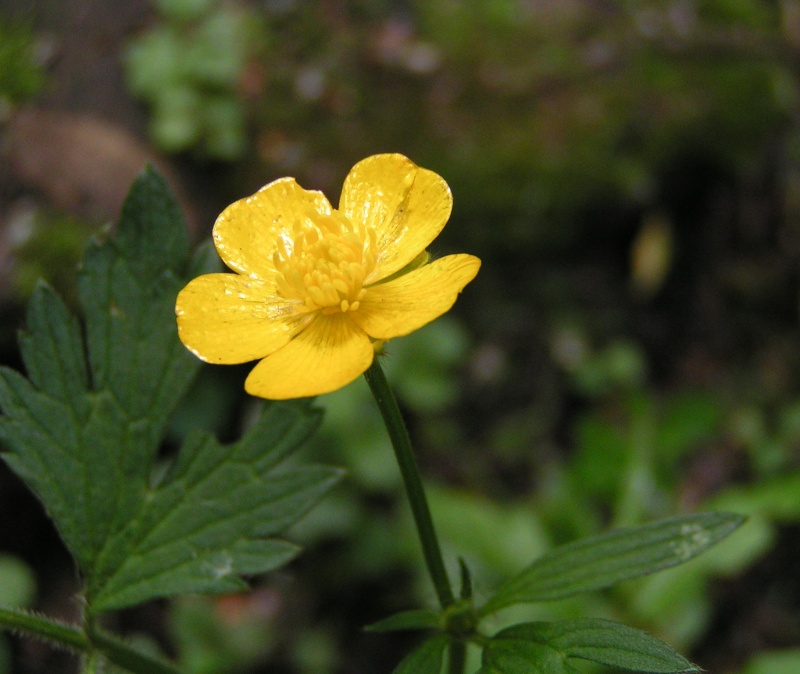
Creeping Buttercup
Ranunculus repens
☀️ Partial Sun 💧 High

Celery-Leaved Buttercup
Ranunculus sceleratus
☀️ Full Sun 💧 High

Meadow Buttercup
Ranunculus acris
☀️ Full Sun 💧 Moderate

Hairy Buttercup
Ranunculus sardous

Persian Buttercup
Ranunculus asiaticus
☀️ Full Sun 💧 Moderate