
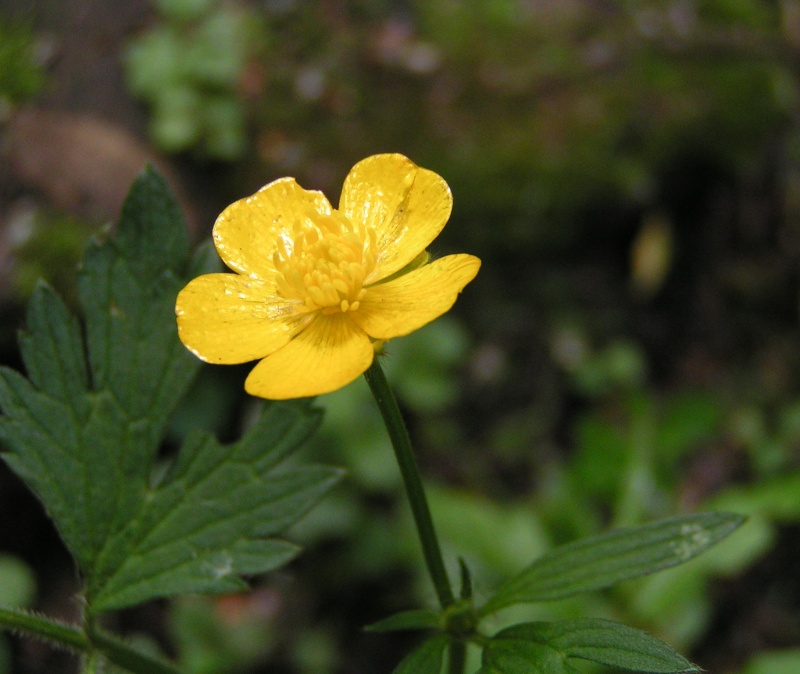
Bulbous buttercup (Ranunculus bulbosus) is a perennial European wildflower named for the bulb-like swollen stem base resting just beneath the turf. It bears five glossy yellow petals and downward-turned green sepals on dry, sunlit grassland.
Crushing or chewing any fresh part releases the blistering compound protoanemonin, which burns the mouth of grazing livestock and causes contact dermatitis on bare skin. Unlike creeping buttercup, it spreads only through seed rather than running stolons.
Key Facts
- Native range: Western Europe, the Mediterranean basin, and parts of North Africa
- Diagnostic feature: Sepals turn sharply downwards against the flower stem
- Root type: Swollen, corm-like base functioning as a storage organ
- Toxicity: Severe skin irritant containing ranunculin that converts to protoanemonin
- Peak flowering: April to July across temperate lowland meadows
Encountering Bulbous Buttercup in the Wild
Bulbous buttercup thrives in dry, unfertilised meadows and well-drained pastures where intensive farming has not stripped the topsoil of lime. You typically notice its upright yellow blooms from mid-April through June, appearing two to three weeks earlier than neighbouring meadow species.
Because livestock refuse to consume the bitter, burning foliage, the plant often forms dense yellow stands in heavily grazed paddocks. Once cut and thoroughly dried in summer hay, the irritant compounds break down completely into harmless anemonin, allowing farm animals to ingest the dry fodder without ill effect.
How to Identify Bulbous Buttercup
The quickest way to confirm bulbous buttercup is to look at the sepals beneath the open flower petals. While most buttercups hold their green sepals flat against the underside of the yellow cup, this species bends its sepals sharply backwards down the stem.
A thorough field identification relies on four anatomical traits:
- Sepals: Reflexed downwards against the flower stem (pedicel) during bloom.
- Flower stem: Grooved or furrowed along its length rather than smooth and cylindrical.
- Basal leaves: Three-lobed and divided into toothed leaflets, with the central leaflet carried on its own distinct stalk.
- Stem base: Swollen into a firm, rounded corm measuring 1-2 cm (0.4-0.8 in) across, seated just under the soil line.
- Foliage texture: Lightly hairy stems and leaf petioles that feel rough to the touch.
Why This Plant Causes Severe Skin Blisters
Direct contact with crushed stems or leaves causes chemical skin blistering within 12 to 24 hours. The plant tissues contain an unstable glucoside called ranunculin, which enzymatic activity hydrolyses into protoanemonin when cells rupture.
Protoanemonin is a strong vesicant that binds to cellular proteins, triggering redness, linear burn marks, and fluid-filled blisters that resemble severe scalds. Symptoms progress through predictable phases:
- Early contact (0-2 hours): Mild tingling or itching, often unnoticed while handling weeds outdoors.
- Inflammatory stage (6-12 hours): Intense localized erythema and burning sensation across exposed skin.
- Blister formation (12-48 hours): Large, painful dermal bullae that require clean dressings and protection from secondary infection.
- Pigmentation stage (1-3 weeks): Slow re-epithelialisation followed by persistent dark skin staining.
Native Habitat and Soil Requirements
Bulbous buttercup occupies free-draining neutral to alkaline grasslands across lowlands and open hillsides. It favours chalk downs, limestone ridges, sandy cliff-tops, and unimproved churchyards where winter moisture never forms standing pools.
The subterranean corm stores carbohydrates that permit survival in thin, parched topsoils during summer heat waves. When dry weather arrives in July, the above-ground stems wither down completely, leaving the resting corm dormant until autumn rains stimulate basal leaf emergence.
Blister Beetles and Meadow Ecology
The name blister flower refers both to the plant’s blistering sap and its ecological links to blister beetles. In meadow habitats, adult blister beetles of the family Meloidae feed heavily on the pollen and nectar of open buttercup blooms, mating directly within the yellow cups.
Certain blister beetle species exhibit a specialized larval behaviour known as flower imitation or cooperative aggregation:
- Larval swarms: Hundreds of newly hatched triungulin larvae climb vegetation and cluster into compact masses.
- Pheromone mimicry: The clump emits chemical signals that resemble female solitary bee mating pheromones.
- Host hitchhiking: When an investigating male bee approaches the clump, the larvae latch onto its hairs to ride back to the nest.
- Nest parasitism: The larvae transfer to female bees during mating, enter brood cells, and consume stored pollen provisions.
Conservation Status and Weed Management
Bulbous buttercup carries an official status of Least Concern (LC) on the IUCN Red List due to massive wild populations across its home continents. In natural grassland reserves, it supports early-season solitary bees, hoverflies, and small beetles that forage across the shallow floral discs.
In agricultural pastures, however, it spreads aggressively where overgrazing exposes bare soil. Because chemical herbicides damage non-target meadow herbs, land managers control excessive populations through light autumn aeration, rotational livestock grazing, and pulling flowering heads before achenes drop in June.
Historical Medicine and Homeopathic Uses
Historic herbalists traditionally used fresh bulbous buttercup as a counter-irritant to raise blisters over rheumatic joints and chest complaints. Folk healers pounded the acrid root to apply topically for warts, gout, and stubborn skin ulcers, though the resulting tissue necrosis frequently produced permanent scarring.
In early homeopathic literature, including William Boericke’s Materia Medica, preparations derived from the fresh flowering plant were documented under the name Ranunculus bulbosus. Practitioners traditionally prescribed ultra-diluted mother tinctures and potencies such as 30C or 200C for vesicular eruptions like shingles, intercostal neuralgia, and burning skin blisters.
Bulbous Buttercup vs Creeping and Meadow Buttercup
You can separate bulbous buttercup from its two closest relatives by inspecting sepals, stolons, and stem furrows. In mixed grass fields, bulbous buttercup regularly grows alongside creeping buttercup and meadow buttercup.
Key diagnostic differences include:
- Creeping buttercup (Ranunculus repens): Produces long, rooting horizontal runners; sepals spread outwards horizontally; leaf stems are grooved; lacks an underground corm.
- Meadow buttercup (Ranunculus acris): Grows taller up to 80 cm (31 in); sepals press flat against the petals; flower stems are smooth and completely round without grooves; lacks a basal corm.
- Lesser celandine (Ficaria verna): Blooms earlier in late winter; bears 8 to 12 narrow petals rather than five; possesses heart-shaped leaves and tuberous finger-like roots.
Frequently Asked Questions
Why is Ranunculus bulbosus called blister flower?
It earns the name blister flower because damaged foliage releases an irritating compound called protoanemonin. When sap touches skin in the presence of friction or moisture, it triggers painful, fluid-filled dermal blisters.
How can you tell bulbous buttercup from meadow buttercup?
Check the green sepals beneath the flower: bulbous buttercup sepals turn sharply downwards against the grooved stem, while meadow buttercup (Ranunculus acris) sepals stay pressed flat against the petals on a smooth, rounded stem.
What is Ranunculus bulbosus used for in homeopathy?
In traditional homeopathic practice recorded by Boericke, highly diluted preparations (such as 30C or 200) were used for nerve pain, intercostal neuralgia, and blister-forming skin conditions like shingles.
Is bulbous buttercup poisonous to dogs and horses?
Yes, fresh bulbous buttercup is toxic to pets and livestock, causing burning blisters on the lips, excessive drooling, abdominal pain, and colic. Most animals avoid eating it due to its acrid, peppery taste unless pasture is exhausted.
Why do blister beetle larvae form flower shapes on plants?
The microscopic triungulin larvae of certain blister beetles cluster together on flower stalks to mimic the visual form and scent of female bees. When a male bee lands on the cluster to mate, the larvae climb aboard to hitch a ride to the bee's underground brood nest.
Information about traditional or historical uses is provided for educational interest only and is not medical advice. Do not use any plant to treat a condition without speaking to a qualified professional.
Sources & Verification
Taxonomy and distribution are checked against the databases below. Care guidance is written for cultivated species only and reviewed by our editor. How We Build Plant Profiles →
More in Ranunculus

Celery-Leaved Buttercup
Ranunculus sceleratus
☀️ Full Sun 💧 High
Creeping Buttercup
Ranunculus repens
☀️ Partial Sun 💧 High

Hairy Buttercup
Ranunculus sardous

Meadow Buttercup
Ranunculus acris
☀️ Full Sun 💧 Moderate

Persian Buttercup
Ranunculus asiaticus
☀️ Full Sun 💧 Moderate

Glacier Buttercup
Ranunculus glacialis