

Celery-Leaved Buttercup is an annual wildflower found in mud and shallow water across North America, Europe, and Asia, known scientifically as Ranunculus sceleratus. It is recognized by its shiny, succulent foliage that looks remarkably like garden celery and its tiny, pale yellow flowers.
Unlike the common meadow buttercup, this species is highly toxic and can cause severe skin blistering on contact. It thrives in nitrogen-rich mud where other plants fail to establish, often appearing at the edges of farm ponds and ditches.
Key Facts
- Water: Grows in standing water or saturated mud
- Toxicity: High; contains skin-blistering protoanemonin
- Height: Reaches 10-60 cm (4-24 in)
- Life Cycle: Fast-growing annual
- Habitat: Nitrogen-rich wetlands and ditches
Is Celery-Leaved Buttercup a Garden Plant?
You generally find this plant in the wild rather than a nursery because of its aggressive growth and high toxicity. It is a pioneer species that colonizes bare mud in ditches, pond edges, and cattle-poached ground. While it provides food for specific pollinators, its presence in a garden often indicates drainage issues or excessive nutrient runoff from nearby lawns.
If you encounter it, handle it with thick gloves to avoid “buttercup itch,” a painful skin reaction. It is not a plant for ornamental borders or child-friendly spaces due to the risk of accidental poisoning. In agricultural settings, it is often removed to prevent livestock from grazing on the fresh foliage.
How to Identify Ranunculus sceleratus
Look for shiny, hairless stems and leaves that resemble garden celery (Apium graveolens) but with a more succulent texture. The stems are hollow, fleshy, and can grow 10-60 cm (4-24 in) tall depending on the water level. Unlike many other buttercups, the foliage has a distinct sheen and lacks any noticeable hairs.
Key identification features include:
- Lower leaves are deeply three-lobed and held on long stalks.
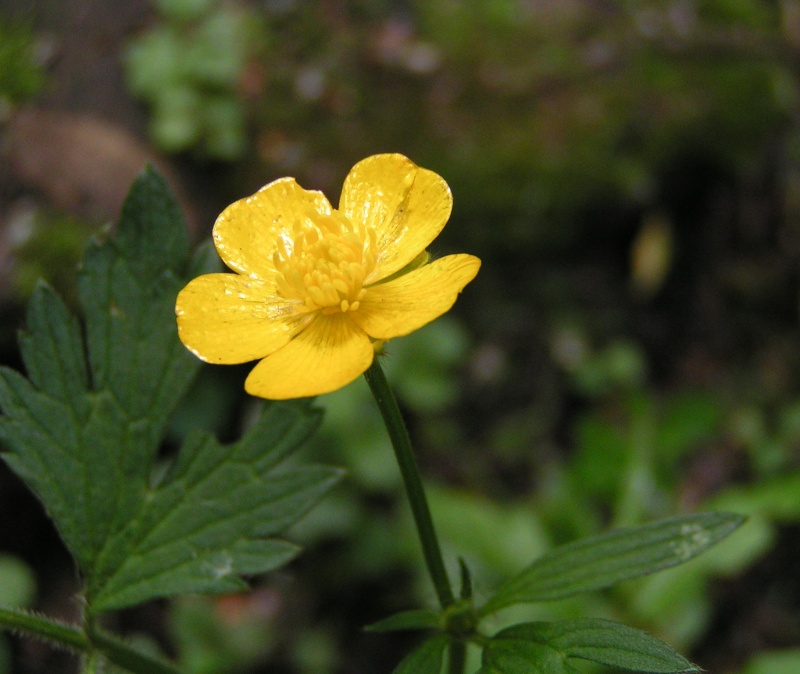
- Flowers are small, only 5-10 mm (0.2-0.4 in) across, with five pale yellow petals.
- The central seed head (receptacle) elongates into a distinct cylinder as it matures.
- Upper leaves are smaller and divided into narrow, finger-like segments.
Where Does Cursed Buttercup Grow?
This species thrives in nitrogen-rich, wet mud and shallow, slow-moving water. You will find it in marshes, the margins of eutrophic ponds, and drainage ditches across the Northern Hemisphere. It is a common sight in areas where the soil has been disturbed or compacted by machinery or animal hooves.
It is particularly frequent at the edges of livestock watering holes where manure increases the nitrogen content of the soil. The plant can tolerate seasonal flooding and will even flower while partially submerged. Its ability to grow in anaerobic mud gives it a competitive advantage over most terrestrial wildflowers.
Ecological Role and Pollinators
The flowers provide nectar and pollen for hoverflies and small bees during the summer months. Because it flowers from May to October, it serves as a consistent food source in wetland habitats when other plants have finished blooming. The small size of the flowers makes them accessible to insects with short mouthparts.
The seeds are small achenes that are often distributed by water or by sticking to the feet of waterfowl. In some regions, it acts as a nutrient-sink plant by absorbing excess phosphorus and nitrogen from runoff. This helps prevent algae blooms in larger water bodies, although the plant can become dominant in heavily polluted waters.
Conservation Status and Range
The Celery-Leaved Buttercup is classified as Least Concern (LC) on the IUCN Red List and is widespread globally. It is native to temperate and boreal regions of North America, Europe, and Asia, and has naturalized in parts of the Southern Hemisphere. Its population remains stable because it produces thousands of seeds per plant.
These seeds remain viable in the soil bank for several years, allowing the plant to reappear whenever mud is exposed. In some agricultural contexts, it is viewed as a weed because it can contaminate hay. However, when dried in hay, the toxic protoanemonin breaks down, making it less dangerous to livestock than when fresh.
Historical and Medicinal Uses of Ranunculus sceleratus
Historically, this plant was traditionally used in homeopathy under the name Ranunculus sceleratus 30 for skin conditions and rib pain. In the past, beggars reportedly used the fresh juice to induce skin ulcers to garner sympathy, which led to the common name “Cursed Buttercup.” This practice was documented in several 19th-century botanical texts.
The plant contains ranunculin, which breaks down into protoanemonin when the tissue is crushed. This chemical is a powerful irritant; while drying or boiling can reduce the toxicity, the plant is generally considered unsafe for any internal use. Modern medicine does not use this species due to the high risk of chemical burns and internal organ damage.
Similar Species and Look-Alikes
The most common confusion is with garden celery (Apium graveolens), which has very similar leaf shapes but lacks the yellow buttercup flowers. You might also mistake it for other wetland buttercups that share its muddy habitat. Distinguishing them requires a close look at the stems and seed heads.
Compare it with these similar species:
- Meadow Buttercup (Ranunculus acris) has hairy stems, whereas the Celery-Leaved Buttercup is hairless.
- Creeping Buttercup (Ranunculus repens) has runners (stolons) that root at the nodes.
- Lesser Spearwort (Ranunculus flammula) has narrow, unlobed leaves and larger flowers.
- Cursed Buttercup has an elongated, cylindrical seed head, while most others have a spherical one.
Frequently Asked Questions
Why is it called Cursed Buttercup?
It is called "cursed" because of its extreme toxicity and the fact that its sap causes painful skin blistering and ulcers on contact.
Is Ranunculus sceleratus safe for livestock?
No, it is highly toxic to cattle, horses, and sheep if eaten fresh. However, the toxins break down and become harmless once the plant is dried in hay.
What is Ranunculus sceleratus 30?
This is a homeopathic preparation diluted to a specific potency, traditionally used in alternative medicine for skin eruptions and chest wall pain.
How do you get rid of Celery-Leaved Buttercup?
The best way is to improve soil drainage and pull the plants by hand while wearing thick, waterproof gloves to prevent skin irritation.
Can you eat Celery-Leaved Buttercup?
No, every part of the plant is poisonous and causes severe mouth blistering, vomiting, and internal distress if ingested.
Information about traditional or historical uses is provided for educational interest only and is not medical advice. Do not use any plant to treat a condition without speaking to a qualified professional.
Sources & Verification
Taxonomy and distribution are checked against the databases below. Care guidance is written for cultivated species only and reviewed by our editor. How We Build Plant Profiles →
More in Ranunculus

Hairy Buttercup
Ranunculus sardous
Common Water-Crowfoot
Ranunculus aquatilis
☀️ Full Sun 💧 Aquatic
Creeping Buttercup
Ranunculus repens
☀️ Partial Sun 💧 High
Bulbous Buttercup
Ranunculus bulbosus
☀️ Full Sun 💧 Low

Persian Buttercup
Ranunculus asiaticus
☀️ Full Sun 💧 Moderate

Glacier Buttercup
Ranunculus glacialis