
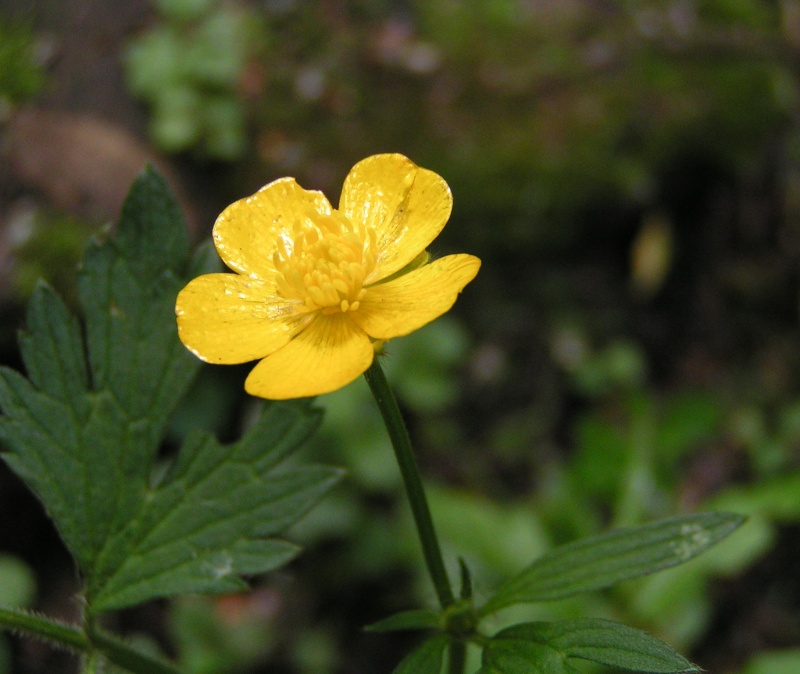
Creeping buttercup (Ranunculus repens) is a herbaceous perennial native to Europe, Asia, and northwestern Africa, known for its glossy yellow flowers and aggressive spreading stolons. It establishes dense ground-hugging mats in damp grasslands, woodland edges, and cultivated gardens.
Unlike many meadow wildflowers, livestock actively avoid this plant due to blistering ranunculin compounds released when tissues crush. In lawns and wet pastures, its persistent creeping runners allow it to choke out turf grasses within a single growing season.
Key Facts
- Native range: Europe, Asia, and northwestern Africa
- Plant type: Spreading herbaceous perennial wildflower
- Bloom period: May through August
- Spread mechanism: Above-ground rooting stolons and abundant seeds
- Toxicity: Blistering toxin protoanemonin affects livestock and humans
- Soil preference: Heavy, compacted, moisture-retentive soils
Living with Creeping Buttercup: Garden Fit and Weed Reality
Creeping buttercup functions primarily as an aggressive garden weed and pasture competitor rather than an intentional border plant. Its creeping stems root down every 10 to 20 cm (4 to 8 in), rapidly consolidating into thick carpets that suppress lawn grass, delicate perennials, and native seedlings.
You will struggle to eradicate it from moist borders without digging out every root fragment. It suits only naturalized damp woodlands where strong competitive natives hold ground against its vigorous vegetative spread.
- Spreads along ground surface via grooved leafy stolons
- Outcompetes turfgrasses in poorly drained or waterlogged soils
- Tolerates heavy foot traffic and close lawn mower blades
- Forms monocultures in poorly managed livestock paddocks
How to Identify Ranunculus repens Leaves, Flowers, and Stems
You can identify Ranunculus repens by its three-lobed leaves with a distinctly stalked central leaflet. Basal leaves measure 4-12 cm (1.5-5 in) across, featuring coarse teeth and often bearing pale or silvery patches near the leaflet bases.
The flowers open from May to August, measuring 2-3 cm (0.8-1.2 in) across with five lustrous, waxy yellow petals. A ring of numerous stamens surrounds an elevated green central receptacle composed of many distinct carpels.
- Central leaflet: Sits on a noticeable stalk, unlike other buttercup species
- Stems: Grooved, lightly hairy, creeping along the soil surface
- Petals: Glossy yellow with a basal nectar gland, 8-15 mm (0.3-0.6 in) long
- Sepals: Spreading flat beneath petals, not turned downwards
- Roots: Pale, thick, fibrous cluster forming at every running node
Habitat and Soil Preferences
Creeping buttercup thrives in compacted, poorly drained ground that remains wet for weeks at a time. It grows naturally in water meadows, stream banks, ditch sides, marshy pastures, and shaded woodland tracks across temperate latitudes.
Heavy clay soils with poor aeration favor this plant over turf grasses. Its adventitious roots penetrate oxygen-poor soils that drown standard pasture species, making buttercup abundance an indicator of ground compaction and drainage failure.
Ecology, Pollinators, and Grazing Toxicity
Livestock avoid fresh stands of creeping buttercup because masticating the plant releases blistering protoanemonin oils that cause mouth inflammation and digestive distress. Cattle and horses graze around dense buttercup patches, accelerating the plant’s spread across overgrazed paddocks.
Despite its bitterness to mammals, the yellow blossoms provide pollen and nectar for hoverflies (family Syrphidae), solitary bees, and small beetles. Once dried thoroughly in hay, the toxic lactones hydrolyze into harmless anemonin, rendering well-cured meadow hay safe for animal feed.
Conservation Status and Invasive Weed Impact
The International Union for Conservation of Nature lists Ranunculus repens as Least Concern (LC) across its broad native Eurasian range. In its native territory, populations are stable, ubiquitous, and completely secure.
In North America, Australia, and New Zealand, creeping buttercup is classified as an invasive agricultural and environmental weed. It alters nutrient cycles in wetland communities, displaces native marsh marigold (Caltha palustris), and reduces forage capacity in dairy pastures across the Pacific Northwest.
- Regulated as an invasive weed or noxious weed in several US states
- Forms impenetrable surface carpets across floodplains
- Depresses pastoral yield by occupying valuable forage space
- Exhibits resistance to several standard selective turf herbicides
How Creeping Buttercup Reproduces by Seed and Stolon
Individual plants produce up to 150 achenes per flower stem that can remain viable in moist soil for over 20 years. Each seed features a short, curved beak measuring 0.5-1 mm (0.02-0.04 in) that lodges in mud and animal hooves.
While seeds guarantee long-range dispersal, vegetative stolons drive local invasion. Runners emerge in late spring, producing leafy daughter rosettes at leaf nodes that root within 10 to 14 days of soil contact.
Botanical Details, Floral Formula, and Historical Uses
The standard floral formula for Ranunculus repens is * K5 C5 A∞ G∞, denoting a radial flower with five sepals, five petals, numerous stamens, and numerous superior, free carpels. Linnaeus described the species under its binomial in 1753.
Historical records show folk practitioners traditionally used crushed leaves as a blistering poultice or counterirritant for joint pain, though this frequently resulted in severe chemical burns. Double-flowered forms known as Ranunculus repens var. pleniflorus have occasionally been selected for traditional cottage gardens despite their invasive habits.
Differences Between Creeping Buttercup and Look-Alike Species
Meadow buttercup (Ranunculus acris) differs by having upright stems without creeping runners and palmately divided leaves without stalked central lobes. Bulbous buttercup (Ranunculus bulbosus) features reflexed sepals that point down along the stem and a swollen corm-like stem base.
Lesser celandine (Ficaria verna) blooms much earlier in late winter or early spring, displaying 8-12 narrow petals rather than five, and heart-shaped glossy foliage. Celery-leaved buttercup (Ranunculus sceleratus) bears much smaller, pale yellow flowers with an elongated cylindrical receptacle.
- Ranunculus acris: Taller erect growth up to 1 m (3.3 ft), no runners
- Ranunculus bulbosus: Reflexed sepals curved downward against stem
- Ficaria verna: Heart-shaped undivided leaves, 8-12 petals
- Ranunculus flammula: Narrow lance-shaped leaves, prefers standing water
Frequently Asked Questions
How can you tell creeping buttercup apart from other buttercups?
Check the central leaflet of the basal leaves. Creeping buttercup has a middle leaflet on a distinct stalk and sends out rooting horizontal runners, whereas meadow buttercup has sessile leaflets and no runners.
Why is creeping buttercup considered invasive?
It spreads rapidly via rooted horizontal stolons and persistent seed banks, forming dense mats that crowd out native plants and pasture grass in moist ground.
Is Ranunculus repens toxic to horses and livestock?
Yes, crushed foliage contains ranunculin, which converts into the toxic, blistering compound protoanemonin. Grazing animals generally avoid fresh plants, but ingestion causes mouth blisters, excessive salivation, and colic.
What is the floral formula for Ranunculus repens?
Its floral formula is * K5 C5 A∞ G∞, indicating an actinomorphic flower with 5 sepals, 5 petals, numerous stamens, and numerous free superior carpels.
How long do creeping buttercup seeds remain viable in soil?
Seeds of creeping buttercup can remain dormant and viable in wet, undisturbed soil for 20 years or longer.
Information about traditional or historical uses is provided for educational interest only and is not medical advice. Do not use any plant to treat a condition without speaking to a qualified professional.
Sources & Verification
Taxonomy and distribution are checked against the databases below. Care guidance is written for cultivated species only and reviewed by our editor. How We Build Plant Profiles →
- Kew Plants of the World OnlineTaxonomy, distribution, and native range verification
- Global Biodiversity Information FacilityOccurrence data and common names
- USDA PLANTS DatabaseWeed status and North American distribution
- IUCN Red List of Threatened SpeciesGlobal conservation status: Least Concern
- Wikipediageneral reference
More in Ranunculus

Meadow Buttercup
Ranunculus acris
☀️ Full Sun 💧 Moderate

Glacier Buttercup
Ranunculus glacialis

Persian Buttercup
Ranunculus asiaticus
☀️ Full Sun 💧 Moderate

Hairy Buttercup
Ranunculus sardous
Bulbous Buttercup
Ranunculus bulbosus
☀️ Full Sun 💧 Low
Common Water-Crowfoot
Ranunculus aquatilis
☀️ Full Sun 💧 Aquatic