

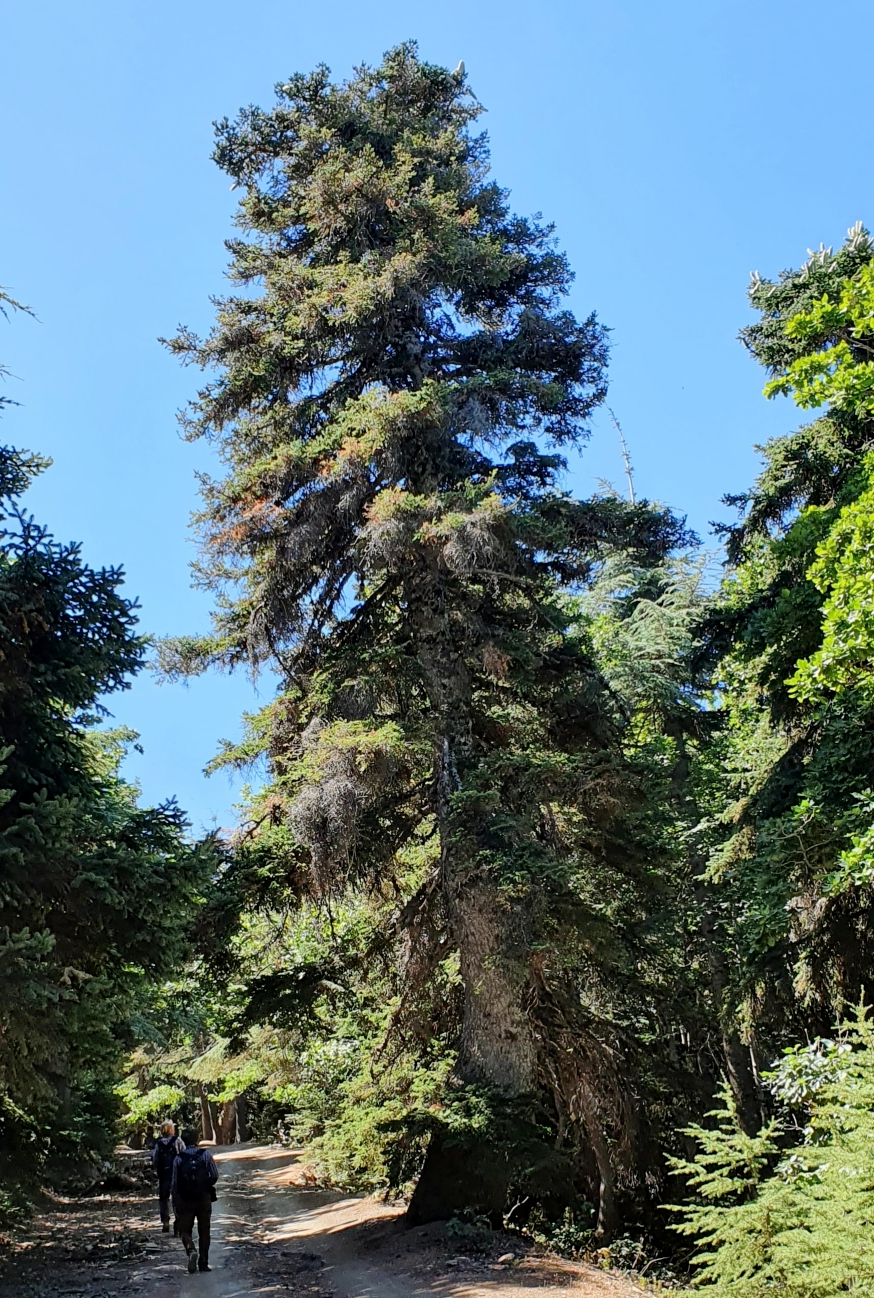
The Giant Fir (Abies grandis) is a massive evergreen conifer native to the coastal and interior forests of northwestern North America. It is characterised by its straight, cylindrical trunk and dense, dark green foliage that emits a distinct citrus-like scent when crushed.
This species is a dominant member of the Cascade Range ecosystems, thriving in deep, moist soils. It is not typically grown in small residential gardens due to its extreme mature height.
Key Facts
- Native Range: Northwestern North America
- Mature Height: Up to 70 m (230 ft)
- Needle Arrangement: Two distinct rows on the branch
- Cone Habit: Upright, disintegrating while still on the tree
- Habitat: Coastal and montane forests
Why Giant Fir Suits Large Landscapes
The Giant Fir is best suited for expansive woodland settings where it has sufficient room to reach its full potential. It is an excellent choice for reforestation projects or large estates in the Pacific Northwest that require a fast-growing, native evergreen.
Because this tree can reach heights of 70 m (230 ft), it is unsuitable for typical suburban yards. It requires deep, fertile soils to support its massive root system and rapid vertical growth. If you have the space, it provides significant vertical interest and habitat for local wildlife.
How to Identify Giant Fir
You can identify the Giant Fir by its flat, glossy needles that appear in two distinct ranks on the branch. These needles are dark green above with two conspicuous white stomatal bands on the underside, which gives the tree its common name, lowland white fir.
- Needles: 3-6 cm (1.2-2.4 in) long, arranged in a horizontal plane.
- Bark: Smooth and grey on young trees, developing deep furrows with age.
- Cones: Erect, 7-12 cm (2.8-4.7 in) long, greenish-purple when young.
- Scent: Strong, pleasant citrus aroma when needles are crushed.
Natural Habitat and Ecology
The Giant Fir is most common at elevations below 1,700 m (5,600 ft) where moisture is abundant. It frequently grows in association with Douglas Fir (Pseudotsuga menziesii) and Western Hemlock (Tsuga heterophylla) in the Cascade Range.
This species prefers cool, humid climates with high annual rainfall. It is shade-tolerant in its youth, allowing it to grow beneath the canopy of larger trees before eventually emerging into the light. It plays a critical role in forest succession and provides nesting sites for various bird species.
Site Selection and Planting
Successful establishment of the Giant Fir requires a site with deep, moist, and well-drained soil. It is intolerant of prolonged drought or waterlogged conditions, so ensure the site allows for consistent moisture throughout the growing season.
When planting, choose an area that provides protection from drying winds, especially while the tree is young. Avoid sites with heavy clay or compacted soil, as these restrict root penetration and growth. Proper spacing is essential, as the mature spread can reach 12 m (40 ft) in width.
Ongoing Care and Maintenance
The Giant Fir is largely self-sustaining once established in its preferred environment. Periodic monitoring for pests, such as the balsam woolly adelgid, is the most important maintenance task for forest managers.
- Watering: Only necessary during extreme, prolonged dry spells for young trees.
- Fertilizing: Not required in natural forest soils.
- Mulching: Can help retain moisture around the base of young specimens.
Pruning and Tree Management
Pruning is rarely required for the Giant Fir unless you are removing dead or diseased lower branches. Because this tree naturally maintains a straight, symmetrical form, structural pruning is unnecessary in a woodland context.
If you must prune, perform the work during the dormant winter season to minimize sap loss. Always use sharp, sterilized tools to prevent the spread of pathogens. Focus only on removing damaged limbs to maintain the tree’s natural health and appearance.
Winter Survival and Hardiness
The Giant Fir is fully hardy in USDA zones 6 through 8, where it withstands significant snow and ice loads. Its flexible branches are adapted to shed heavy snow, preventing breakage during winter storms.
In its native range, the tree enters a state of dormancy as temperatures drop, protecting its tissues from freezing injury. No special winter protection is needed for mature trees. Young saplings may benefit from protection against browsing animals if the winter is particularly harsh and food sources are scarce.
Uses and Timber Value
The Giant Fir is traditionally harvested for its high-quality, lightweight timber. It is commonly used in construction, for interior framing, and in the production of pulp and paper.
Beyond its commercial value, the tree is a vital component of the Pacific Northwest landscape. It provides essential cover for large mammals and nesting habitat for raptors. While it is not a common ornamental, its rapid growth rate makes it a candidate for sustainable forestry and carbon sequestration projects.
Frequently Asked Questions
Is the Giant Fir the same as the Fire Giant from Elden Ring?
No, the Giant Fir is a real-world conifer species, whereas the Fire Giant is a fictional boss character in a video game.
How can I tell the difference between Giant Fir and Douglas Fir?
You can tell them apart by their cones and needles; Giant Fir has upright cones that disintegrate on the branch, while Douglas Fir (Pseudotsuga menziesii) has hanging cones with distinct three-pointed bracts.
Does the Giant Fir have any medicinal uses?
The resin of various fir species was traditionally used by Indigenous peoples for its antiseptic properties, but there are no modern clinical recommendations for its use.
Why is my Giant Fir losing its lower needles?
It is normal for older, interior needles to drop as the tree matures and shades its own lower branches, but if the loss is sudden or involves new growth, it may indicate a pest or disease issue.
Sources & Verification
Taxonomy and distribution are checked against the databases below. Care guidance is written for cultivated species only and reviewed by our editor. How We Build Plant Profiles →
More in Abies

Siberian Fir
Abies sibirica
☀️ Full Sun 💧 Moderate

Nordmann Fir
Abies nordmanniana
☀️ Full Sun 💧 Moderate

Subalpine Fir
Abies lasiocarpa
☀️ Full Sun 💧 Moderate
Algerian Fir
Abies numidica
☀️ Full Sun 💧 Moderate

Fraser Fir
Abies fraseri
☀️ Full Sun 💧 High

Silver Fir
Abies alba
☀️ Partial Sun 💧 Moderate