
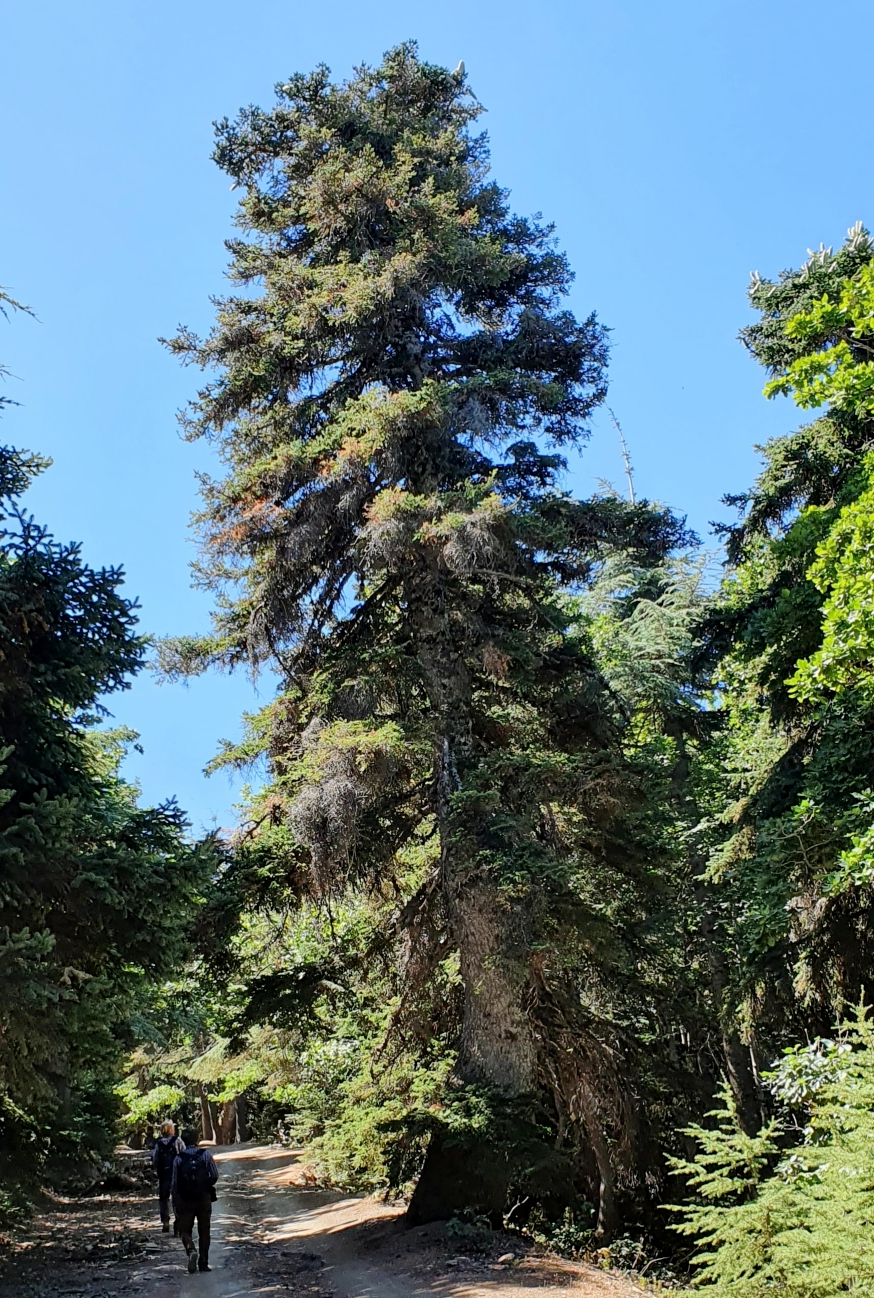
Algerian fir (Abies numidica) is an evergreen conifer native strictly to the high-altitude peaks of Mount Babor and Mount Tababort in northern Algeria. It forms a stiff, conical crown lined with glossy dark green needles that feature striking white stomatal bands.
This slow-growing species reaches heights up to 20 m (66 ft) in cultivation. It tolerates hot summers and alkaline chalky soils far better than most other silver firs, making it suitable for locations where traditional firs fail.
Key Facts
- Plant Type: Evergreen conifer tree
- Hardiness: USDA zones 6 to 8
- Native Range: Tell Atlas mountains, Algeria
- Growth Rate: 15-25 cm (6-10 in) per year
- Soil pH: 6.0 to 7.5 (acidic to alkaline)
- Light: Full sun to light partial shade
Is Algerian Fir Suitable for Your Garden?
Select Algerian fir if you need a drought-tolerant, wind-resistant conical evergreen for large gardens, parks, or open rural acreage. This tree suits growers who want the traditional appearance of a silver fir without the extreme moisture and humidity demands typical of northern species.
It requires ample vertical and horizontal space to mature without crowding. Because it grows at a measured pace of 15-25 cm (6-10 in) annually, it will not overpower mid-sized landscapes quickly, but it is unsuited for small city lots unless dwarf cultivars are selected.
Identifying Features of Algerian Fir
You can identify Algerian fir by its flattened, needle-like leaves that spread around the shoot in a dense, brush-like arrangement. Individual needles measure 15-20 mm (0.6-0.8 in) long and 2-3 mm (0.08-0.12 in) wide, with a dark green top surface and two bright silver-white stomatal bands underneath.
Key botanical characteristics of this species include:
- Bark: Smooth grey on young trees, developing deep furrows and scaly plates on mature trunks.
- Branches: Horizontal to slightly ascending shoots arranged in regular whorls.
- Cones: Erect cylindrical cones measuring 15-20 cm (6-8 in) long, starting greenish-brown and maturing to purplish-brown.
- Needle Tip: Rounded or slightly notched, less sharp to the touch than blue spruce (Picea pungens).
Algerian Fir Mature Height and Growth Rate
A wild Algerian fir can reach heights of up to 25 m (82 ft) with a base width of 6 m (20 ft), though cultivated specimens usually stop between 15-20 m (50-66 ft).
Annual growth remains slow during the first 3-5 years after transplanting while the taproot establishes. Once settled, shoots expand by 15-25 cm (6-10 in) each season depending on soil fertility and rainfall.
Best Sunlight and Soil Exposure
Plant Algerian fir in full sunlight receiving at least 6 hours of direct sun daily to maintain dense foliage down to ground level.
Unlike many fir species native to northern Europe or North America, this tree originates on limestone slopes between 1,800-2,000 m (5,900-6,560 ft) elevation. As a result, it accommodates neutral to slightly alkaline clay-loam soils alongside typical acidic forest soils. Excellent drainage is essential, as waterlogged roots decay quickly.
How to Plant Abies numidica
Plant container-grown or balled-and-burlapped trees in autumn or early spring while the canopy is dormant. Prepare a site with uncompacted soil extending 3 times the diameter of the root ball.
Follow these steps when planting:
- Dig a planting hole matching the depth of the root ball but twice as wide.
- Position the tree so the root flare sits flush with or 2 cm (0.8 in) above the surrounding grade.
- Backfill using native topsoil mixed with unamended garden soil; avoid adding heavy compost directly to the hole.
- Tamp the soil gently to remove large air pockets without compacting the root space.
- Apply a 7-10 cm (3-4 in) layer of bark mulch, keeping it 5 cm (2 in) away from the trunk base.
Watering and Soil Care for Algerian Fir
Water young trees deeply with 20-30 L (5-8 gal) of water once every 7-10 days during their first two growing seasons when rainfall is sparse.
Mature trees display impressive drought tolerance thanks to their deep root system. Fertilisation is rarely necessary; an annual autumn top-dressing of well-rotted leaf mould or light organic mulch provides sufficient nutrients without triggering weak, forced growth.
Pruning and Maintenance Guidelines
Pruning is limited to removing dead, broken, or diseased branches in late winter before new growth shoots emerge in spring.
Never cut back the central leader shoot unless it is damaged, as fir trees do not easily form a strong new primary stem. Lower branches should be left intact to preserve the characteristic narrow conical form down to the ground.
Algerian Fir Diseases and Preventing Tree Death
Prevent tree death in Algerian fir by eliminating standing water around the root zone to stop Phytophthora root rot.
Watch for the following symptoms and pests:
- Phytophthora Root Rot: Yellowing needles, root decay, and sudden canopy browning caused by soggy, poorly drained soil.
- Balsam Woolly Adelgid: White, cotton-like wax tufts on trunk bark and twigs; treat with horticultural oil in late winter.
- Spider Mites: Fine webbing and speckled needle discoloration during hot, dry spells; wash foliage with strong water sprays.
- Bark Beetles: Small entry holes and sawdust on stems suffering from severe drought stress.
Winter Care and Cold Hardiness
Algerian fir is hardy in USDA zones 6 through 8, surviving winter temperatures down to -20 °C (-4 °F) without foliage damage.
Young saplings in zone 6 benefit from shelter against drying winter winds, which can cause winter burn on southern-exposed foliage. Ensure the root zone receives thorough soaking before ground freezing occurs in late autumn.
Landscape Uses and Wild Population Status
Use Algerian fir as a standalone specimen tree, windbreak element, or park feature where its symmetrical form and silver-backed needles can be viewed up close.
In the wild, this species is classified as Critically Endangered on the IUCN Red List. Its wild habitat on Mount Babor covers less than 30 km² (11.5 sq mi) and faces ongoing pressure from climate shifts, livestock grazing, and summer forest fires. Regional wildfire monitoring maps show increased fire activity in the Tell Atlas, underscoring the importance of ex-situ cultivation in arboreta and gardens worldwide.
Frequently Asked Questions
Why is my Abies numidica dying?
Sudden decline or death in Algerian fir is most often caused by root rot from poorly drained soil or extreme root damage during severe drought. Ensure the root zone drains freely and water young trees deeply during extended summer dry spells.
How do you grow Abies numidica from seeds?
Cold-stratify Algerian fir seeds in moist sand at 4 °C (39 °F) for 30 to 60 days before sowing in spring. Sow seeds 5 mm (0.2 in) deep in a free-draining sandy compost mix and maintain light moisture until germination occurs in 3 to 5 weeks.
What is the difference between Abies numidica and Nordmann fir?
Algerian fir features stiffer, shorter needles that spread all around the shoot, whereas Nordmann fir (Abies nordmanniana) has longer, softer needles arranged flatly with a distinct parting along the upper shoot. Algerian fir also tolerates chalky soils and hot, dry summers better than Nordmann fir.
Why do searches for Algerian fir bring up fire maps or firefighters?
Search engines frequently misinterpret queries for 'Algerian fir' as 'Algerian fires' or 'Algerian firefighters' due to spellcheck defaults. Additionally, forest fires represent a major real-world threat to the native wild populations of Abies numidica on Mount Babor in Algeria.
Who first classified Abies numidica scientifically?
The species was scientifically described as Abies numidica de Lannoy ex Carrière in 1866 by French botanist Élie-Abel Carrière, based on specimens collected by M. de Lannoy in the Algerian Atlas.
Sources & Verification
Taxonomy and distribution are checked against the databases below. Care guidance is written for cultivated species only and reviewed by our editor. How We Build Plant Profiles →


