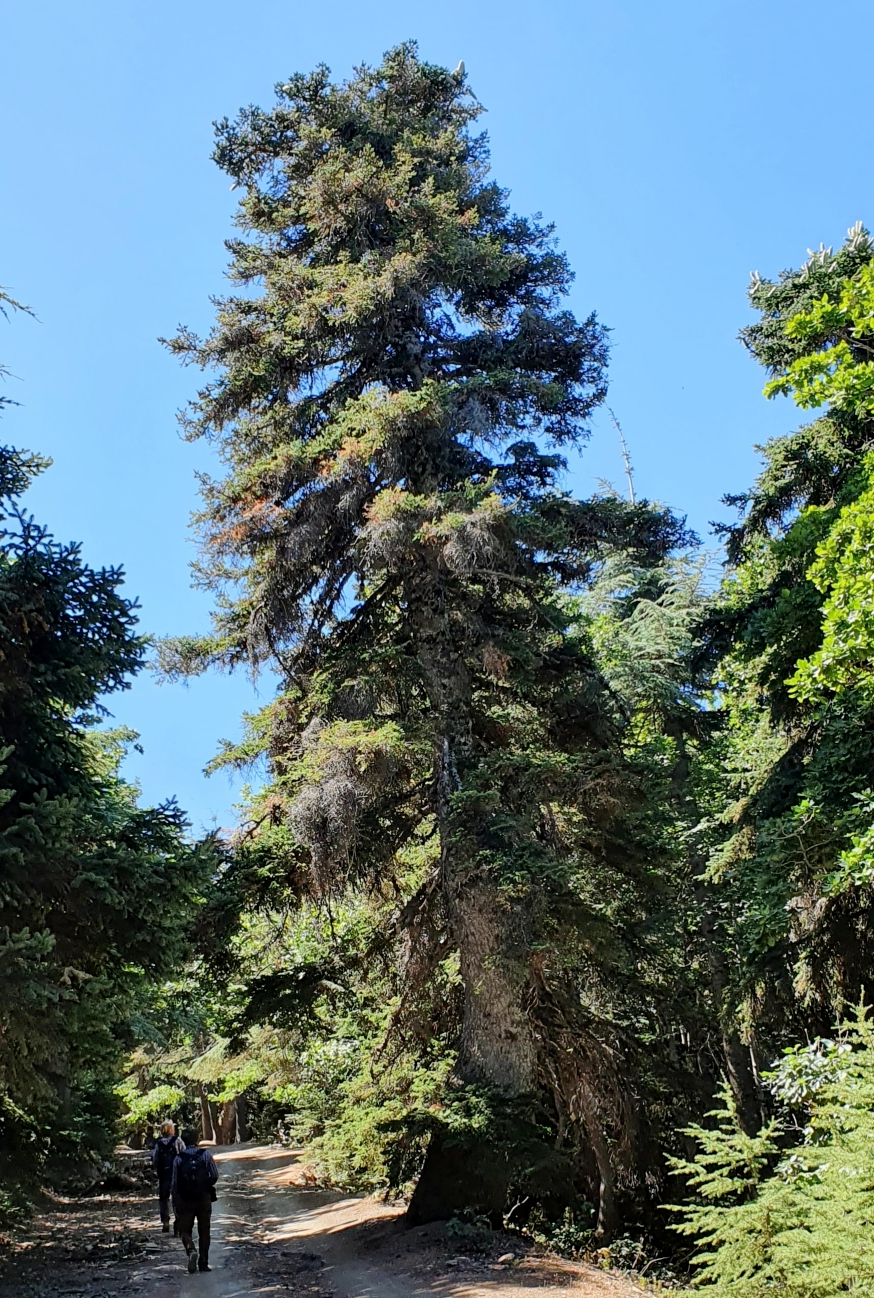
Silver fir (Abies alba) is a towering evergreen conifer native to the mountain ranges of central and southern Europe. It is easily recognised by its dark green needles with distinct silvery-white bands underneath and upright, cylindrical cones that sit upright on the branches.
This tree requires deep, moist soil and cool mountain air to thrive, making it poorly suited for hot, dry lowland areas or confined urban gardens. Give it plenty of space to reach its mature dimensions, as mature specimens demand expansive root runs and uninhibited overhead clearance.
Key Facts
- Light: Full sun to partial shade
- Water: High moisture, well-drained soil
- Hardiness: USDA Zones 5 to 7
- Growth rate: Slow to moderate
- Mature height: Up to 50 m (164 ft)
Is Silver Fir Right for Your Garden
Silver fir is best suited for large rural properties, estates, or woodland gardens with plenty of open ground. You should plant this species only if you have the vertical clearance for a tree that can eventually exceed 50 m (164 ft) in height. It performs poorly in small suburban yards or confined urban spaces where root restriction stunts its development.
- Requires ample lateral space for a spread of 10-20 m (33-66 ft)
- Intolerant of severe air pollution and prolonged summer droughts
- Functions well as a grand specimen tree in cool, damp climates
If you live near a municipal park or a regional development like the Silver Firs neighbourhood in Washington, you might encounter related plantings, but ensure local soil conditions match its woodland origins before attempting to grow one yourself.
What Silver Fir Looks Like
Silver fir possesses a straight, columnar trunk covered in smooth, grey bark that gradually becomes furrowed and scaly on older specimens. The flat, linear needles measure 1.5-3 cm (0.6-1.2 inches) long, featuring two distinct white stomatal bands on their undersides which create the characteristic silvery appearance.
- Needles feature notched tips and are arranged spirally on the twig
- Cones grow 10-20 cm (4-8 inches) long, standing completely upright on the upper branches
- Mature trees develop a broad, flat-topped crown over decades of growth
Unlike Norway spruce (Picea abies), whose cones hang downwards and drop intact, the cones of silver fir disintegrate while still attached to the branch, leaving behind a bare central spike.
How Much Space Does a Silver Fir Tree Need
A mature silver fir requires a planting site with at least 10 m (33 ft) of clearance from buildings, power lines, and neighboring large trees. Because the root system develops a deep taproot alongside wide lateral roots, it commands a substantial underground footprint.
- Space multiple trees at least 8-12 m (26-39 ft) apart for a natural grove effect
- Keep away from septic fields and underground utilities that might be disrupted by aggressive roots
- Ensure overhead power lines are entirely absent above the eventual canopy zone
Allocating sufficient initial room prevents the need for drastic structural pruning later in the tree’s life cycle.
Where to Plant Silver Fir
Silver fir grows best in a location that receives full sun to partial shade and is protected from harsh, desiccating winds. It demands deep, fertile, moisture-retentive soils that remain consistently damp without becoming waterlogged.
- Choose sites with acidic to neutral soil, ideally between pH 5.0 and 6.5
- Avoid heavy, compacted clay or dry, sandy soils that dry out rapidly in summer
- Select frost-prone valleys or high-altitude pockets where cool air pools naturally
Mountain provenance is key; specimens sourced from high-elevation native stands struggle immensely when planted in hot, low-altitude flatlands.
How to Plant Silver Fir Saplings
Plant container-grown or balled-and-burlapped silver fir saplings during the dormant season in early spring or autumn. Dig a hole twice as wide as the root ball and just as deep to encourage outward root expansion into surrounding soil.
- Tease out circling roots gently before placing the tree in the planting hole
- Position the root flare level with or slightly above the surrounding soil grade
- Backfill with native soil, firming gently to eliminate large air pockets without compacting
Water the newly planted sapling thoroughly with at least 20 litres (5 gallons) of water immediately after installation, and apply a 7 cm (3 inch) layer of organic mulch across a 1 m (3 ft) radius to retain moisture.
Silver Fir Watering and Feeding Care
Silver fir requires moderate to high soil moisture, needing supplemental irrigation during extended dry spells for the first 3 to 5 years after establishment. Once its deep taproot system reaches lower water tables, it becomes moderately resilient against brief dry periods.
- Provide deep watering every 10 to 14 days during hot summer months without rain
- Apply a balanced, slow-release evergreen fertiliser in early spring if soil fertility is low
- Refrain from fertilizing after mid-summer to prevent vulnerable late-season flush growth
Avoid overhead sprinkling during humid weather, as moisture trapped on the dense needles can encourage fungal pathogen development.
Pruning and Maintenance
Silver fir requires very little pruning, needing only the removal of dead, damaged, or diseased branches in late winter. Never cut back the main vertical leader unless severe storm damage forces you to redirect growth.
- Sanitize pruning saws and loppers with rubbing alcohol before cutting
- Cut cleanly back to the branch collar without leaving unsightly stubs
- Clear fallen organic debris and competing weeds from beneath the drip line annually
Routine shaping is unnecessary because the tree naturally develops a symmetrical, pyramidal silhouette.
Common Silver Fir Problems
Silver fir is occasionally troubled by pests and fungal diseases that affect its vigor, particularly when stressed by drought or poor soil. Watch for woolly adelgids, needle casts, and root rot in poorly drained conditions.
- Woolly adelgids: Appears as white cottony masses on twigs; treat with horticultural soap or insecticidal oils in early spring
- Root rot (Phytophthora): Caused by standing water; improve soil drainage and reduce irrigation frequency
- Yellowing needles: Often indicates iron chlorosis in alkaline soils or severe drought stress
Prompt diagnosis and correction of environmental stressors remain the most effective defense against decline.
Winter Care for Silver Fir
Silver fir is exceptionally hardy in USDA Zones 5 through 7 and requires no winter protection once established. Young trees planted in exposed, windy sites may benefit from a windbreak or extra mulch to protect shallow roots from extreme freeze-thaw cycles.
- Inspect the canopy after heavy winter snowstorms for broken or snow-loaded branches
- Gently brush heavy wet snow upward off lower branches to prevent structural splitting
- Maintain a 7 cm (3 inch) layer of organic mulch over the root zone to insulate against deep freezes
Dormant winter maintenance focuses primarily on structural checks rather than watering or feeding.
Uses for Silver Fir Wood and Timber
Silver fir produces lightweight, straight-grained timber traditionally used in construction, paper pulp, and furniture making. The wood lacks strong resin ducts, making it valuable for interior joinery, musical instrument soundboards, and general carpentry.
- Utilized widely for roof trusses, framing lumber, and interior paneling
- Processed into high-grade cellulose pulp for paper and cardboard manufacturing
- Employed regionally as traditional Christmas trees due to its pleasant scent and needle retention
Its historical abundance in European montane forests made it a foundational species for regional timber economies for centuries.
Silver Fir Through the Seasons
| Spring | Apply a slow-release granular fertiliser around the drip line as new buds begin to swell. Check young trees for woolly adelgid activity on new shoots. |
|---|---|
| Summer | Provide deep weekly irrigation during prolonged dry spells to protect the shallow surface roots. Monitor for signs of drought stress or needle yellowing. |
| Autumn | Apply a fresh layer of organic bark mulch to insulate roots before freezing temperatures arrive. Ensure drainage channels remain clear of fallen leaves. |
| Winter | Prune out any dead or storm-damaged branches while the tree is fully dormant. Brush heavy accumulations of wet snow off low-hanging boughs to prevent splitting. |
Silver Fir Pest and Disease Problems Explained
| What you see | Likely cause | What to do |
|---|---|---|
| White cottony spots on needles and twigs | Silver fir woolly adelgid infestation | Spray affected branches thoroughly with horticultural soap or dormant oil in early spring. |
| Needles turning yellow and dropping prematurely | Soil too alkaline or severe drought stress | Test soil pH and apply sulfur if alkaline, or increase watering frequency during dry periods. |
| Overall canopy thinning and dieback | Root rot caused by waterlogged soil | Improve site drainage immediately and reduce supplemental irrigation. |
Popular Silver Fir Cultivars Compared
- ‘Pyramidalis’ – narrow, fastigiate growth habit suitable for smaller landscapes
- ‘Pendula’ – weeping form with dramatic, gracefully cascading branches
- ‘Compacta’ – dwarf selection remaining under 2 m (6.5 ft) at maturity
Frequently Asked Questions
How do you fire silver clay?
Firing silver clay requires reaching specific high temperatures using a dedicated kiln, a butane torch, or a gas hob depending on the specific clay binder used. Always follow the manufacturer instructions for temperature hold times to ensure proper sintering of the metal particles.
How long to fire silver clay with a torch?
Firing silver clay with a handheld butane torch typically takes 2 to 5 minutes once the piece reaches a glowing orange heat. The exact timing depends on the piece's size and weight, and you must maintain the glowing state for the duration specified by the clay brand.
How was silver first discovered?
Silver was first discovered and separated from lead ores through an ancient metallurgical process called cupellation around 4000 BCE in regions including ancient Anatolia and the Aegean islands. This technique used fire to oxidize lead and base metals, leaving behind pure molten silver.
What is the difference between silver fir and Norway spruce?
Silver fir features flat needles with silvery undersides and upright cones that disintegrate on the branch, whereas Norway spruce (Picea abies) has square, all-green needles and pendant cones that fall to the ground intact.
Sources & Verification
Taxonomy and distribution are checked against the databases below. Care guidance is written for cultivated species only and reviewed by our editor. How We Build Plant Profiles →