

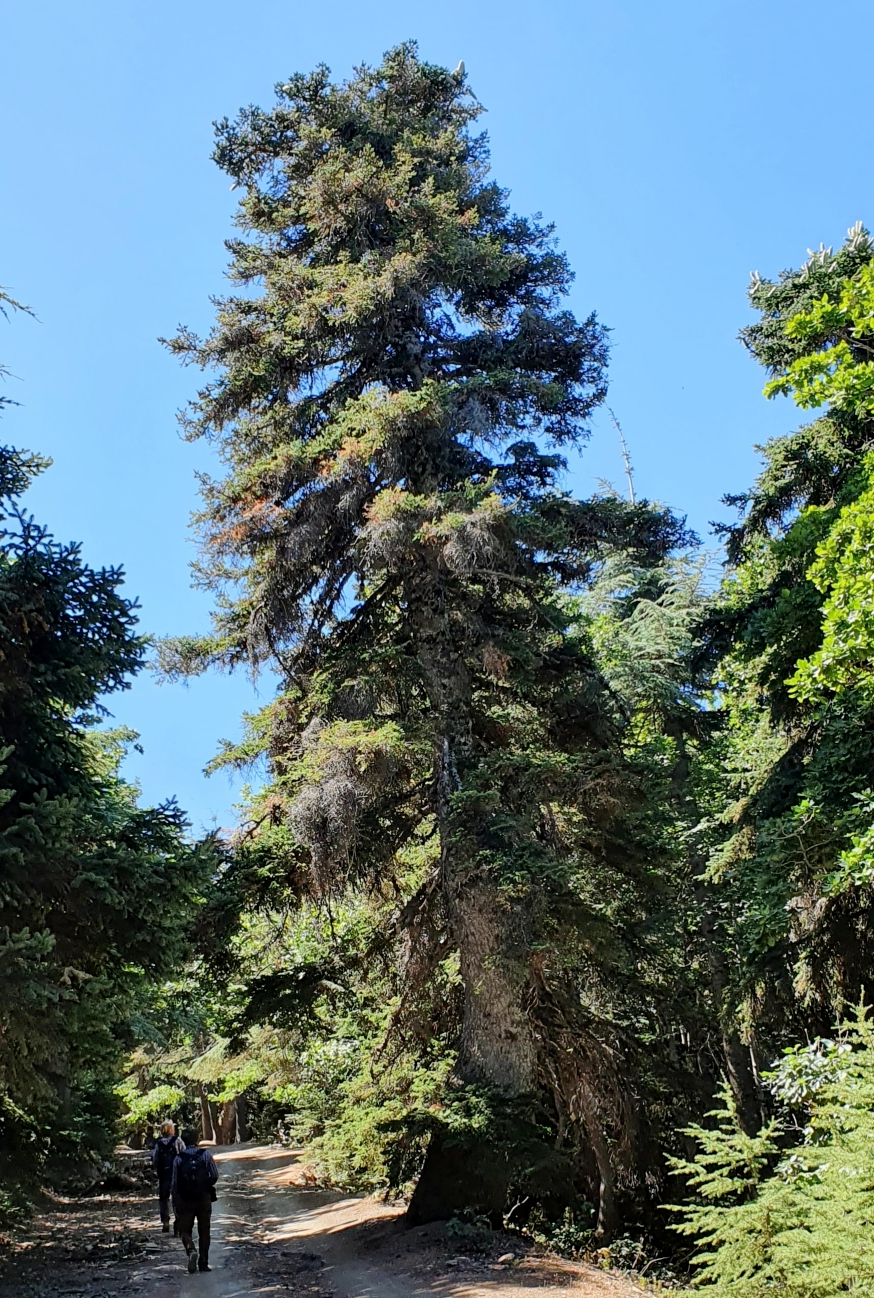
Spanish fir (Abies pinsapo) is an evergreen conifer native to mountain slopes in southern Spain and northern Morocco, recognised by stiff, short needles that project radially around each shoot like a bottle brush. In natural stands, it grows on steep limestone and serpentine slopes between 900 and 1,800 m (3,000 and 5,900 ft) elevation.
Unlike many true firs that demand acidic, moist forest ground, this species tolerates alkaline chalk and dry summer heat once rooted. It requires sharp drainage above all else, deteriorating rapidly in heavy clay that stays wet in winter.
Key Facts
- Light: Full sun all year
- Soil: Sharp drainage, neutral to alkaline limestone preferred
- Hardiness: USDA Zones 6 to 8
- Mature height: 15–25 m (50–80 ft)
- Water: Low to moderate once established
Growing Spanish Fir in the Landscape
Spanish fir forms a dense, strictly pyramidal specimen tree that broadens slowly into a flat-topped silhouette over several decades. It suits large gardens, parks, and open lawns where its architectural branching can be seen from all sides without crowding.
Because it grows at a measured rate of 15–30 cm (6–12 in) per year, it does not overwhelm medium spaces quickly, but its eventual spread demands clear clearance from buildings. Give it an open, breezy position away from damp hollows or overhead shade from faster-growing trees such as common beech (Fagus sylvatica).
How to Identify Hedgehog Fir
The tree earns the name hedgehog fir from its rigid, sharply pointed needles that project symmetrically around the branchlets rather than flattening into two ranks. Each needle measures 1–2 cm (0.4–0.8 in) in length and feels stiff to the touch, with visible grey-white stomatal bands on both the upper and lower surfaces.
Mature female cones emerge high in the canopy in spring, standing erect on upper branches:
- Female cones: Cylindrical, 9–16 cm (3.5–6.3 in) long, purple-brown when young and turning pale brown before disintegrating on the tree.
- Male pollen cones: Small, purplish to dark red, clustered on the undersides of shoots.
- Bark: Smooth and pale silver-grey on young trees, developing deep fissures and dark brownish ridges as the trunk thickens.
Spanish Fir Mature Size and Growth Rate
In cultivation, Spanish fir typically reaches 15–20 m (50–65 ft) tall with a branch spread of 4–6 m (13–20 ft). Ancient trees in relict Spanish forests occasionally reach 25–30 m (80–100 ft) with trunk diameters exceeding 1.5 m (5 ft).
Young saplings maintain a clean spire-like form for the first 25 years. After reaching mature height, apical dominance declines, leading to multiple irregular leader branches and a broad, rugged canopy.
Best Soil and Planting Site
Plant Spanish fir in full sun and freely draining, alkaline to neutral soil. Unlike noble fir (Abies procera) or silver fir (Abies alba), this species naturally colonises dolomitic limestone and calcareous scree, making it one of the few true firs that thrives in chalky soils with a pH up to 8.5.
Site selection guidelines:
- Choose high ground or slopes to avoid water pooling around the root crown during winter rains.
- Provide complete exposure to direct sun; shaded shoots thin out and lose their dense needle coverage.
- Shelter very young trees from extreme gale-force winds until their deep taproot anchors in native substrate.
Planting Spanish Fir
Transplant Spanish fir in autumn or early spring while the tree is dormant and soil moisture is consistent. Fir taproots are sensitive to disturbance, so container-grown or carefully root-balled specimens establish far more reliably than bare-root plants.
Dig a hole twice as wide as the root mass but no deeper than the root flare. Backfill with the native excavated soil without heavy organic amendments, tamp firmly to remove air pockets, and water thoroughly with 20–30 L (5–8 gal) of water to settle the root system.
Watering and Feeding
Established trees survive on natural seasonal rainfall and require supplemental irrigation only during prolonged summer droughts. During the first two growing seasons, apply deep water every 10–14 days when the top 5 cm (2 in) of soil feels completely dry.
Fertiliser requirements remain minimal:
- Avoid high-nitrogen lawn fertilisers, which cause weak, rapid shoot extension vulnerable to wind breakage.
- Apply a 5 cm (2 in) layer of coarse organic bark mulch over the root zone annually, keeping the mulch 10 cm (4 in) away from the trunk.
- In poor rocky soils, top-dress with a light application of balanced granular conifer feed in early spring just before new buds swell.
Pruning and Maintenance
Spanish fir requires no routine pruning to retain its natural shape. Firs do not regenerate easily from old, needle-free wood, so indiscriminate shearing or hedge-trimming will ruin the canopy permanently.
Limit cutting to removing dead, broken, or storm-damaged branches back to the branch collar during dry weather in late winter. If a young sapling develops two competing vertical leaders, cut the weaker leader cleanly back to the main stem in early spring to preserve a single straight central trunk.
Common Pests and Diseases
The single most destructive health issue is root rot caused by Phytophthora species in waterlogged, poorly aerated soil. Prevent this entirely by planting only in sites with unimpeded downward drainage.
Watch for these common issues:
- Bark beetles: Attack drought-stressed trees; maintain tree vigour to prevent infestation.
- Balsam woolly adelgid (Adelges piceae): Causes swelling at branch nodes and needle drop; treat severe infestations with horticultural oils in early spring.
- Foliage browning: Usually caused by standing water or excessive winter road salt spray rather than fungal foliar diseases.
Winter Care and Cold Tolerance
Spanish fir is fully hardy down to -20 °C (-4 °F), matching USDA Zone 6 cold conditions. Because it comes from high Mediterranean peaks subject to winter snow, its rigid branches bear snow loads without snapping easily.
In northern climates with frequent freeze-thaw cycles, protect the southern side of young trunks with tree guards to avoid winter sunscald. Cease all supplemental watering by early autumn to allow summer shoots to harden their lignified wood before the first hard freeze.
Spanish Fir Seasonal Calendar
| Spring | Inspect branch tips for new bud emergence and remove any damaged winter wood before growth begins. Apply a light mulch ring and water newly planted trees deeply if spring rainfall is sparse. |
|---|---|
| Summer | Provide 20–30 L (5–8 gal) of water every two weeks to trees planted within the past two years during heatwaves. Avoid pruning or fertilising to prevent soft shoot growth in high temperatures. |
| Autumn | Plant container-grown specimens while the soil remains warm. Refresh organic mulch around the root plate to conserve moisture through winter and insulate soil. |
| Winter | Brush heavy, wet snow accumulations off juvenile lower limbs if branches bend severely. Avoid applying de-icing salts anywhere near the root zone. |
Spanish Fir Problems and Solutions
| What you see | Likely cause | What to do |
|---|---|---|
| Yellowing needles that turn brown and drop from inner shoots | Overwatering or poor soil drainage causing root suffocation | Stop irrigation immediately and improve surrounding soil drainage away from the root ball. |
| White cottony tufts on bark and branch nodes | Balsam woolly adelgid infestation | Apply horticultural dormant oil spray in early spring before fresh buds break. |
| Needles turning pale brown on one side of the tree | Winter wind desiccation or road salt runoff | Erect a burlap windbreak in late autumn and redirect saline winter road runoff. |
| Two competing vertical leaders growing at the top | Mechanical damage or vigorous competing apical shoot | Prune out the weaker or crooked secondary leader flush with the stem in late winter. |
Spanish Fir Cultivars
- ‘Glauca’ – intense powder-blue needles, highly sought after
- ‘Aurea’ – bright golden-yellow young shoots turning yellow-green
- ‘Kelleriis’ – conical habit with silvery-blue foliage and good vigor
- ‘Horstmann’ – semi-dwarf, irregular spreading form for rockeries
- ‘Fastigiata’ – narrow, upright column suitable for restricted spaces
Landscape Uses and Companions
Use Spanish fir as a stand-alone specimen tree or as an architectural focal point in Mediterranean, gravel, and rock gardens. Its geometric branches create strong winter contrast against deciduous trees.
Suitable landscape companions from similar Mediterranean climates include holm oak (Quercus ilex), strawberry tree (Arbutus unedo), and Atlas cedar (Cedrus atlantica). Underplant the outer perimeter of the tree’s drip line with drought-tolerant shrubs such as Spanish lavender (Lavandula stoechas) and rockrose (Cistus ladanifer).
Frequently Asked Questions
How fast does Spanish fir grow?
Spanish fir grows slowly, adding roughly 15 to 30 cm (6 to 12 in) of height each year under optimal conditions. Growth is especially deliberate during the first three to five years while establishing its root network.
Can Spanish fir grow in alkaline or chalky soil?
Yes, Spanish fir thrives in chalky, limestone-rich soils with a pH above 7.0. It is one of the few true firs that naturally populates calcareous mountain scree and actively resists lime-induced chlorosis.
Is Spanish fir endangered in the wild?
Yes, wild populations are classified as Endangered on the IUCN Red List due to extremely fragmented forest ranges in Andalusia and the Moroccan Rif mountains. Wild groves face threats from forest fires, past logging, and changing rainfall patterns.
What is the difference between Spanish fir and Nordmann fir?
Spanish fir (Abies pinsapo) has short, rigid needles that radiate all the way around the stem like a bottle brush. Nordmann fir (Abies nordmanniana) features longer, softer needles that comb forward and lay relatively flat along the branch.
Can you grow Spanish fir in a container?
Dwarf cultivars like 'Horstmann' can live in large containers for several years, but the standard species develops a deep taproot that outgrows pots quickly. Move trees to open ground within three years to prevent root circling.
Sources & Verification
Taxonomy and distribution are checked against the databases below. Care guidance is written for cultivated species only and reviewed by our editor. How We Build Plant Profiles →
- Kew Plants of the World OnlineTaxonomy, synonymy, and native distribution.
- IUCN Red List of Threatened SpeciesConservation status and relict habitat data.
- Royal Horticultural SocietyCultivation parameters and Award of Garden Merit notes.
- Missouri Botanical GardenLandscape characteristics and hardiness ranges.
- GBIF — Global Biodiversity Information Facilitytaxonomy, synonyms, occurrence records
- Wikipediageneral reference
More in Abies

Subalpine Fir
Abies lasiocarpa
☀️ Full Sun 💧 Moderate

Silver Fir
Abies alba
☀️ Partial Sun 💧 Moderate

Balsam Fir
Abies balsamea
☀️ Full Sun 💧 Moderate

Nordmann Fir
Abies nordmanniana
☀️ Full Sun 💧 Moderate
Algerian Fir
Abies numidica
☀️ Full Sun 💧 Moderate

Siberian Fir
Abies sibirica
☀️ Full Sun 💧 Moderate