
Green Amaranth (Amaranthus hybridus) is a fast-growing annual plant in the Amaranthaceae family, widely recognised for its adaptability to disturbed soils. It is native to the Americas but has established itself as a common weed across much of North America, Europe, and Eurasia.
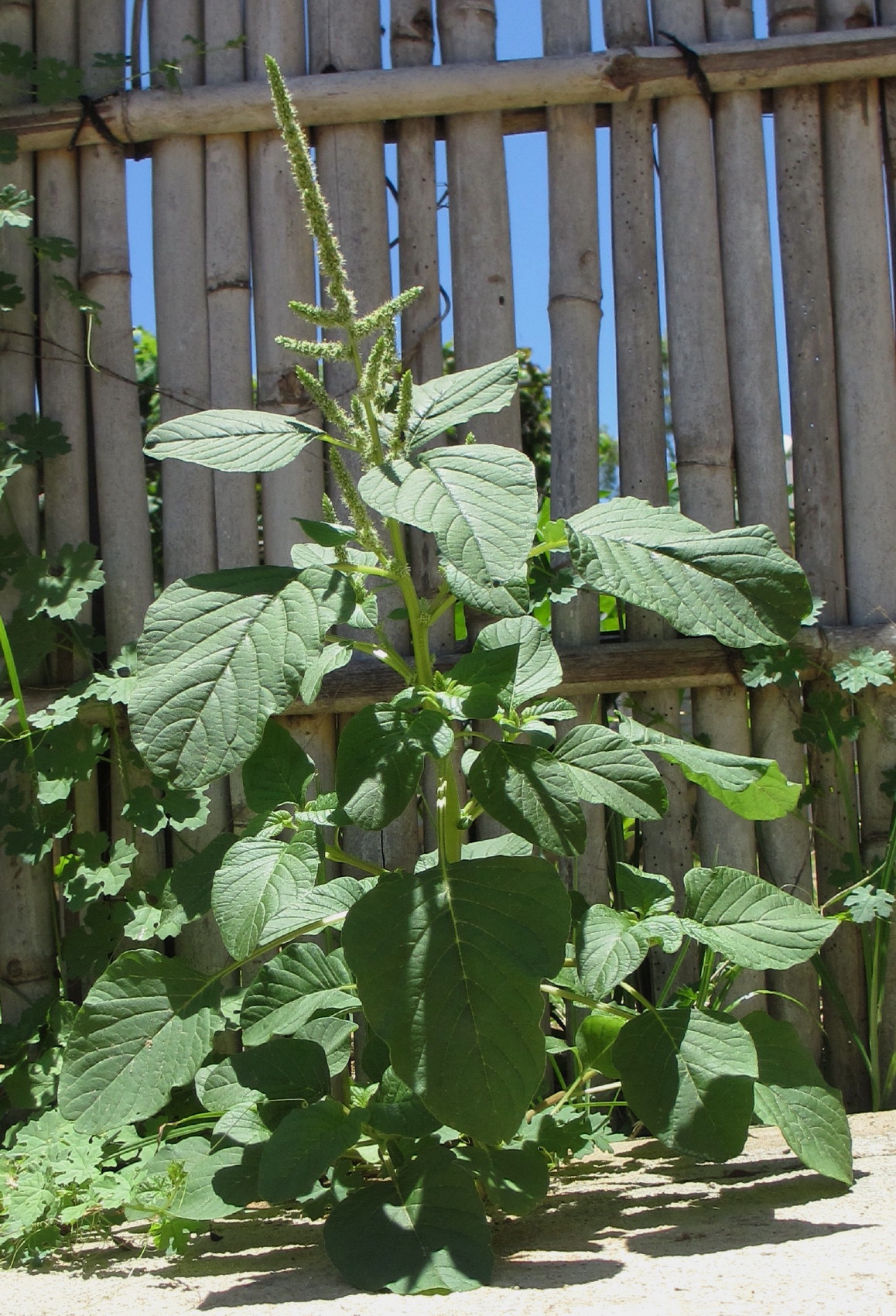
You will most frequently encounter this species in cultivated fields, gardens, and along roadsides where it colonises open, sunny ground. It is often distinguished from other pigweeds by its slender, green-to-reddish flower spikes that appear from mid-summer through autumn.
Key Facts
- Scientific Name: Amaranthus hybridus
- Life Cycle: Annual
- Max Height: Approximately 2 m (6.5 ft)
- Native Range: North and South America
- Preferred Habitat: Disturbed soil and open fields
Why Green Amaranth Is Often Called Pigweed
The name pigweed refers to the plant’s tendency to grow rapidly in disturbed agricultural settings where it was historically used as forage. It is a highly competitive species that thrives in nitrogen-rich soil, making it a frequent sight in vegetable patches and crop rows.
You can identify this plant by its erect, branching stems that can reach up to 2 m (6.5 ft) in height. The leaves are alternate, ovate to lanceolate, and often show a slight reddish or purplish tint on the undersides. The tiny, greenish flowers are packed into dense, slender terminal spikes that are characteristic of the Amaranthus genus.
Where Does Green Amaranth Grow
Green Amaranth is most commonly found in open, sun-drenched areas with disturbed soil. It is an opportunistic coloniser that seeds prolifically, ensuring its presence in fields, roadsides, and waste areas throughout North America and beyond.
The plant requires high light levels and struggles to establish in deep shade or under heavy canopy cover. It is particularly well-suited to soils that have been tilled or recently cleared of other vegetation. If you see it in your garden, it is likely competing for space with your vegetables or decorative flowers.
Can You Eat Wild Amaranth
You can safely eat the young leaves of Green Amaranth, which are traditionally prepared similarly to spinach. It is important to harvest the leaves when the plant is young and tender, as they become tough and bitter once the plant begins to flower.
- Harvest only young, fresh leaves before the plant bolts.
- Wash the leaves thoroughly to remove dust or soil.
- Steam or sauté the leaves briefly to soften the texture.
- Avoid harvesting from areas treated with pesticides or herbicides.
Traditional Medicinal Uses of Amaranth
Green Amaranth has been traditionally used in various cultures for its purported soothing properties. Historically, indigenous groups and herbalists utilised different parts of the plant, including the roots and leaves, for a range of topical and internal applications.
While these historical uses are well-documented in ethnobotanical literature, they are not a substitute for modern medical advice. Always consult a healthcare professional before using wild plants for medicinal purposes, as concentrations of active compounds can vary significantly based on the local soil and environmental conditions.
Ecological Role and Wildlife Value
This species serves as an important food source for many insects and birds throughout the late summer and autumn. The tiny seeds are particularly high in energy and are frequently consumed by ground-feeding birds and small rodents.
The dense flower spikes also attract various pollinators, including bees and butterflies, during the peak blooming season. By providing a reliable source of pollen and seeds, the plant supports a local food web in disturbed habitats that might otherwise lack biodiversity.
How to Tell Green Amaranth from Similar Species
Distinguishing Green Amaranth from other common pigweeds requires examining the flower spikes and leaf shape. It is frequently confused with Palmer amaranth (Amaranthus palmeri) or Redroot pigweed (Amaranthus retroflexus) which share similar habitats.
- Amaranthus hybridus typically has slender, upright spikes that are less coarse than those of Amaranthus retroflexus.
- The leaves of Amaranthus hybridus are generally smoother and lack the distinctively long petioles found in Amaranthus palmeri.
- The overall growth habit is usually more upright and less sprawling than other related species.
Frequently Asked Questions
Is Green Amaranth the same as Red Amaranth?
While they are related species within the same genus, they are distinct. Green Amaranth (Amaranthus hybridus) often displays reddish tints on the leaves, but it is not the same as the ornamental or culinary varieties specifically cultivated for deep red foliage.
Does Green Amaranth provide nutritional value?
Yes, the leaves are a source of vitamins and minerals, including vitamin A, vitamin C, and iron. However, like many leafy greens, they also contain oxalates, so they should be consumed in moderation.
How do I control Green Amaranth in my garden?
The best way to control it is to remove the plants by hand before they go to seed. Because it is an annual, preventing the dispersal of its thousands of tiny seeds is the most effective way to reduce its presence next season.
Is Green Amaranth toxic to dogs or cats?
There are no reports of Green Amaranth being toxic to common pets. However, it is always best to prevent pets from consuming large quantities of any wild plant, especially if it was growing in soil that might contain chemicals.
Information about traditional or historical uses is provided for educational interest only and is not medical advice. Do not use any plant to treat a condition without speaking to a qualified professional.
Sources & Verification
Taxonomy and distribution are checked against the databases below. Care guidance is written for cultivated species only and reviewed by our editor. How We Build Plant Profiles →
More in Amaranthus

Tumble Pigweed
Amaranthus albus
☀️ Full Sun 💧 Low
Prince’s Feather
Amaranthus hypochondriacus
☀️ Full Sun 💧 Moderate

Joseph’s Coat
Amaranthus tricolor
☀️ Full Sun 💧 Moderate
Mat Amaranth
Amaranthus blitoides
Purple Amaranth
Amaranthus blitum
☀️ Full Sun 💧 Moderate

Red Amaranth
Amaranthus cruentus
☀️ Full Sun 💧 Moderate