

Red amaranth (Amaranthus cruentus) is an annual crop native to Central and South America, grown worldwide for its deep red foliage and dense seed plumes. It matures rapidly in warm weather, producing edible leaves within four weeks of sowing and grain by late summer.
Unlike cold-hardy leafy greens like spinach, this species halts growth below 10 °C (50 °F) and succumbs to freezing temperatures. Seedlings require soil temperatures above 20 °C (68 °F) to germinate evenly.
Key Facts
- Plant Type: Annual leafy green and grain crop
- Sowing Season: Late spring after final frost
- Harvest Time: Leaves at 30 days; grain at 90 days
- Light Need: Full sun (6+ hours direct sun)
- Watering: 2.5 cm (1 in) per week
- Edible Parts: Tender young leaves, stems, and seeds
Growing Red Amaranth in Your Garden
Red amaranth thrives in high midsummer heat where conventional leafy green crops bolt and turn bitter. It serves dual purposes in vegetable plots as a fast-growing salad green and a tall upright crop producing edible grain.
This plant converts sunlight into biomass with high efficiency during hot weather. It suits warm-climate plots and raised beds, though potted growth requires a container at least 30 cm (12 in) deep to accommodate its taproot.
Identifying Red Amaranth Plants, Leaves, and Flowers
Red amaranth grows as an erect annual stem reaching 60 to 200 cm (2 to 6.5 ft) in height with reddish-purple pigmentation throughout. Its oval to lance-shaped leaves measure 5 to 15 cm (2 to 6 in) long and display reddish-purple veins or dark burgundy leaves depending on light levels.
In midsummer, tall terminal flower spikes emerge in dense plumes up to 45 cm (18 in) long. These inflorescences vary from deep crimson to magenta and contain thousands of tiny black or ivory seeds measuring 1 to 1.5 mm (0.04 to 0.06 in) in diameter.
Ideal Growing Conditions for Red Amaranth
Red amaranth requires at least six hours of direct sunlight daily and soil temperatures above 20 °C (68 °F) for rapid growth. Shaded conditions produce weak stems and reduce burgundy foliage pigmentation.
Plant in light, well-draining loam with a pH between 6.0 and 7.5. Rich organic soils yield soft leaf growth, but excessive nitrogen causes high nitrate accumulation in leaves, which alters flavor and reduces stem rigidity.
How to Sow Red Amaranth Seeds
Sow seeds directly into warm outdoor soil 1 to 2 weeks after the last spring frost at a depth of 3 mm (0.12 in). Thin emerging seedlings to a final spacing of 25 to 35 cm (10 to 14 in) apart.
Because seeds are small, mix them with clean dry sand before broadcasting to achieve even spacing across the seedbed. Keep the surface soil moist; seedlings emerge within 3 to 10 days at temperatures between 21 and 26 °C (70 to 79 °F).
Red Amaranth Plant Care and Maintenance
Provide red amaranth with 2.5 cm (1 in) of water weekly during periods without rain to sustain leaf production. Established plants access deeper soil moisture, but drought turns foliage tough and accelerates early flowering.
Apply balanced organic liquid fertilizer once 30 days after germination if growing primarily for leaf harvest. Pinch out the central growing tip when the plant reaches 30 cm (12 in) tall to promote side branching and shoot production.
Harvesting Red Amaranth Leaves and Seeds
Harvest young leaves 30 days after sowing when they reach 5 to 10 cm (2 to 4 in) in length for tender greens. Cut individual outer leaves or clip the top 10 cm (4 in) of shoots every two weeks to encourage continuous regrowth.
For grain harvest, allow flower plumes to dry on the stalk in autumn until seeds slip easily when rubbed between fingers. Cut complete flower heads on a dry sunny day, place them inside a paper bag, and thresh to separate seeds from chaff.
What to Do with Red Amaranth: Cooking Leaves and Seeds
Cook red amaranth leaves using the same methods as spinach (Spinacia oleracea) or Swiss chard (Beta vulgaris subsp. vulgaris). Sautéing leaves in olive oil with garlic for 3 to 5 minutes softens the leaf tissue while retaining stem color.
Leaves feature prominently in Caribbean callaloo stews, Indian thotakura stir-fries, and Asian soups. Popped amaranth grain can be mixed with honey into traditional Mexican alegría sweets or simmered into porridge using a 3-to-1 water-to-grain ratio cooked for 20 minutes.
Red Garnet, Callaloo, and Hopi Red Dye Amaranth Care
Care for specialized red amaranth cultivars requires matching harvest timing to individual growth habits. While baseline requirements remain consistent across Amaranthus cruentus selections, foliage density and flowering times vary.
- ‘Red Garnet’: Fast-growing tender cultivar selected for deep fuchsia leaves; harvest microgreens within 14 days or mature leaves at 35 days.
- ‘Callaloo’: Heat-tolerant leaf cultivar producing dense shoot biomass; cut shoots repeatedly back to 15 cm (6 in) for season-long leaf production.
- ‘Hopi Red Dye’: Heirloom strain producing dark red flower heads; harvested plumes yield natural food pigments and textile dye.
Managing Red Amaranth Pests and Diseases
Control flea beetles and stem borers by covering young seedlings with floating row covers until plants reach 20 cm (8 in) in height. Flea beetles chew tiny holes through young leaves, reducing green leaf yield.
Damping-off fungus affects seedlings in cold soil, while stem rot occurs in overcrowded beds with limited air movement. Space plants properly and apply water directly to the soil to avoid wet foliage during humid weather.
Storing Fresh Red Amaranth Leaves and Harvested Grain
Store unwashed red amaranth leaves wrapped in paper towels inside a sealed container in the refrigerator for 3 to 5 days. Excess surface water on stored leaves accelerates decay.
Store dried amaranth grain in airtight glass jars kept in a cool, dark pantry for up to two years. For long-term seed storage, ensure moisture content is below 10% before sealing containers to prevent mold growth.
Frequently Asked Questions
Is red amaranth a perennial?
No, red amaranth is a tender annual that completes its life cycle in one growing season. It dies with the first autumn frost and must be re-sown each spring.
What are the benefits of red amaranth leaves?
Red amaranth leaves contain vitamins A, C, and K, along with iron, calcium, and protein. They also contain anthocyanin pigments responsible for their deep burgundy color.
How do you cook red amaranth leaves?
Sauté trimmed red amaranth leaves in olive oil with garlic for 3 to 5 minutes until soft. You can also add leaves to soups, curries, and stews as a substitute for spinach (Spinacia oleracea).
Can you eat red amaranth flowers?
Yes, young red amaranth flower buds and plumes are edible and can be cooked with young leaves. As flower heads mature into stiff seed stalks, harvest them for grain harvest instead.
How fast does red amaranth grow?
Red amaranth grows rapidly, producing young harvestable leaves within 25 to 30 days of germination. Flower plumes mature and seed heads ripen within 80 to 100 days.
Sources & Verification
Taxonomy and distribution are checked against the databases below. Care guidance is written for cultivated species only and reviewed by our editor. How We Build Plant Profiles →
More in Amaranthus
Mat Amaranth
Amaranthus blitoides

Slender Amaranth
Amaranthus viridis
☀️ Full Sun 💧 Moderate

Tumble Pigweed
Amaranthus albus
☀️ Full Sun 💧 Low
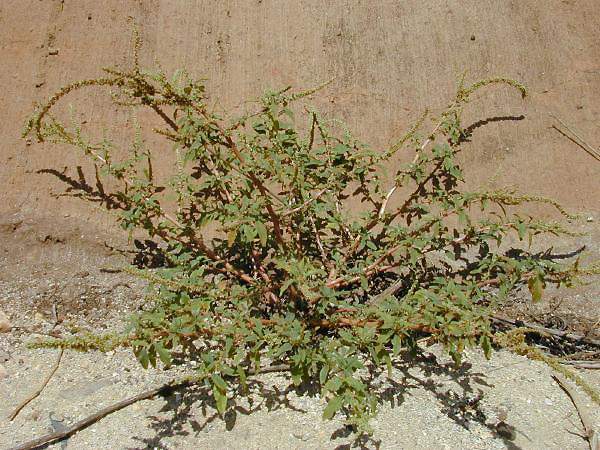
Spiny Amaranth
Amaranthus spinosus
☀️ Full Sun 💧 Moderate

Spleen Amaranth
Amaranthus dubius
☀️ Full Sun 💧 Moderate
Prince’s Feather
Amaranthus hypochondriacus
☀️ Full Sun 💧 Moderate