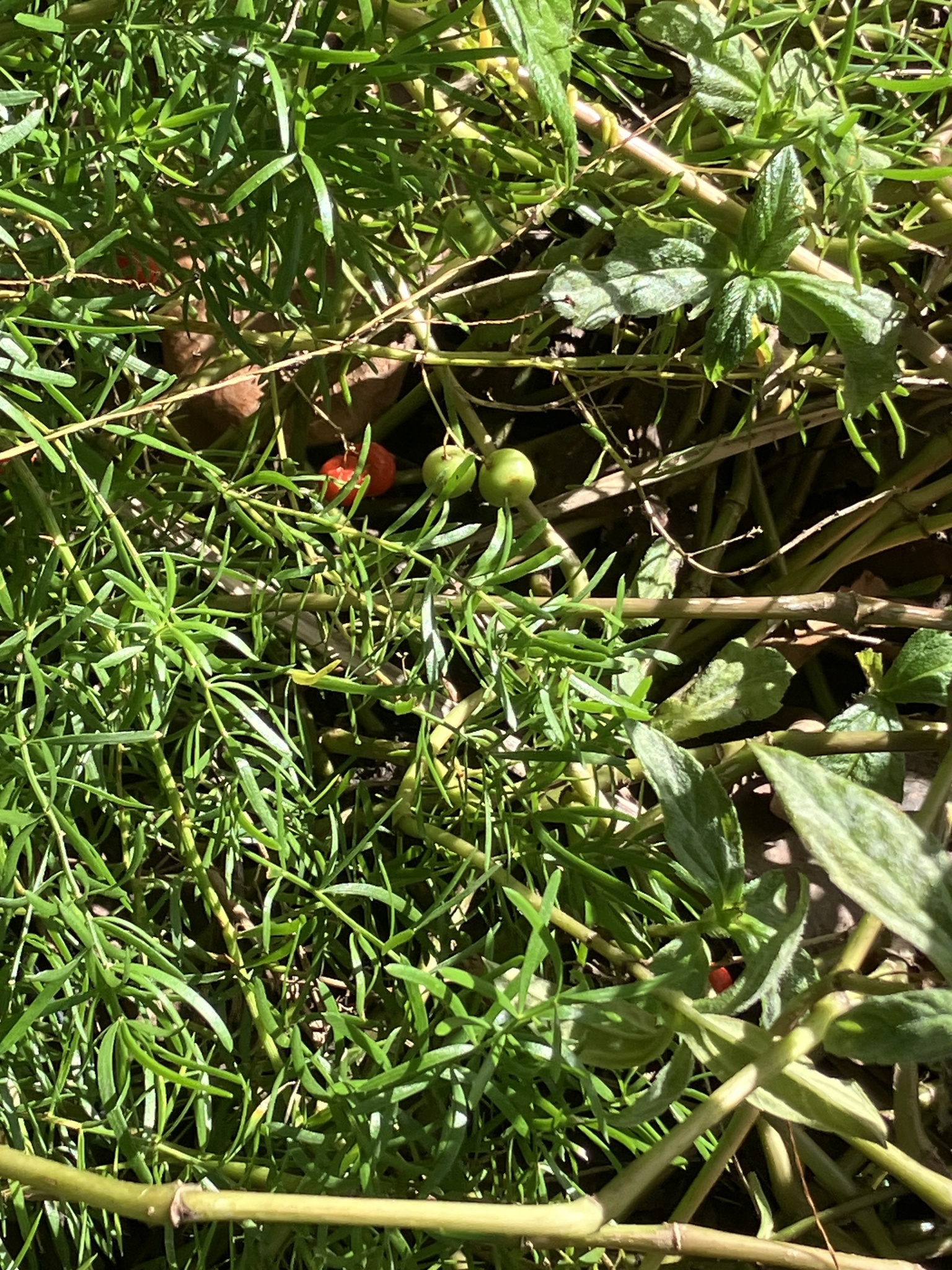
Shatavari (Asparagus racemosus) is a climbing woody perennial native to tropical Africa, South Asia, and northern Australia, recognizable by its needle-like green branchlets and sharp recurved spines.
The plant requires 18 to 24 months in warm, frost-free ground before its cluster of finger-thick storage roots reaches harvestable size.
Key Facts
- Soil: rocky, sandy, or gravelly loam with free drainage
- Light: full sun to light afternoon shade
- Root harvest: ready 18–24 months after field transplanting
- Root yield: 4–7 kg (9–15 lb) fresh tubers per mature crown
- Frost tolerance: tender below 0 °C (32 °F)
Growing Shatavari: What to Expect
Shatavari requires substantial underground space and a sturdy trellis to accommodate its climbing woody stems and massive root clusters. Unlike culinary garden asparagus (Asparagus officinalis), which you grow for tender spring spears, growers raise this species almost exclusively for its medicinal underground tubers.
Mature plants develop sharp, hook-like spines along every stem, making thick leather gloves necessary during weeding and harvest. You will need a frost-free growing season of at least 8 to 9 months or a heated greenhouse in cold temperate zones.
How to Identify Asparagus racemosus
Look for tuberous fascicled roots radiating in bunches of 50 to 100 white, succulent spindles beneath woody, sprawling stems. True leaves are reduced to minute scales that terminate in backward-pointing spines measuring 5–10 mm (0.2–0.4 in) long.
The photosynthetic foliage consists of cladodes (flattened stem segments) arranged in whorls of 2 to 6:
- Cladode dimensions: linear and sickle-shaped, 10–25 mm (0.4–1.0 in) long and 1–2 mm wide.
- Flowers: tiny, fragrant white or off-white stars arranged on racemes 2.5–5 cm (1–2 in) long.
- Fruit: small spherical berries 5–6 mm (0.2 in) across that turn dark reddish-purple when ripe.
- Roots: tapered, spindle-shaped storage tubers 30–100 cm (12–39 in) long and 1–2 cm (0.4–0.8 in) thick.
Ideal Soil and Light Conditions
Shatavari thrives best in full sunlight with deep, loose, gravelly or sandy loam that allows storage roots to expand without compaction. In scorching continental summers above 40 °C (104 °F), light afternoon shade prevents cladodes from scorching.
Soil drainage determines cultivation success. Heavy clays with poor percolation cause rapid tuber rot during monsoon rains or regular irrigation. Aim for a soil pH between 6.5 and 8.0, incorporating coarse grit or decomposed leaf mold into beds before planting.
Sowing Seeds and Planting Crowns
Soak fresh black seeds in warm water for 24 hours prior to sowing in spring to soften the thick seed coat. Seeds sown at a depth of 1 cm (0.4 in) in a sandy nursery mix germinate within 20 to 35 days at 25–30 °C (77–86 °F).
You can also propagate by separating crowns from an existing crown during late winter dormancy:
- Ensure each separated crown section contains at least 2–3 healthy buds and intact roots.
- Space seedlings or crown divisions 60 to 75 cm (24 to 30 in) apart in rows 1 m (3.3 ft) wide.
- Dig planting trenches 30 cm (12 in) deep to allow deep tuber development.
- Apply 2–3 kg (4.4–6.6 lb) of well-rotted farmyard manure to each planting pit.
Shatavari Plant Care: Trellising, Water, and Feeding
Water deeply whenever the top 5 cm (2 in) of soil dries out during the first growing season. Once root systems establish after the first year, mature crowns withstand several weeks of severe drought, drawing moisture from their swollen root tubers.
Stems climb 1 to 2 m (3.3 to 6.6 ft) and require vertical bamboo stakes or wire netting to maintain upright growth and prevent fungal stagnation in wet weather. Top-dress with aged compost or apply a balanced organic fertilizer every spring; avoid excessive chemical nitrogen, which encourages weak foliage at the expense of root mass.
Harvesting Shatavari Tuberous Roots
Begin digging roots 20 to 24 months after field planting, typically when the stems turn yellow and enter dormancy in late autumn or early winter. Harvesting too early yields thin, fibrous tubers with low active saponin content.
Careful lifting prevents breaking the brittle storage roots:
- Clear away top growth and cut back thorny stems to 15 cm (6 in) above ground level.
- Dig a wide trench around the perimeter of the plant, roughly 45 cm (18 in) out from the crown.
- Gently lift the root cluster with a garden fork rather than pulling the main stem.
- Wash away soil thoroughly using a gentle stream of clean water.
- Separate individual tubers from the central woody crown, leaving the crown for replanting.
Traditional Uses and Shatavari Powder
Shatavari root was traditionally used in Ayurvedic herbalism as a rejuvenating tonic, frequently paired with ashwagandha (Withania somnifera) to support female reproductive vitality, milk production, and general vitality. Traditional practitioners also used it in topical pastes mixed with ghee for inflamed skin conditions.
Commercial preparations process harvested tubers into dry powder, capsules, and juice extracts. Fresh roots undergo peeling to remove the thin brownish outer cortex, followed by gentle drying in dehydrators or indirect sun until completely brittle before being pulverized into fine beige powder.
Common Shatavari Growing Problems
Address tuber crown rot immediately by cutting back irrigation and improving drainage beds, as waterlogged soil kills root systems within days. Pests rarely decimate mature foliage, but several issues require monitoring:
- Aphids and red spider mites: target soft young cladodes in hot, arid weather; wash off with neem spray.
- Cutworms: sever young shoots at the soil surface; protect seedlings with collar barriers.
- Root-knot nematodes: cause stunted shoot growth and swollen galls on tubers; rotate with marigolds (Tagetes patula).
- Leaf blights: cause browning on cladodes during humid periods; prune crowded shoots to increase airflow.
Processing and Storing Shatavari Tubers
Dry peeled root tubers until they reach a moisture level below 10 percent to prevent internal mould. Freshly harvested roots spoil within 5 to 7 days if left in warm, damp conditions.
To process roots for long-term storage:
- Boil fresh tubers in water for 10 minutes to loosen the outer bark, then slip off the outer skin.
- Slice peeled tubers lengthwise into halves or quarters to speed drying.
- Dehydrate at 45–50 °C (113–122 °F) until pieces snap cleanly without bending.
- Store whole dried root segments or ground powder in airtight glass containers away from heat and light.
Year-Round Shatavari Care Routine
| Spring | Sow pre-soaked seeds in nursery trays or divide dormant crowns; top-dress established garden plants with 5 cm (2 in) of aged organic compost. |
|---|---|
| Summer | Tie new climbing shoots to trellises weekly; irrigate every 7 to 10 days during dry spells and monitor for spider mites. |
| Autumn | Reduce supplemental watering as shoots cease vegetative growth; allow the top growth to yellow naturally to concentrate starches into tubers. |
| Winter | Excavate 2-year-old root clusters for processing; cut back dead stems to the crown and apply thick dry straw mulch in marginal zones. |
Diagnosing Common Shatavari Plant Problems
| What you see | Likely cause | What to do |
|---|---|---|
| Soft, brown, foul-smelling roots | Tuber rot from waterlogged, poorly drained soil | Cease watering, lift crowns, trim away decayed tubers, and replant in gravel-amended raised beds. |
| Yellowing cladodes with fine webbing | Red spider mite infestation under hot, dry conditions | Spray stems thoroughly with insecticidal soap or neem oil solution every 5 days. |
| Pale, thin, spindly shoots | Insufficient sunlight or heavy shade from nearby trees | Relocate the container or prune back overhead tree canopies to provide at least 6 hours of direct sun. |
| Chewed shoots severed at ground level | Cutworm larvae attacking young stems at night | Install cardboard or plastic collars 5 cm (2 in) into the soil around young emerging crowns. |
Frequently Asked Questions
What is shatavari in English?
Shatavari is known in English as wild asparagus, Indian asparagus, or bottlebrush asparagus, though commercial products usually retain its Hindi name, shatavari.
How long does a shatavari plant take to mature for harvest?
Harvesting occurs 18 to 24 months after planting, when root clusters have stored maximum sugars and active steroidal saponins.
What are traditional shatavari benefits?
Traditionally, practitioners used shatavari root preparations to support female reproductive balance, promote breast milk production, calm gastric irritation, and enhance overall stamina.
Can you grow shatavari in pots?
You can grow it in deep containers of at least 45 to 60 litres (12 to 16 gallons), provided the pot has ample drainage holes and gritty, free-draining potting compost.
How do you make shatavari powder from fresh roots?
Peel the outer skin of freshly dug tubers, slice them lengthwise, dry them until crisp, and grind the brittle pieces into a fine flour using a high-powered mill.
Information about traditional or historical uses is provided for educational interest only and is not medical advice. Do not use any plant to treat a condition without speaking to a qualified professional.
Sources & Verification
Taxonomy and distribution are checked against the databases below. Care guidance is written for cultivated species only and reviewed by our editor. How We Build Plant Profiles →
- Kew Plants of the World OnlineTaxonomy, distribution, and native geographic range.
- GBIF Backbone TaxonomyGlobal occurrence records and botanical nomenclature.
- National Center for Biotechnology Information (NCBI)Pharmacological overview and botanical profile of Asparagus racemosus.
- Wikipediageneral reference